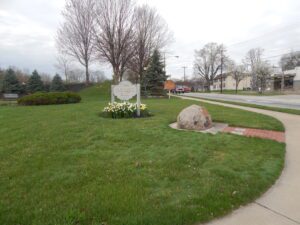
Trenton’s founder, Michael Pearce, came to the area in 1801. The original village of 33 lots was named Bloomfield. When the post office was established in 1820, it was named Trenton to honor the founder’s home state of New Jersey. Pearce’s son-in-law, Squier Littell, was the first resident doctor in Butler County. Originally settled by the English, Trenton saw a migration of Germans by 1840. By 1851, the farming community became a grain center with the introduction of the Cincinnati, Hamilton, and Dayton Railroad. Further development occurred when a franchise was granted to operate interurban electric traction cars through the village in 1896. Early commercial endeavors were Dietz, Good & Company grain elevator, Trenton Foundry, and Magnode Corporation. By 1991, the largest industries were Miller Brewing Company and Cinergy/Cincinnati Gas & Electric.
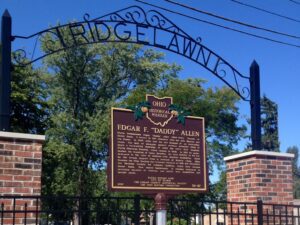
Elyria businessman Edgar “Daddy” Allen (1862 — 1937), founder of Easter Seals, is buried in this cemetery with his wife Blanche and son Homer. In 1907 Allen lost his son because of an interurban crash. The lack of adequate medical services prompted Allen to begin a fundraising campaign to build the city’s first hospital, Elyria Memorial Hospital, which opened in 1908. In 1915 he spearheaded the founding of Gates Hospital, the first facility in the U.S. dedicated to the care of children with physical disabilities. Aided by the strong support from a network of Rotary Clubs, Allen founded the Ohio Society for Crippled Children in 1919 and thereafter the National Society for Crippled Children, which later became Easter Seals. Now named Easterseals, it remains dedicated to providing services to children and adults with disabilities and special needs.
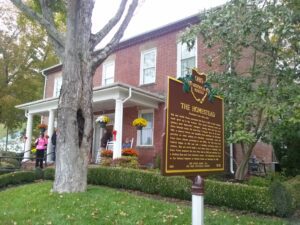
The Homestead was built in 1820 by Nehemiah Wood with an addition completed in 1822 by his son, Harrison. The Wood family, a pioneer family of Gallia County, arrived in 1805. The Homestead remained in the Wood family for over 100 years. The two-story Federal style building is constructed of bricks made on site by freed slaves who accompanied Nehemiah Wood from Virginia. The lane just below the house was a stagecoach route that ran between Chillicothe and Gallipolis. In the mid-1800s the Homestead served as an inn and stagecoach stop. The Wood family sold the farm to Rio Grande College in 1938 which used the land for college gardening and farming programs. (Continued on other side)
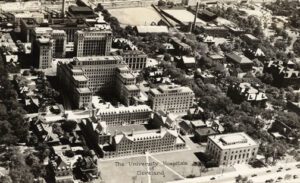
Named for the streetcar turnaround once located at Euclid Avenue and East 107th Street, University Circle is a 600-acre district that is home to many of Cleveland’s major cultural, educational, medical, and service institutions. The area was first settled in 1799 by tavernkeeper Nathaniel Doan and became known as Doan’s Corners. In 1882, Western Reserve College moved here from Hudson, followed in 1885 by the Case School of Applied Science from downtown Cleveland. These two colleges federated in 1967 to become Case Western Reserve University. (continued on other side)
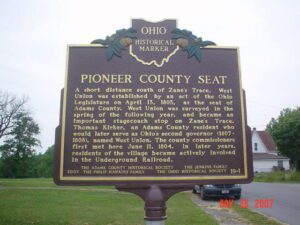
The Adams County Fairgrounds, established at this site in October 1853, on seven acres of land donated by Judge George Collings, was converted to a Civil War training camp named in honor of General Thomas Hamer, a Mexican War hero, of Georgetown, Ohio. The old stone Courthouse was made into a hospital to serve the camp. The 70th Ohio Volunteer infantry, organized in October 1861, trained on the old fairgrounds until Christmas day 1861, when it marched from Camp Hamer to Ripley. The 70th participated in the battles of Shiloh, Tennessee; Atlanta, Georgia; the siege at Vicksburg, Mississippi, and Sherman’s March to the Sea.
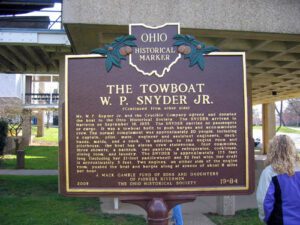
The W.P. SNYDER Jr. is one of the few links between the age of steam-powered, stern-wheeled towboats and the diesel-powered, propeller-driven vessels that push barges on America’s rivers today. The James Rees and Sons Company in Pittsburgh built the boat for the Carnegie Steel Company, and she was launched in 1918 as the W.H. CLINGERMAN. During the boat’s working life, she primarily pushed barges loaded with coal on the Monongahela and Ohio Rivers. After various changes in name, the Crucible Steel Company of America bought the boat in 1945 and named her the W.P. SNYDER Jr. after the company’s president. Crucible retired the SNYDER in 1954 and, as was the fate of her kind, she would have probably been scrapped. In 1955, however, the Sons and Daughters of Pioneer Rivermen and the Ohio Historical Society concluded that one example of a steam towboat should be preserved. (continued on the other side)
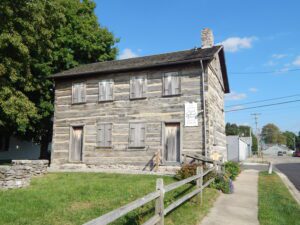
On this site Daniel Gebhart established a tavern in 1811. Taverns were where people gathered to eat, rest, and share news. During spring freshets, boatmen from the Great Miami River stayed at the tavern. Joining them were pioneers coming by the river and overland to settle at Hole’s Station, now Miamisburg. The tavern closed in 1840, became a boarding house, and then sold to become a private residence in 1853. To commemorate the nation’s Bicentennial in 1976, Miamisburg’s bicentennial committee purchased the tavern and gave it to the city. It was restored and opened as a museum in 1982. (Continued on other side)
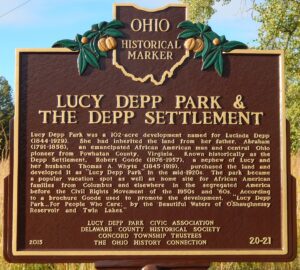
Lucy Depp Park was a 102-acre development named for Lucinda Depp (1844-1929). She had inherited the land from her father, Abraham (1791-1858), an emancipated African American man and central Ohio pioneer from Powhattan County, Virginia. Known historically as the Depp Settlement, Robert Goode (1876-1957), a nephew of Lucy and her husband Thomas A. Whyte (1845-1919), purchased the land and developed it as “Lucy Depp Park” in the mid-1920s. The park became a popular vacation spot as well as home site for African American families from Columbus and elsewhere in the segregated America before the Civil Rights movement of the 1950s and 60s. According to a brochure Goode used to promote the development, “Lucy Depp Park…For People Who Care; by the Beautiful Waters of O’Shaughnessy Resevoir and Twin Lakes.”