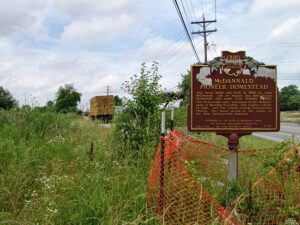
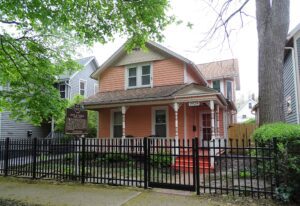
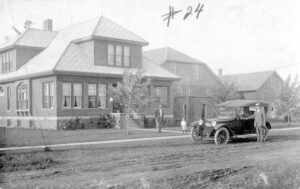
This brick home was built in 1856 by John McDannald, son of Samuel and Bell (Craig) McDannald who came from Virginia in 1813. The McDannalds were prominent in the development of Blendon Township, The Central College of Ohio, and The Central College Presbyterian Church. This house served as one station on the Ohio Underground Railroad.
Here was born (October 23, 1869) the man for whom the Heisman Football Trophy is named. The College Football Hall of Fame enshrines him as a superior coach. An important pioneer and game innovator, Heisman is considered the “Father” of the forward pass, the center snap, interference on end runs, the hidden ball play, the double pass, dividing the game into quarters, the statistical score board, and the quarterback’s “hike” or “hep” to initiate plays.
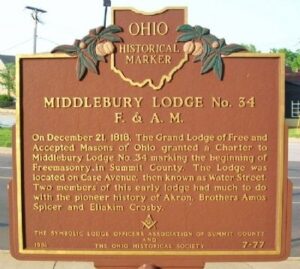
On December 21, 1818, The Grand Lodge of Free and Accepted Masons of Ohio granted a Charter to Middlebury Lodge No. 34 marking the beginning of Freemasonry in Summit County. The Lodge was located on Case Avenue, then known as Water Street. Two members of this early lodge had much to do with the pioneer history of Akron, Brothers Amos Spicer and Eliakim Crosby. [Masonic Emblem]
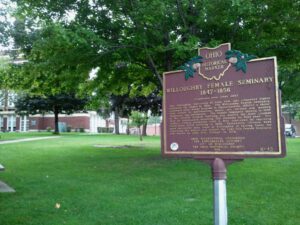
The village of Chagrin, founded in 1798, changed its name in 1834 to honor Dr. Westel Willoughby, a pioneer medical educator. That same year, the Willoughby University of Lake Erie was chartered, and the Willoughby Medical College opened its doors, signaling the beginning of medical education in northern Ohio. The Medical College trained 160 doctors, educated in contemporary methods of medicine, anatomy, chemistry, and surgery. Financial struggles and public outcry against grave-robbing — which supplied cadavers for anatomy classes — hampered the college’s development. The movement of faculty to Cleveland and the transfer of the state charter to Columbus hastened the demise of the Medical College in 1847, and laid the foundation for the establishment of the medical schools of Case Western and Ohio State universities. (Continued on side two)
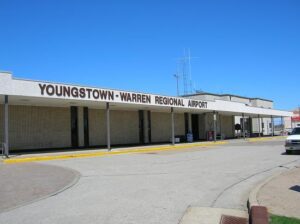
Born on April 18, 1913, in Barrea, Province L’Aquila Abruzzi, Italy to Salvatore and Maria (Lombardozzi) Campana, Mary Ann Campana immigrated to the United States with her parents at age eight. Raised in Youngstown and educated in the Youngstown Public Schools and Youngstown College, Ms. Campana was a pioneer in Ohio, National, and international aviation. In 1932, at age eighteen, she achieved the distinction of being the first licensed woman pilot in Ohio. On June 4, 1933, with only 44 hours of prior flying time, Mary Ann established the world’s endurance record in the Light plane class for a non-refueled flight. Flying above Youngstown in a 500-pound Taylor Cub Plane with a 40-horsepower engine and loaded with 40 gallons of gasoline, she flew for 12 hours and 27 minutes without a parachute, breaking the old record by one hour and ten minutes before electrical storms forced her down. (Continued on other side)
Nicknamed “Dutchtown” for the many German families that settled in this area, New Washington was platted in 1833 by George Washington Meyers, who arrived in Cranberry Township in 1826. Prominent Austrian romantic poet Nicholas Lenau (1802-1850), author of “Faust” and “Don Juan,” owned property here in the 1830s. The village incorporated in 1874, shortly following the arrival of the Mansfield, Coldwater & Lake Erie Railroad. New Washington is a pioneer in the commercial poultry hatchery industry and initiated the shipment of baby chicks by rail in 1900.
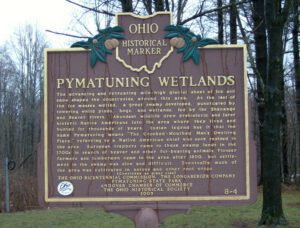
The advancing and retreating mile-high glacial sheet of ice and snow shaped the countryside around this area. As the last of the ice masses melted, a great swamp developed, punctuated by towering white pines, bogs, and wetlands, fed by the Shenango and Beaver rivers. Abundant wildlife drew prehistoric and later historic Native Americans into the area where they lived and hunted for thousands of years. Indian legend has it that the name Pymatuning means “The Crooked-Mouthed Man’s Dwelling Place,” referring to a Native American chief who once resided in the area. European trappers came to these swamp lands in the 1700s in search of beaver and other fur-bearing animals. Pioneer farmers and lumbermen came to the area after 1800, but settlement in the swamp was slow and difficult. Eventually much of the area was cultivated in onions and other root crops. (continued on other side)
In 1918, Charles Young made a desperate attempt to convince the U.S. Army that he was fit for duty. The Army’s highest-ranking Black officer, he had been medically retired and not given a command during World War I. To demonstrate his fitness, he rode 497 miles from his home in Wilberforce, Ohio, to Washington, D.C. Leaving on June 6 he made the journey in 17 days, 16 on horseback and 1 resting. Averaging 31 miles each day, he rode 45 minutes and walked 15 minutes every hour. Upon his arrival, Young met with Secretary of War Newton Baker. Pressured by the Black press and the White House, Baker hedged. He recalled Young to active duty a year later and assigned him to Camp Grant, Illinois, just five days before the end of the war.