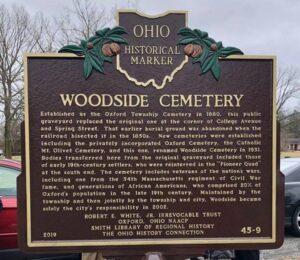
Established as the Oxford Township Cemetery in 1880, this public graveyard replaced the original one at the corner of College Avenue and Spring Street. That earlier burial ground was abandoned when the railroad bisected it in the 1850s. New cemeteries were established including the privately incorporated Oxford Cemetery, the Catholic Mt. Olivet Cemetery, and this one, renamed Woodside Cemetery in 1931. Bodies transferred here from the original graveyard included those of early 19th-century settlers, who were reinterred in the “Pioneer Quad” at the south end. The cemetery includes veterans of the nation’s wars, including one from the 54th Massachusetts regiment of Civil War fame, and generations of African Americans, who comprised 20% of Oxford’s population in the late 19th century. Maintained by the township and then jointly by the township and city, Woodside became solely the city’s responsibility in 2002.
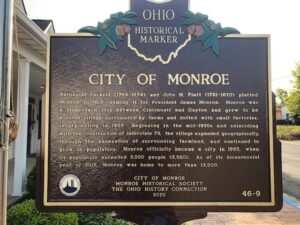
Nathanial Sackett (1768-1854) and John H. Piatt (1781-1820) platted Monroe in 1817, naming it for President James Monroe. Monroe was a stagecoach stop between Cincinnati and Dayton and grew to be a rural village surrounded by farms and dotted with small factories, incorporating in 1907. Beginning in the mid-1950s and coinciding with the construction of Interstate 75, the village expanded geographically, through the annexation of surrounding farmland, and continued to grow in population. Monroe officially became a city in 1995, when its population exceeded 5,000 people (5,380). As of its bicentennial year of 2017, Monroe was home to more than 13,000.
In 1951, several pioneer drag racers opened on of the Midwest’s first drag strips known by local racing enthusiasts as the “Fulton Airport Champioins Raceway.” For the next eight years half-brothers Art and Walt Arfons, Otis “Otie” Smith and “Akron Arlen” Vanke raced here. Both Arfons, who were long-time bitter rivals, at one point held the world land speed record. Otie, the first president of the Cam Jammers car club in Akron, won the National Hot Rod Association’s 1959 championship. Vanke won many national champtionships as a Stock, Super Stock and Pro Stock racer.
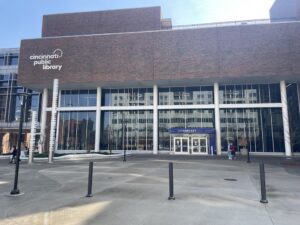
Among the first in America, Cincinnati’s public library dates from March 14, 1853. A public reading room opened in 1856, but funding remained a problem until 1867, when local school board president Rufus King II secured legislation for a renamed Cincinnati Public Library. In 1869, King lured leading librarian William Frederick Poole to organize Cincinnati as a national model for the growing public library movement. Poole designed 19th century America’s most advanced library at 629 Vine Street, which fully opened in 1874. Becoming a countywide system in 1898, the Public Library of Cincinnati and Hamilton County was a pioneer in the 20th century with special services for the blind and for children, bookmobile services, and circulation of audiovisual materials. (continued on other side)
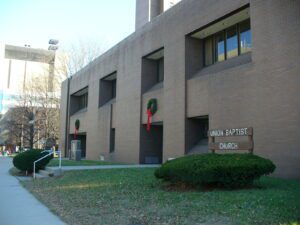
George Washington Williams was born in 1849 in Bedford, Pennsylvania. At age 14, he enlisted in the Union Army to fight in the Civil War and received a medical discharge in 1868. In 1874, he became the first African American to graduate from the Newton Theological Institution in Cambridge, Massachusetts, and shortly after married Sarah. A. Sterrett. He became pastor of the Twelfth Baptist Church in Boston before moving to Washington, D.C. to serve as editor of a newspaper called The Commoner. He then moved to Cincinnati to become pastor of the Union Baptist Church and while there served as the first black member of the Ohio Legislature from 1879-1881. Williams went to the Belgian Congo in 1890 where he criticized King Leopold II in an Open Letter for his inhumane policies in the Congo. He died in 1891 in England.
Sylvania was once the headquarters for the Toledo and Western Railway, an electric interurban line that provided service between Toledo and Pioneer with a branch line to Adrian, Michigan. Construction began here in 1900 with planning and specifications set to steam railroad standards. With completion of rails, a powerhouse, maintenance facilities, and offices, the Toledo and Western Railway Company was soon in the business of providing freight and passenger service and was especially competitive as it owned more freight engines than most interurban lines. Operating an electric interurban line also meant that the company had the ability to provide electricity to people living in Sylvania and to other communities and property owners living along the line’s right-of-way. Besides freight, passengers, and electricity, Toledo and Western also provided postal service, one of the first interurban lines to do so. [continued on other side]
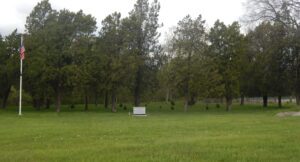
Toledo State Hospital opened in January 1888 as the Toledo Asylum for the Insane. Originally located immediately south of this cemetery, the hospital was designed to function as a self-contained community for 650 people. Patients lived in large cottages, surrounded by a post office, church, library, male and female hospital, strong wards, bakery, and dining hall. People were admitted with mild to severe forms of mental illness, and a variety of other disabling conditions, including developmental, medical or neurological, as well as for addictions, injuries, and old age. Work became a form of treatment, with patients involved in construction, farming, laundry, and other jobs to help maintain the hospital. Patients could also participate in recreational activities from gardening to playing in the hospital band. The State Hospital became home for many, as hospitalization could last a lifetime, often spanning decades. (continued on other side)
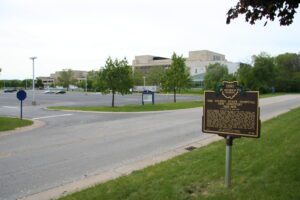
Toledo State Hospital opened in January 1888 as the Toledo Asylum for the Insane. People were admitted with mild to severe forms of mental illness, and a variety of developmental, medical and neurological conditions, as well as for addictions, injuries, and old age. Originally built to house 650 people, by the 1950s its campus had grown to accommodate over 3,000. Growing access to new medications and treatments then began a gradual decline in patient population. Eventually, most of the buildings were razed, and much of the hospital’s property was transferred, later becoming the site of The Medical College of Ohio. This transfer included the two Toledo State Hospital cemeteries, with documented burials (as of 2009) totaling 1,994 persons. Toledo State Hospital New Cemetery was opened in 1922, when the Old Cemetery (1888-1922), located .5 miles to the northeast, reached capacity. (continued on other side)