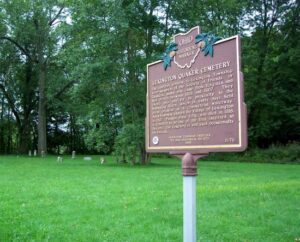
The earliest settlers to Lexington Township were members of the Society of Friends, or Quakers, many who came from Virginia and New Jersey between 1805 and 1807. They chose this site for its proximity to the Mahoning River, which in early days held great promise as a commercial waterway. Amos Holloway platted the Village of Lexington in 1807. Pioneer Jesse Felts, who died in 1818, is reported to be one of the first interred at this site. The cemetery is still used occasionally for burials.
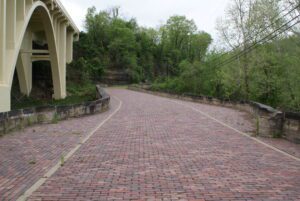
The first Blaine Hill Bridge was constructed in 1828 as part of the National Road, the nation’s first federally funded highway. This three-arch S-shaped structure, 345 feet in length, spans Wheeling Creek (a tributary of the Ohio River) and is the longest original “S” bridge in existence on the old National Road. At a gradient of approximately 6.3 percent from east to west, it significantly eased, for the first time, the arduous 500-foot western climb out of the valley. Crumbling and in poor condition, it was saved from demolition in 1999 and in 2001 was designated Ohio’s official Bicentennial Bridge. Now tucked between the 1933 U.S. 40 viaduct and Interstate 70, it illustrates the earliest of Ohio’s three eras in national highway transportation.
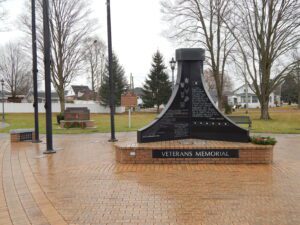
Veteran’s Park, S triangle of OH 66 & Washington Avenue
Piqua
, OH
Local views on the Vietnam War mirrored national attitudes of pride and confusion. Piqua citizens participated in the “Letters for Life” campaign in 1970 for prisoners of war. Piqua Daily Call assistant news editor James W. DeWeese traveled to Paris in a frustrated attempt to deliver the letters to the Hanoi Peace delegation. The state activated the local Ohio National Guard unit in 1970 to help suppress anti-Vietnam student rioting in Columbus. The military conflict came home in 1966 when William Pitsenbarger became the first of eleven men from Piqua to die in Vietnam. In 1967, Piqua High School graduate Air Force Major William J. Baugh was shot down over North Vietnam and taken prisoner. He remained a P.O.W. until 1973.
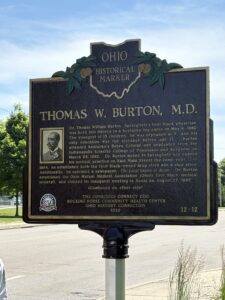
Dr. Thomas William Burton, Springfield’s first Black physician, was born into slavery in a Kentucky log cabin on May 4, 1860. The youngest of 15 children, he was orphaned at 9, and his only education was the alphabet before age 21. Burton attended Kentucky’s Berea College and graduated from the Indianapolis Eclectic College of Physicians and Surgeons on March 24, 1892. Dr. Burton moved to Springfield and opened his medical practice on East Main Street the same year. In 1894, he established both the first Black-owned drug store and a shoe store. Additionally, he operated a newspaper, The Loyal Legion of Honor. Dr. Burton established the Ohio Mutual Medical Association (Ohio’s first Black medical society), and chaired its inaugural meeting in Xenia on August 27, 1897. (Continued on other side)
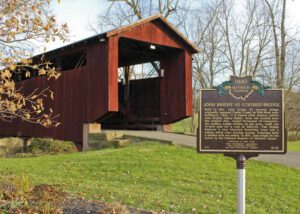
Built in 1881, John Bright #2 covered bridge originally spanned Poplar Creek on Bish Road near Baltimore, Ohio. It is named after pioneer settler John Bright, whose family farm was located near the original site. August Borneman of Lancaster, the leading bridge builder in the area, built the 70-foot span for a cost of $927.50. The bridge features a rare inverted bowstring truss and a unique metal sway bracing system. Sometime later a wooden arch was added. In 1975, John Bright #2 was listed on the National Register of Historic Places. (Continued on other side)
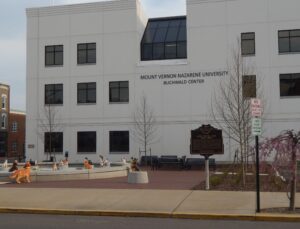
Side A: Jane Payne, M.D. (1825-1882). Dr. Jane Payne’s family migrated from Bristol, England in 1825. Her father Henry served as an Episcopal priest in Ohio, finally settling in Mount Vernon. Although her sight was impaired and she was challenged by infirmities left by childhood diseases and injuries, Payne resolved to be a physician. She began her studies with Dr. John W. Russell (1804-1887) in Mount Vernon. In 1861, she graduated first in what was the ninth class of the Woman’s Medical College of Pennsylvania in Philadelphia. Overcoming prejudices against female physicians, Dr. Payne practiced from 1861 to 1882. She showed special concern for municipal sanitation and care for the poor. Her office was located at northwest corner of South Main and West Gambier streets. Dr. Payne succumbed to cancer and is buried in Mound View Cemetery.
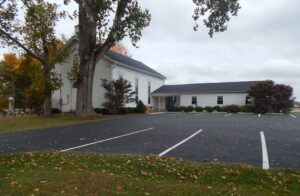
The comingling of faiths in an area settled predominantly by Quakers helps explain the origins of Jonah’s Run Baptist Church. Ministered to by a Baptist preacher, the children and neighbors of Daniel Collett (1752-1835), an Episcopalian and private in the Revolutionary War, and his wife Mary Haines Collett (1753-1826), a Quaker from Virginia, became Baptists and started the church in 1838. Levi Lukens (1767-1860), a Quaker from Pennsylvania by way of Virginia, purchased the land where the church stands in 1812 and sold it in 1839 to a founder of the congregation. Like local Quaker meetinghouses, the church had separate entrances for men and women and a partition between the two that divided the sanctuary. The congregation’s sons and daughters lived their faith. Howard McCune (1852-1923) was the Clinton Baptist Association’s moderator and president of the Ohio Baptist Convention’s state board. Anne Cossum (1894-1977) was a missionary in China from 1920-1927.
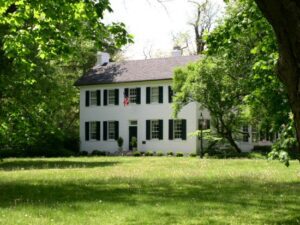
John Anderson Ward had this Federal style house constructed from 1823-1825 on land inherited from his father, Urbana’s founder Colonel William Ward. The Colonel’s will stipulated that a local mason use 26,500 bricks to build the house and be paid $80.00. The original house is thought to have had four rooms, two rooms each on the first and second floors and both divided by central hallways. John and his wife Eleanor Ward reared seven children in the house, two of whom became nationally recognized artists, John Quincy Adams Ward and Edgar Melville Ward. The farmstead, consisting of 172 acres, was also the site of a huge feast held in honor of General William Henry Harrison’s visit to Champaign County during his 1840 presidential campaign. Twelve 300 foot-long tables were spread across the lawn where thousands of people from the surrounding countryside dined on barbecued beef and lamb and drank barrels of cider.