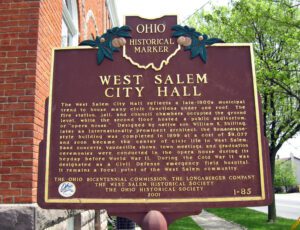
The West Salem City Hall reflects a late-1800s municipal trend to house many civic functions under one roof. The fire station, jail, and council chambers occupied the ground level, while the second floor hosted a public auditorium, or “opera house.” Designed by native son William K. Shilling, later an internationally prominent architect, the Romanesque-style building was completed in 1899 at a cost of $9,077 and soon became the center of civic life in West Salem. Band concerts, vaudeville shows, town meetings, and graduation ceremonies were conducted in the opera house during its heyday before World War II. During the Cold War it was designated as a Civil Defense emergency field hospital. It remains a focal point of the West Salem community.
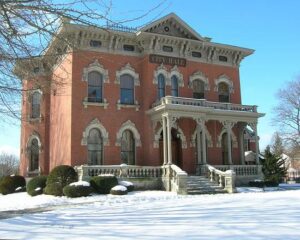
This ornate Victorian/Italianate house was constructed in 1871 as the home of Henry Bishop Perkins, Sr., a civic, business, and political leader of the Western Reserve. During the 19th and early 20th century political figures such as U.S. Grant, James A. Garfield, Rutherford B. Hayes, Benjamin Harrison and William McKinley were visitors to this house.
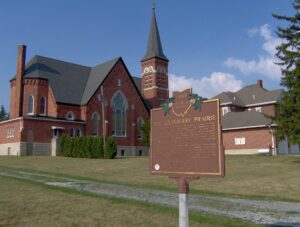
The Cranberry Prairie, southwest of this marker, is a part of Ohio’s natural history. The place was named for the cranberries that grew in a swamp here prior to drainage of the area. The Cranberry Prairie was created by centuries of peat accumulation in a late Ice Age lake that formed at the base of St. John’s Moraine. Paleo-Indian or Early Archaic peoples probably killed the elk whose skeleton was dug up here in 1981. This elk was dated at approximately 7400 B.C. By the 1860s, immigrant German farmers had begun transforming the swamp into fertile farmland. “Wild Bill” Simison, a legendary inhabitant, lived in the swamp and settlers respected him for his knowledge of the area. By the turn of the nineteenth century, Granville Township School #7, St. Francis Catholic Church, and Bertke’s Store stood at the edge of the Cranberry Prairie.
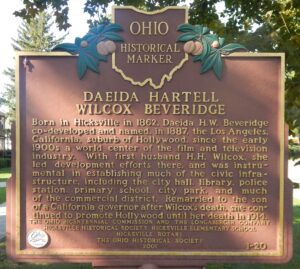
Born in Hicksville in 1862, Daeida H.W. Beveridge co-developed and named, in 1887, the Los Angeles, California, suburb of Hollywood, since the early 1900s a world center of the film and television industry. With first husband H.H. Wilcox, she led development efforts there, and was instrumental in establishing much of the civic infrastructure, including the city hall, library, police station, primary school, city park, and much of the commercial district. Remarried to the son of a California governor after Wilcox’s death, she continued to promote Hollywood until her death in 1914.
In April 1830 four Dominican sisters from St. Catherine’s, Kentucky, founded St. Mary’s Academy, the first Catholic school in Perry County. Bishop Edward Fenwick, first Bishop of Ohio, donated a small brick house and attached building situated on an acre of land for the school’s use. Classes began with forty students. The following year the sisters built a three-story structure with a dormitory for boarders; by the end of the Civil War, enrollment had increased to 134 students, and St. Mary’s gained recognition as one of the finest schools in Ohio. An 1866 fire destroyed the academy, and in 1885 the Dominican sisters reestablished the academy as a parish school. The present Holy Trinity School building dates to 1968.
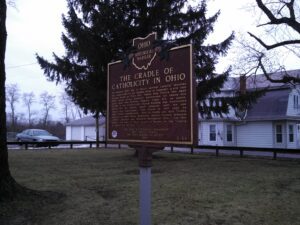
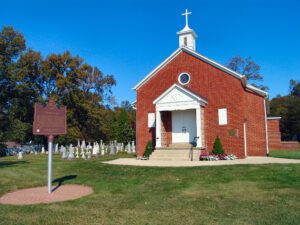
This area, known as Calmoutier, was an early French Catholic farming community founded in 1832 by Claude Druhot, who came from Calmoutier, Hte-Saône, France. Its first native, the four-month-old Claude Joseph Druhot, was baptized on 9 June 1833 by Fr. John Henni, who resided at St. John’s in Canton (and in 1854 became Milwaukee’s first bishop). In 1836 Fr. John Alleman, O.P., established St. Genevieve’s Mission (when it began to keep its own records) on land donated by the Pierson and Roussel families. The log chapel that was built (the first of four churches here) predated any Catholic church building in Cleveland, Akron, and Toledo.
Jefferson Street, between N. 5th and N. 6th Streets
Greenfield
, OH
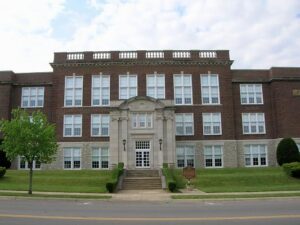
A focal point of community pride for generations, McClain High School was the gift of textile manufacturer Edward Lee McClain to his hometown, “as promising the greatest good to the greatest number for the longest time.” Designed by nationally prominent school architect William B. Ittner, the school was dedicated in September 1915. Lauded as one of the most complete and state-of-the-art school plants of its time, McClain High School embodied the ideals of the progressive education movement in the early 20th century. A fully equipped gymnasium, motion-picture equipment, and a pipe organ were rare luxuries for any school during this era. Additional gifts by McClain also furnished a vocational training center and an athletic field. Numerous sculptures, paintings, and other works of art displayed throughout the school continue to enhance the atmosphere of Greenfield’s acclaimed halls of learning.
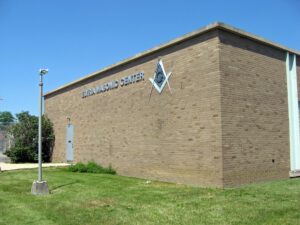
King Solomon Lodge, the first Masonic Lodge in Lorain County, was chartered on December 11, 1821, with Heman Ely as Worshipful Master. Ely (1775-1852), a prominent land developer, founded the City of Elyria in 1817, and built the first grist and saw mills and frame house in the village. Through his efforts, Elyria became the county seat in 1823.