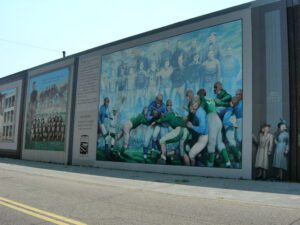
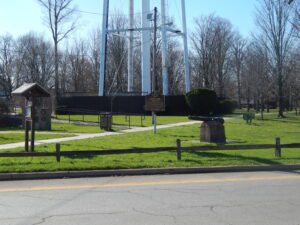
The Ohio River floodwaters account for Portsmouth’s settlement. Alexandria, the county’s first town, was laid out in 1799 on the west bank of the Scioto at its confluence with the Ohio. Early settlers in Alexandria were forced to higher ground across the river in Portsmouth because of frequent flooding. As a result, Portsmouth, platted in 1803, became Scioto County’s seat and business center by 1814. Prominent local industries included brick, stone, steel, wood products, and shoe manufacturing. As of 2003, the Ohio River is the cornerstone of Portsmouth’s transportation system, providing a means for materials to reach destinations throughout the region. It also serves as a recreation hub. The three-mile long levy, first built in 1908, failed in the 1937 flood and was subsequently improved.
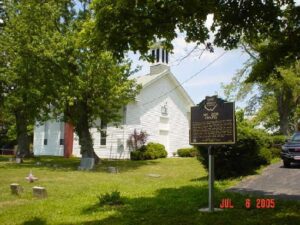
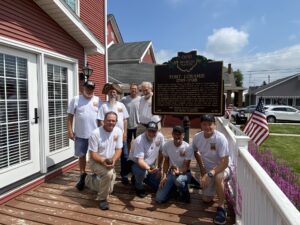
The Mount Zion Chapel of the Christian Church was built in 1872 on this hill adjacent to the members’ cemetery outside of Clermontville. The site was part of a two-acre parcel that had been secured from the farm of William R. Clark, Sr. for church and cemetery purposes. The Mount Zion Chapel replaced the Boat Run Christian Church that was organized in 1842 by a sect called the Christians, or the New Lights. Their first meeting house in Clermontville was dedicated on June 4, 1843 and damaged by floods in 1871. Worship was first held in the new frame church with the new name on October 6, 1872 and the church remains active today.
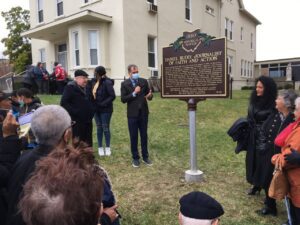
Daniel Arthur Rudd was born into slavery on August 7, 1854, in Bardstown, Kentucky. He became a newspaperman, lecturer, publicist, and tireless advocate for the Roman Catholic Church. After the Civil War Rudd moved to Springfield. Baptized and raised in Catholicism, he joined St. Raphael Parish, where the philosophy of racial equality offered by the church solidified his vision of justice. By 1885 he had established his own weekly newspaper, The Ohio State Tribune. He rebranded it The American Catholic Tribune (ACT) after moving to Cincinnati. Rudd claimed ACT was the only Catholic newspaper owned by an African American. At the height of its popularity in 1892, the publication had a circulation of 10,000. In 1893 Rudd was asked to chair the Afro-American Press Association, representing more than 200 black-owned newspapers.
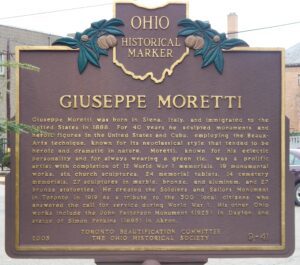
Giuseppe Moretti was born in Siena, Italy, and immigrated to the United States in 1888. For 40 years he sculpted monuments and heroic figures in the United States and Cuba, employing the Beaux-Arts technique, known for its neoclassical style that tended to be heroic and dramatic in nature. Mor etti, known for his eclectic personality and for always wearing a green tie, was a prolific artist with completion of 12 World War I memorials, 19 monumental works, six church sculptures, 24 memorial tablets, 14 cemetery memorials, 27 sculptures in marble, bronze, and aluminum, and 27 bronze statuettes. He created the Soldiers and Sailors Monument in Toronto in 1919 as a tribute to the 300 local citizens who answered the call for service during World War I. His other Ohio works include the John Patterson Monument (1925) in Dayton and statue of Simon Perkins (1895) in Akron.
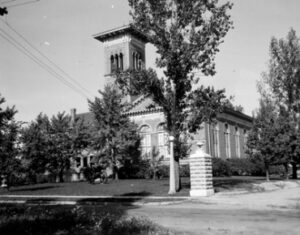
At the turn of the twentieth century, increased enrollment in the Combined Normal and Industrial Department at Wilberforce University (which later became Central State University) spurred construction of new teaching and dormitory facilities. Galloway Hall, which included an auditorium and a tower with chimes and a clock, was completed in 1906. Many famous personalities performed in Galloway Hall’s auditorium, including the renown opera singer Leontyne Price; Robert McFerrin, the first African American male lead with the New York Metropolitan Opera; actors Ruby Dee and Ossie Davis; comedian and civil rights activist Dick Gregory; and composer and conductor Duke Ellington. Noted authors and intellectuals addressed audiences there, including historian John Hope Franklin; writer, poet, actor, and playwright Maya Angelou; Lerone Bennett, author, historian, and editor of EBONY Magazine; and writer and essayist James Baldwin. (continued on other side)
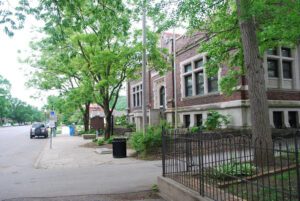
Born in Chillicothe in 1872, Burton Stevenson’s life was devoted to the written word as a prolific author and anthologist, and as a librarian. Following stints as a journalist while a student at Princeton University and then at newspapers in Chillicothe, Stevenson became the librarian of the city’s public library in 1899. He held the post for 58 years. Stevenson helped secure a Carnegie Library for Chillicothe, completed in 1906, and became prominent for his service during World War I. He founded a library at Camp Sherman (an army training camp north of the city), which became a model for others nationally.
In 1769, Pierre-Louis de Lorimier (Peter Loramie) traveled from Canada to this vicinity to establish fur trading with the local indigenous tribes. This location is a portage between tributaries of the Ohio River and Lake Erie that eased the transport of the quantity of furs in this lucrative trade. His very profitable trading post was located just west of this marker along Loramie Creek. Lorimier’s friendship with the local Shawnee and Delaware tribes, and the British, led him to join them in efforts to curtail the movement of white settlers into the Northwest Territory. In 1782, in an attempt to halt raids along the Ohio River (many of which were formulated at Lorimier’s store), General George Rogers Clark ordered Col. Benjamin Logan to burn Lorimier’s store.
In 1796, surveyors for the Connecticut Land Company designated an area five miles square surrounding this place as Range 7, Township 7 of the Connecticut Western Reserve. A landowner’s expedition on June 15, 1798, arrived at the northwest corner of the township. One of its members, Thomas Umberfield (Umberville) brought his family to the center of the township (now Burton Village) on June 21, 1798. Here they built the first home, a simple log cabin located southwest of the spring at the end of Spring Street. The owner of the largest parcel of land in the township, Titus Street, was given the honor of naming the township. He named it after his son, Burton.