

, OH
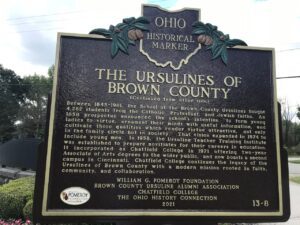
On July 21, 1845, eleven Ursuline sisters from Boulogne-sur-Mer and Beaulieu, France, arrived in St. Martin, Brown County, Ohio. A Catholic order of sisters known for providing quality education to young women, the Ursulines were invited by Cincinnati Archbishop John Baptist Purcell (1800-1883) to establish a school in the diocese and granted approximately 400 acres in St. Martin for that purpose. Led by Mother Julia Chatfield (1808-1878), the sisters quickly established their convent, a day school, and, within the year, admitted their first boarders. Originally known as The Saint Ursula Literary Institute, the school operated for the next 136 years. The Ursulines educated local students from their adopted Brown County as well as many who came from across the U.S. and farther abroad to board on campus. (Continued on other side)
, OH
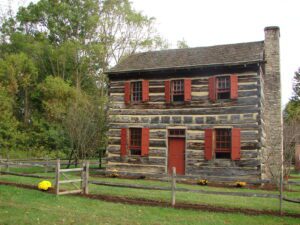
Zachariah Price DeWitt was born of a Dutch family in New Jersey in 1768. With brothers Jacob and Peter, he migrated to Kentucky where, in 1790, he married Elizabeth Teets, who was born in Pennsylvania in 1774. By 1805 all three brothers had settled in Ohio near Four Mile (Talawanda) Creek. Here Zachariah and Elizabeth raised corn, hogs, and eventually, nine children. Zachariah became a prominent community leader, operating a sawmill, building houses in Oxford, serving as Masonic Lodge secretary, and commanding a rifle company during the War of 1812. Tradition has it that Elizabeth wore a black sunbonnet to cover a scar from having been scalped as a child in Kentucky. Elizabeth died in 1843, followed by Zachariah in 1851. Both are buried in Darrtown Cemetery.
, OH
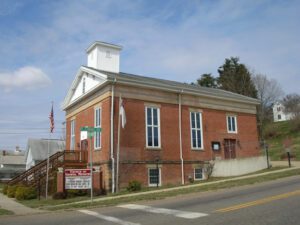
This former Universalist Church, which held a strong conviction for education and the pursuit of knowledge, was built in 1852 at a cost of $3,500. In 1865, its members decorated the first Christmas tree to be placed in a church in McConnelsville. Two years later they installed a pipe organ at a cost of $1,000, the first such organ in the community. The first Sunday School Library was also added, allowing members to borrow books and return them a week later. A number of prominent local families attended the church, including the Manly, Whitiker, Beckett, Arrick, and Murray families from the 1850s through the early twentieth century. Richard Bilbe, a former slave who had been freed, served as an early trustee of the church and attended with his family. The church was restored and reopened as a non-denominational church in 1997.
, OH
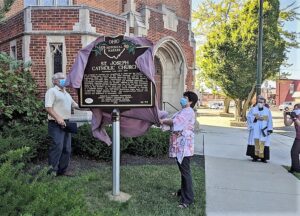
St. Joseph Catholic Church has been located here since the parish’s formation in 1845. Tiffin was established by Josiah Hedges in 1822, and shortly after, many German Catholic families began to settle in the area. They formed part of St. Mary’s parish until 1845, when they obtained permission from Bishop John Purcell of the Diocese of Cincinnati to organize as the separate congregation of St. Joseph. In May 1845, parishioners bought two acres of land at the conjunction of Melmore and South Washington Streets. Within the month, they laid the cornerstone for a 40-foot by 66-foot brick church that would be completed by August of that year. As the congregation grew, Rev. Joseph Bihn, pastor from 1856 to 1873, saw the need for a new church. (Continued on other side)
, OH
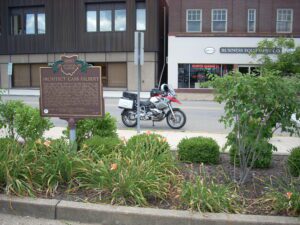
One of America’s leading architects of the early 20th century, Cass Gilbert (1859-1934), was born in a home that stood at this site. After studying at the Massachusetts Institute of Technology, Gilbert apprenticed with prominent architectural firm McKim, Mead, and White. The critical success of his first major public building, the design of the 1895 Minnesota State Capitol, established his national reputation. His influential 1912 Woolworth building, at 792 feet, was then the world’s tallest building, earning Gilbert’s nickname of “Father of the Modern Skyscraper.” Combining classical designs with modern technology, Gilbert also created the United State Supreme Court building (1932) in Washington, D.C., an enduring icon of American justice and democracy. His other achievements include the Arkansas and West Virginia capitols, the U.S. Custom House in New York, and several buildings at Oberlin College. Gilbert served as the president of the American Institute of Architects and the National Academy of Design.
, OH
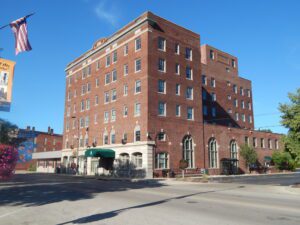
The Hotel Ashtabula was built in 1920 during an economic boom that lasted most of that decade. Architecturally, it represents a combination of Second Renaissance Revival and Georgian Revival styles. The H.L. Stevens and Company of Chicago and New York designed and built the hotel and others like it in Cleveland, Dayton, and Warren, Ohio and throughout the Midwest. The building included a ball room accommodating 300, a dining room that could seat 125, and club meeting and social rooms. A prominent structure of this downtown street, the Hotel Ashtabula was a hub for social activity. (Continued other side)
, OH
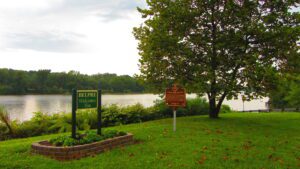
Born in Massachusetts in 1805, Sala Bosworth spent all but nineteen years of his eighty-five years in Washington County. After studying at the Philadelphia Academy of Fine Arts, he returned to the county to paint many full size and miniature portraits of prominent Washington County citizens. His historical drawings were used in Samuel P. Hildreth’s Pioneer History. He is also known for his mural in what is now the Unitarian Universalist Church in Marietta. Bosworth moved to Cincinnati late in life and started to paint with watercolors. He died there in 1890. Charles Sullivan also studied at the Philadelphia Academy and became a fast friend of Bosworth after coming to Washington County in 1833. While he also painted portraits, he excelled in his landscapes, including views of Blennerhassett Island, the Blennerhassett mansion, and the mounds at Marietta. Sullivan died in Marietta in 1867.
, OH
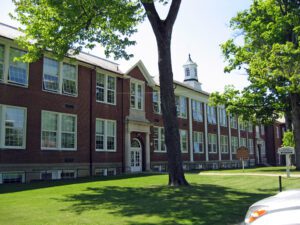
Poland Academy, an elite private school, was established on this site in 1830 and in 1859 graduated its most notable student William McKinley, who became the 25th president of the United States. In 1862, the school changed its name to Poland Seminary and was one of the first schools in northeast Ohio to admit girls on an equal basis. Ida Tarbell, who became a prominent national journalist and author was Preceptress of the Seminary from 1880-1882. William Calhoun graduated from the Seminary and became the U.S. Ambassador to China from 1910-1913. The school became a public institution in 1909 when it became the Poland Seminary High School. In 1972 it was the site of Poland Junior High School and Poland Middle School in 1985.