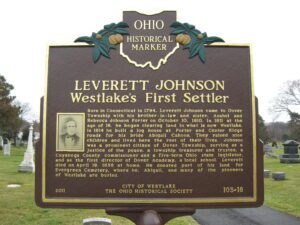
Born in Connecticut in 1794, Leverett Johnson came to Dover Township with his brother-in-law and sister, Asahel and Rebecca Johnson Porter on October 10, 1810. In 1811 at the age of 16, he began clearing land in what is now Westlake. In 1814 he built a log house at Porter and Center Ridge roads for his bride Abigail Cahoon. They raised nine children and lived here the rest of their lives. Johnson was a prominent citizen of Dover Township, serving as a justice of the peace, a township treasurer and trustee, a Cuyahoga County commissioner and a five-term Ohio state legislator, and as the first director of Dover Academy, a local school. Leverett died on April 19, 1856 at home. He donated part of his land for Evergreen Cemetery, where he, Abigail, and many of the pioneers of Westlake are buried.
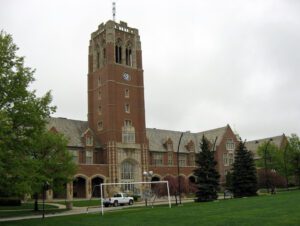
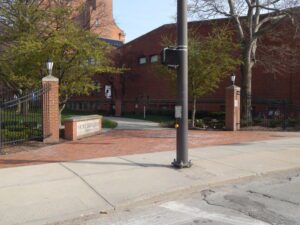
John Carroll University opened its doors as Saint Ignatius College on September 6, 1886. Originally located on Cleveland’s West Side, the College was founded at the request of Bishop Richard Gilmour by German members of the Society of Jesus (the Jesuits, founded in 1540). In 1923, the College was renamed John Carroll University after America’s first bishop. In 1925, the University acquired land in Idlewood Village (now University Heights) and initiated construction of a new campus in 1931. Classes began there in 1935 with 456 students. The institution admitted laywomen to evening and graduate classes in the 1930s and officially became coeducational in 1968. The University’s Jesuit Catholic mission inspires individuals to excel in learning, leadership, and service, both regionally and worldwide. John Carroll University is one of 28 Jesuit institutions of higher learning in the United States.
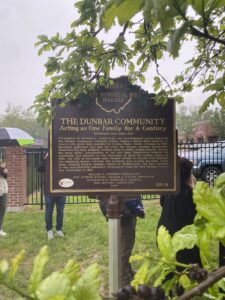
Dunbar, or Corsica Hollow, was an African American neighborhood on the western edge of Madisonville. Its streets and lots were laid out in 1886 after Mahlon and Anna Leonard subdivided their 10-acre tract near Duck Creek and sold lots to African Americans. Many early Dunbar residents were from the South; some born there prior to emancipation. Prominent early citizens included Harriet Deatherage, Elihu Parks, Gandison Embry, Thomas Duett, and James Murphy. Dunbar was home to the New Mission Missionary Baptist Church, founded in 1907. Originally meeting in a one-room building, the extant congregation relocated to Ravenna Street in 1963. By the late 1920s, Dunbar had about forty houses, a grocery run by Henry Lowman, and a hair salon run by Flora Hector. (Continued on other side)
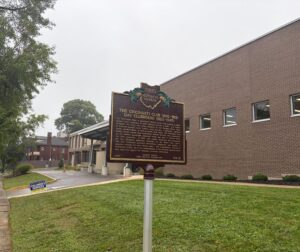
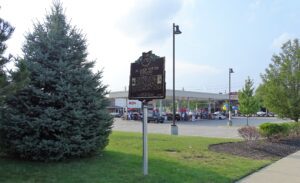
The Cincinnati Club, a prominent Jewish social club founded in 1889, opened their clubhouse at 2840 Melrose Avenue in 1894. A.E. Elzner designed the brick and stone building in the Norman-Gothic style. It featured massive round towers, wide porches, a ballroom, billiard rooms, bowling alley, as well as ornate club rooms. The Cincinnati Club hosted lavish events that celebrated Jewish identity and community. As the Jewish population migrated north and east of Walnut Hills, the club dissolved. In 1922, the vacant clubhouse was purchased by the Disabled American Veterans of the World War (DAV). The DAV Clubhouse provided recreation, resources, and shelter to disabled veterans for over twenty years. The organization, founded in Cincinnati in 1920, led to the establishment of the Veterans Administration and improved support for wounded veterans nationwide.
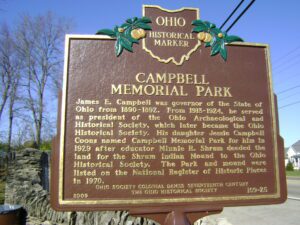
James E. Campbell was governor of the State of Ohio from 1890-1892. From 1913-1924, he served as president of the Ohio Archaeological and Historical Society, which later became the Ohio Historical Society. His daughter Jessie Campbell Coons named Campbell Memorial Park for him in 1929 after educator Minnie R. Shrum deeded the land for the Shrum Indian Mound to the Ohio Historical Society. The park and mound were listed on the National Register of Historic Places in 1970.
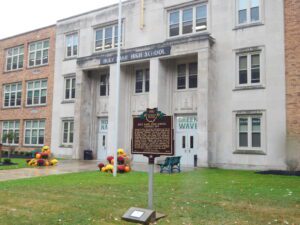
Founded in 1914, Holy Name High School was one of the first co-educational Roman Catholic high schools in Cleveland. Originally located at Harvard and Broadway Avenues, the school opened under the direction of Holy Name Parish with educational leadership of the Sisters of Charity from Cincinnati. In 1978, Holy Name High School moved to its present location in Parma Heights, the former home of Nazareth Academy. Throughout its history, Holy Name High School has served the community by providing a Catholic, college-preparatory education. The Holy Name spirit lives on through its alumni, who have made a difference around the world.
Dr. Jared Potter Kirtland was a prominent nineteenth century professor, physician, naturalist and horticulturist. In 1837, Kirtland purchased land in Rockport Township that stretched from Madison Avenue to Lake Erie. Kirtland used that land as a natural laboratory and filled it with gardens, greenhouses and an arboretum where he developed fruit and grape varieties best suited for the region. His success with new varieties inspired area farmers to successfully concentrate on fruit and grape growing. In 1839, he built a home at Detroit and Bunts Roads and lived there unitl his death in 1877. (Continued on other side)
In 1886, Bishop Richard Gilmour (1824-1891) of the Roman Catholic diocese of Cleveland requested that the Jesuit superior of Buffalo establish a high school on Cleveland’s west side. The Jesuits, an order of the Roman Catholic Church founded by St. Ignatius Loyola in 1540, sought to establish schools that instilled a zeal for the Gospel and a love of learning. Under the leadership of Father Henry Behren, S.J. (1815-1895), the twentieth Jesuit secondary school in the United States opened in September 1886. Named Saint Ignatius College, the school grew from 76 students in 1886 to 490 in 1924. In 1924, the College split into two separate institutions: John Carroll University, which moved to University Heights in 1935, and Saint Ignatius High School, which remains on its original site. (Continued on other side)