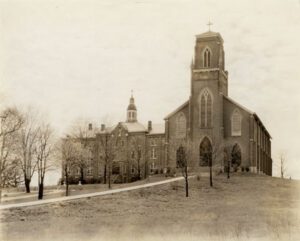
St. Joseph Catholic Church, called the cradle of the faith in Ohio, was the first Catholic church in the state. In 1809, Jacob and Catharine Dittoe deeded Father Edward Fenwick, who had traveled from Kentucky, 320 acres of ground to build the church. The original church, dedicated on December 6, 1818, by Father Fenwick and Father Nicholas Dominic Young, was a log cabin with a bare dirt floor measuring 18 feet by 22 feet. Father Fenwick was soon installed as the first Bishop of Cincinnati. Construction on the present church began in 1839.
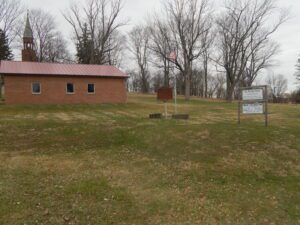
About a mile south in St. Paul’s Cemetery, the Reverend Father Edward J. Fenwick, “Pioneer Apostle of Ohio,” organized the first Catholic parish in northern Ohio. The first mass was celebrated in the log house of Daniel McCallister. A century and a half later the cabin was dismantled, moved here, rebuilt, and rededicated in May, 1967 as the Log Cabin Shrine of Dungannon.
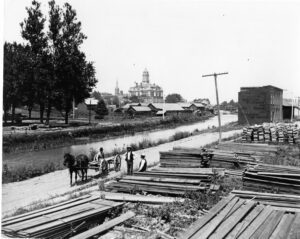
Miami & Erie Canal and Napoleon’s First Cemetery. The Miami & Erie Canal stretched approximately 250 miles from Cincinnati to Toledo. Napoleon and other towns on the Maumee River’s banks were on a slackwater section of the canal. Between 1825 and 1845, laborers constructed the canal using shovels, picks, wheelbarrows, and horse and mule-drawn carts. In Henry County, Napoleon, and elsewhere, German and Irish immigrants and area farmers did the work and were paid around 30 cents a day. As the canal brought more people and business to the area, villages such as Florida, Damascus, and Texas flourished and the county seat of Napoleon boomed. The canal and consequent growth took their tolls, however. Sickness and disease such as “ague” (malaria) and cholera spread and carried off many. Napoleon’s first cemetery was located in the vicinity of 500 East Clinton Street, near the route of the canal.
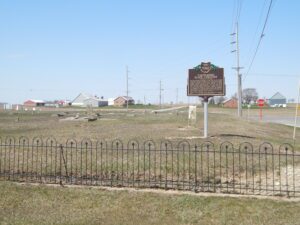
The Carthagena Black Cemetery (Union Cemetery) is a remnant of approximately 70 documented rural black and mulatto settlements established in Ohio before the Civil War. In the charged atmosphere following race riots in Cincinnati in 1829, Quaker abolitionist Augustus Wattles led 15 black families north in 1835. In 1837 Wattles purchased 189 acres where the cemetery is located. Headstones date from 1840, the year mulatto Charles Moore, platted the Village of Carthagena. Wattles and mulatto clergymen Sam Jones and Harrison Lee were Underground Railroad conductors. Wattles moved to Kansas in 1855. By 1860, more than 100 black and mulatto families, totaling 600 people, owned over 10,000 acres. (Continued on other side)
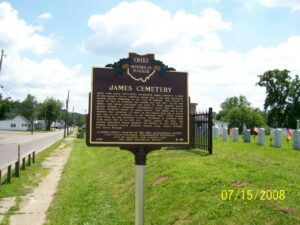
Major John James (1772-1854) established James Cemetery in 1828 on and around a Native American mound that is the only significant ancient mound remaining in the city of Jackson. The mound is about 70 feet in diameter and nearly six feet tall. In the late 1800s, this mound comprised one point of three ancient mound groups forming a triangular configuration along East Broadway Street, formerly known as James Street. One group was a few hundred feet northeast of here on the Watson farm and a second was just to the northwest on the Warnicke farm. These mounds were built by the Hopewell Culture, prominent in southern Ohio from about 100 BC to 400 AD. Major James, his wife, and several immediate family members are buried on the mound including Jackson County pioneers Andrew Long, Daniel Hoffman, and David Mitchell.
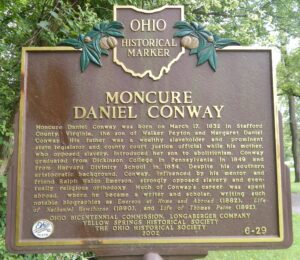
Moncure Daniel Conway was born on March 17, 1832 in Stafford County, Virginia, the son of Walker Peyton and Margaret Daniel Conway. His father was a wealthy slaveholder and prominent state legislator and county court justice official while his mother, who opposed slavery, introduced her son to abolitionism. Conway graduated from Dickinson College in Pennsylvania in 1849 and from Harvard Divinity School in 1854. Despite his southern aristocratic background, Conway, influenced by his mentor and friend Ralph Waldo Emerson, strongly opposed slavery and eventually religious orthodoxy. Much of Conway’s career was spent abroad, where he became a writer and scholar, writing such notable biographies as Emerson at Home and Abroad (1882), Life of Nathaniel Hawthorne (1890), and Life of Thomas Paine (1892).
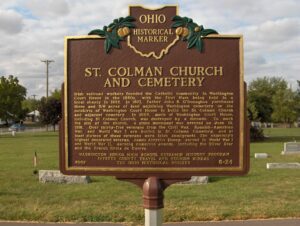
Irish railroad workers founded the Catholic community in Washington Court House in the 1850s, with the first Mass being held in a local shanty in 1852. In 1871, Father John B. O’Donoghue purchased three and 5/8 acres of land adjoining Washington cemetery on the outskirts of Washington Court House to build the St. Colman Church and adjacent cemetery. In 1885, much of Washington Court House, including St. Colman Church, was destroyed by a tornado. To mark the site of the church, a stone monument was erected on June 19, 1916. Over thirty-five veterans from the Civil War, Spanish-American War, and World War I are buried in St. Colman Cemetery, and at least sixteen of these veterans were Irish immigrants. The cemetery’s highest decorated veteran, James Aloysius Ducey, served in World War I and World War II, earning numerous awards, including the Silver Star and the French Croix de Guerre.
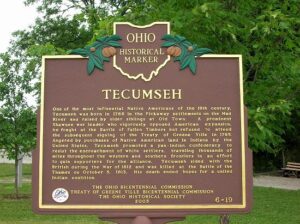
One of the most influential Native Americans of the 19th century, Tecumseh was born in 1768 in the Pickaway settlements on the Mad River and raised by older siblings at Old Town. A prominent Shawnee war leader who vigorously opposed American expansion, he fought at the Battle of Fallen Timbers but refused to attend the subsequent signing of the Treaty of Greene Ville in 1795. Angered by purchases of Native American land in Indiana by the United States, Tecumseh promoted a pan-Indian confederacy to resist the encroachment of white settlers, traveling thousands of miles throughout the western and southern frontiers in an effort to gain supporters for the alliance. Tecumseh sided with the British during the War of 1812 and was killed at the Battle of the Thames on October 5, 1813. His death ended hopes for a united Indian coalition.