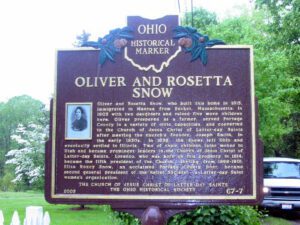
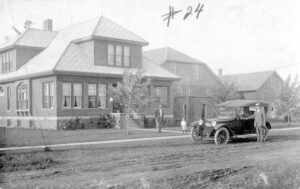
Oliver and Rosetta Snow, who built this home in 1815, immigrated to Mantua from Becket, Massachusetts, in 1805 with two daughters and raised five more children here. Oliver prospered as a farmer, served Portage County in a variety of civic capacities, and converted to the Church of Jesus Christ of Latter-day Saints after meeting the church’s founder, Joseph Smith, in the early 1830s. In 1838, the Snows left Ohio and eventually settled in Illinois. Two of their children later moved to Utah and became prominent leaders in the Church of Jesus Christ of Latter-day Saints. Lorenzo, who was born on this property in 1814, became the fifth president of the Church, serving from 1898-1901. Eliza Roxcy Snow, an acclaimed Portage County poet, became second general president of the Relief Society, a Latter-day Saint women’s organization.
After completing Fort Winchester, Brigadier General James Winchester ordered his troops to cross to the north side of the Maumee River. The troops occupied the new site, Camp #2, from November 3-10, 1812. An earthen fortification was built for protection. Militia soldier Elias Darnell recorded on November 4th that “The weather is very rainy, which makes our situation extremely unpleasant…. Four of this army have gone to the silent tomb to-day never more to visit their friends in Kentucky; the fever is very prevalent in camp; nearly every day there is one or more buried.” Winchester referred to a burial place for the encampment in his General Orders for November 5th. Camp #2 proved to be too wet and marshy, Winchester ordered his army to move to six miles down river to a site called Camp #3.
Saints Peter and Paul Church, Petersburg (1835), was the mother church for St. Joseph, Wapakoneta; St. John the Evangelist, Fryburg; St. Lawrence, Rhine; and Our Lady of the Immaculate Conception, Botkins. All were founded by German-Catholic immigrants to west-central Ohio. After the removal of the Wapakoneta Shawnee in 1832, the land became available for purchase. The 1830s and ’40s saw a wave of devout German settlers who wished to practice their faith in their new home, a desire served by missionary priests such as Father Wilhelm Horstman. Father Horstman first visited the settlement at Petersburg on May 8, 1835, presiding at Mass, baptizing, and blessing a marriage. In April 1836, immigrants John and Anna Mary Ruppert sold 40 acres of land in Pusheta Township to the trustees of the Catholic Church and a log church was built at the Petersburg site. (Continued on other side
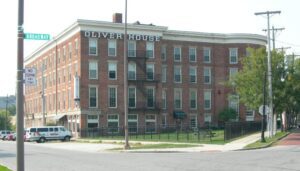
Overlooking the “Middlegrounds,” an early site of railroad, immigration, and commercial activity, the Oliver House opened in 1859 as Toledo’s premier hotel. It was designed by nationally prominent architect Isaiah Rogers, in the Greek Revival style, and built by the family of William Oliver for whom the hotel was named; owner of this land, Oliver was one of Toledo’s earliest real estate investors. (Continued on other side)
A prominent early 20th century illustrator and artist, Howard Chandler Christy was born on a farm in Morgan Township. He first gained notice as an illustrator during the Spanish-American War, but achieved lasting fame for his trademark “Christy Girls,” dream girls who idealized feminine beauty during this era. Between 1908 and 1915, he worked from a studio perched above the Muskingum River near Duncan Falls. In the 1920s Christy began to paint portraits and historical scenes. The Signing of the Constitution of the United States, displayed in the Capitol, is his most famous work. The Signing of the Treaty of Green Ville hangs in the Ohio Statehouse.
Archibald Worthington (1818-1895) was a freed slave from Virginia, a Civil War veteran, and prominent landowner in Highland Township. Census records indicate he was manumitted prior to 1850, and by 1860 owned land in northwest Ohio. Worthington also farmed, boarded freed slaves, and owned apple orchards and livestock. April 1866 township records show that he supported the local school for Black families. He and his wife Elizabeth raised three children: Henry, Mathilda, and James. Henry enlisted in the Massachusetts 54th Volunteer infantry, one of the first Black regiments formed in the Civil War. He died January 8, 1865, in a prison camp and is buried in North Carolina’s Salisbury National Cemetery. Mathilda and James both met partners and married, had children, and left the area. Archibald Worthington died in 1895 and is buried in Wilmington’s Sugar Grove Cemetery.
Nicknamed “Dutchtown” for the many German families that settled in this area, New Washington was platted in 1833 by George Washington Meyers, who arrived in Cranberry Township in 1826. Prominent Austrian romantic poet Nicholas Lenau (1802-1850), author of “Faust” and “Don Juan,” owned property here in the 1830s. The village incorporated in 1874, shortly following the arrival of the Mansfield, Coldwater & Lake Erie Railroad. New Washington is a pioneer in the commercial poultry hatchery industry and initiated the shipment of baby chicks by rail in 1900.
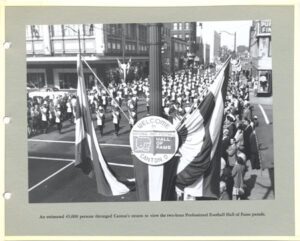
On September 17, 1920, representatives from ten professional football teams met in Canton and formed the American Professional Football Association, which in 1922 became the National Football League (NFL). Pro football evolved from club football in the 1890s, and by the early 1900s had begun to spread across the country, concentrating in the Midwest. Jim Thorpe, the first nationally prominent pro, started with the Canton Bulldogs-an early pro football power-in 1915. In 1959, Canton citizens launched a well-organized and ultimately successful effort to have their city, “the cradle of professional football,” designated as the site of a monument to the sport’s historic stars. The Professional Football Hall of Fame opened on September 7, 1963, inducting seventeen charter members. The Hall of Fame interprets and promotes the study of the role of professional football in American culture.