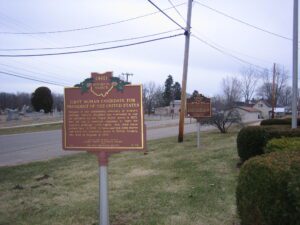
Soldier, engineer, and statesman, W.S. Rosecrans was born in Delaware County in 1819 and grew up in Homer. He graduated from West Point in 1842. During the Civil War, Rosecrans commanded the federal Army of the Cumberland. Popular with his troops, who called him “Old Rosy,” he was a cautious commander and, though victorious at, Corinth, Murfreesboro, and Chattanooga, he suffered major defeat at Chickamauga in 1863. A skilled engineer, Rosecrans developed coal properties in western (now West) Virginia before the war and helped design St. Joseph’s Cathedral in Columbus for his brother, Bishop Sylvester Rosecrans. Following the war he served as minister to Mexico and represented California in Congress from 1881 to 1885. He died in 1898 and is interred at Arlington National Cemetery.
St. Mary of the Assumption parish — Ohio’s second and Fairfield County’s first — was founded circa 1817-1820 by Father Edward Dominic Fenwick. Dominican priests from Somerset began ministering regularly to Lancaster faithful and a small church was dedicated during Easter 1819. Construction on the parish’s third church building, The Basilica of St. Mary of the Assumption, began in February 1854 under the pastorate of Rev. Henry Lange. On August 15, 1859, the Very Rev. John Purcell, Bishop of Cincinnati, laid the cornerstone and it was blessed by former pastor Rev. Josue M. Young, Bishop of Erie, Pennsylvania. Construction proved slow as the Civil War depleted both parish funds and available workers. Father Lange rallied his parishioners, enlisted local contracters Guy and George Blair, and continued the work until his death in February 1864. (Continued on other side)
In February 1819, seven individuals met in Isaac Barnes’ home to form a Congregational Church and entered into covenant. Reverend William Hanford of the Connecticut Missionary Society provided guidance and charged the new congregation to “walk worthy of their high vocation.” Prominent members led the way. In 1832, charter member Nira B. Northrup led the Wadsworth Presbytery in releasing Reverend John Shipherd from pastoral duties to help found what would become Oberlin College. Harrison Gray (H.G.) Blake was a committed abolitionist who, as a state senator, helped repeal the Ohio Black Laws and who was a principal “station master” on the Underground Railroad. (Continued on other side)
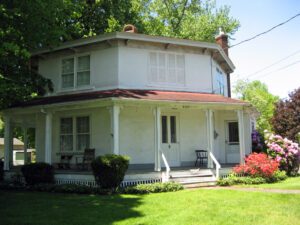
This eight-sided house reflects a widespread pre-Civil War architectural fad. Promoted by phrenologist Orson S. Fowler in his 1848 book A Home for All as a way to “bring comfortable homes within the reach of the poorer classes,” the octagon made efficient use of interior space and natural ventilation. More than thirty octagonal houses are known to have been built in Ohio, and at least twenty-five survive. This example was built circa 1854 and purchased by cabinetmaker Amirus Darrow in 1864. The exterior walls are constructed of chestnut beams between layers of concrete. It was added to the National Register of Historic Places in 1971.
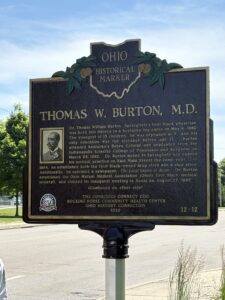
Dr. Thomas William Burton, Springfield’s first Black physician, was born into slavery in a Kentucky log cabin on May 4, 1860. The youngest of 15 children, he was orphaned at 9, and his only education was the alphabet before age 21. Burton attended Kentucky’s Berea College and graduated from the Indianapolis Eclectic College of Physicians and Surgeons on March 24, 1892. Dr. Burton moved to Springfield and opened his medical practice on East Main Street the same year. In 1894, he established both the first Black-owned drug store and a shoe store. Additionally, he operated a newspaper, The Loyal Legion of Honor. Dr. Burton established the Ohio Mutual Medical Association (Ohio’s first Black medical society), and chaired its inaugural meeting in Xenia on August 27, 1897. (Continued on other side)
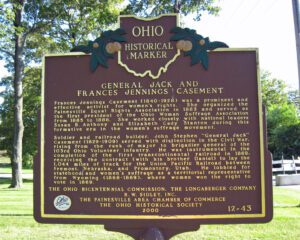
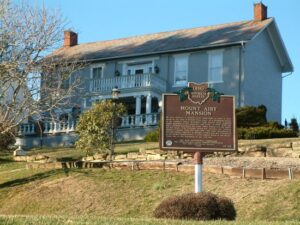
Western Reserve agriculturalist Charles Clement Jennings built the Casement House, also known as the “Jennings Place,” for his daughter Frances Jennings Casement in 1870. Designed by Charles W. Heard, son-in-law and student of Western Reserve master builder Jonathan Goldsmith, it is an excellent example of the Italianate style, featuring ornate black walnut woodwork, elaborate ceiling frescoes, and an innovative ventilation system. It remained in the Casement family until 1953. It was added to the National Register of Historic Places in 1979.
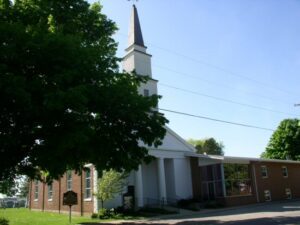
The founders of what would become the Kings Creek Baptist Church first met on June 29, 1805 in the log home of local residents James and Ann Turner. The Baptist congregation continued to meet in people’s homes until 1816 when Taylortown founder John Taylor donated an acre of land to establish a burying site and a meetinghouse. Constructed of logs, this meetinghouse is considered to be the third Baptist church built in Ohio and the Northwest Territory. The original structure was replaced by a more substantial brick building in 1832, and the present Kings Creek Baptist Church was built on the original foundation in 1849. The church features classic Greek design and a grand steeple inspired by the work of the English architect Sir Christopher Wren. An educational wing was added in 1969. (continued on other side)
One of Ohio’s earliest proponents of women’s rights, Frances Dana Gage (1808-1884) was born in Marietta and married McConnelsville attorney James L. Gage in 1829. She immersed herself in the major social issues of the day – temperance, abolition, and universal suffrage – while raising eight children. At a women’s rights convention in 1850, Gage gained national attention by proposing that the words “white” and “men” be removed from Ohio’s constitution. She later served as the editor of an Ohio agricultural journal, as an educator for newly emancipated African Americans, and wrote children’s tales under the pen name “Aunt Fanny.” An enormously influential woman, Gage led the way for Ohio’s next generation of social activists.