

, OH
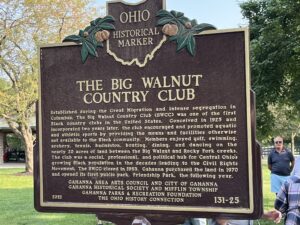
Established during the Great Migration and intense segregation in Columbus, The Big Walnut Country Club (BWCC) was one of the first Black country clubs in the United States. Conceived in 1925 and incorporated two years later, the club encouraged and promoted aquatic and athletic sports by providing the means and facilities otherwise not available to the Black community. Members enjoyed golf, swimming, archery, tennis, badminton, boating, dining, and dancing on the nearly 20 acres of land between the Big Walnut and Rocky Fork creeks. The club was a social, professional, and political hub for Central Ohio’s growing Black population in the decades leading to the Civil Rights Movement. The BWCC closed in 1963. Gahanna purchased the land in 1970 and opened its first public park, Friendship Park, the following year.
, OH
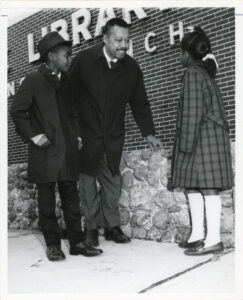
On November 19, 1968, the Columbus Metropolitan Library dedicated the first public library in the nation named after Dr. Martin Luther King Jr. After King’s assassination on April 4, 1968, the East Side Community Council requested that the new library being planned for the King-Lincoln Bronzeville community bear his name. The King family had both family and civic ties to Columbus and were honored by the tribute. More than 1,000 people gathered outside 1600 E. Long Street to hear Martin Luther King Sr. deliver the November dedication speech. Continuing the King family tradition, Martin Luther King III cut the ribbon to open a new branch building at 1487 E. Long Street on October 18, 2018. The Martin Luther King Branch was the first Columbus public library to bear an individual’s name.
, OH
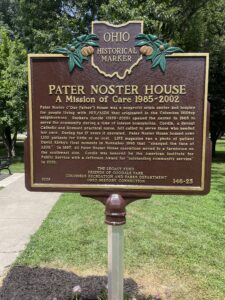
Pater Noster (“Our Father”) House was a nonprofit crisis center and hospice for people living with HIV/AIDS that originated in the Columbus Hilltop neighborhood. Barbara Cordle (1939-2020) opened the center in 1985 to serve the community during a time of intense homophobia. Cordle, a devout Catholic and licensed practical nurse, felt called to serve those who needed her care. During the 17 years it operated, Pater Noster housed over 1,100 patients for little or no cost. LIFE magazine ran a photo of patient David Kirby’s final moments in November 1990 that “changed the face of AIDS.” In 1997, all Pater Noster House operations moved to a farmhouse on the southwest side. Cordle was honored by the American Institute for Public Service with a Jefferson Award for “outstanding community service” in 2002.
, OH
Invited to speak at three Cleveland high schools, Dr. Martin Luther King Jr. delivered his powerful “Rise Up!” speech to students at Glenville High School on April 26, 1967. It signaled King’s opening drive to elect African Americans to prominent government positions in northern cities. Encouraging students to “develop a sense of somebodiness,” King challenged them to “work passionately and unrelentingly for first-class citizenship.” Recognizing the fear of racial unrest in the city, King underscored the significance of nonviolence. “Our power lies in our ability to say non-violently that we’re not going to take it any longer,” he asserted. Making Carl Stokes’ mayoral bid the focus of his push for Black voters to elect Black leaders, King urged Glenville’s students to join civil rights organizations and community action programs.
, OH
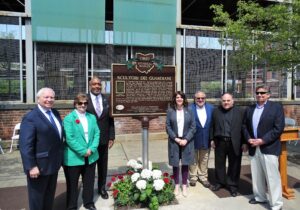
Guardians of Traffic,” four double-sided figural pylons towering over 40-feet above either end of the Hope Memorial Bridge, have connected Cleveland’s east and west side since 1932. They were designed by architect Frank R. Walker and lead sculptor Henry Hering. More than 20 immigrant stonemasons — many fromthe Italian village of Oratino — carved the figures at Ohio Cut Stone Company on Random Road from sandstone quarried in nearby Berea. The Italian sculptors lived or worshipped in Cleveland’s Little Italy. Each hand-carved Guardian holds a different vehicle, meant to portray the history of ground transportation. Voted “an outstanding architectural triumph” by the American Institute of Steel Construction in 1936, the bridge and its iconic Guardians were added to the National Register of Historic Places in 1976.
, OH
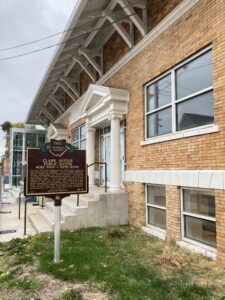
In the early 20th century, the City of Cleveland began opening public bath houses as a way to address the unsanitary living conditions of its overcrowded immigrant neighborhoods. Opened in January 1908, the Clark Avenue Bath House was Cleveland’s third public bath house. It cost $32,000 to build and was designed by prominent Cleveland architect Charles F. Schweinfurth. The semi-Colonial building featured heavy Ionic columns that framed the two entrances marked for “Men” and “Women” overhead. Clark Avenue Bath House had 35 private shower “cabinets,” two group showers, locker rooms, and a gymnasium with a spectator gallery. By 1921, seven such bath houses served the city. Today, five remain and four continue to offer public services to their neighborhoods as Neighborhood Resource and Recreation Centers.
, OH
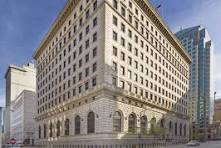
Cleveland was chosen as one of the country’s twelve Federal Reserve cities after a competitive selection process and opened its bank on November 16, 1914. The Federal Reserve Banks promote maximum employment and stable prices as part of the central banking system authorized by the 1913 Federal Reserve Act. Cleveland’s Bank serves the communities of the Fourth Federal Reserve District through supervision and regulation of financial institutions, analyzing and reporting on regional economic trends, and producing research on economic issues of importance to the nation and world. The first woman officer in any of the twelve banks was promoted to her role in 1956 by the Cleveland Fed. In 1982, the first woman in any of the nation’s Federal Reserve Banks served as the sixth President of the Federal Reserve Bank of Cleveland.

, OH
Prominent architect William S. Lougee designed the Woodland Public Bath House that opened in 1915 at a cost of approximately $90,000. The first floor of the facility included separate shower baths for men and women, an office, waiting rooms, and a gymnasium with a 53-yard running track. The second story was divided into four rooms: a club room, a small city library branch, a baby dispensary, and clinic. The basement featured an indoor swimming pool popular among adults and children. Like other public bath houses in Cleveland, the Woodland Bath House was an invaluable social space for its diverse community of largely Hungarian, but also Slovak, Bohemian, Italian, Lithuanian, and Jewish residents. In 1918, the City estimated that 254,508 residents had used Woodland Bath House facilities, enjoying classes, camps, baths, and clinics.