

, OH
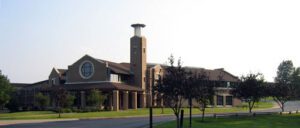
The first women’s college chartered in the state of Ohio, Ursuline College opened in 1871 in downtown Cleveland as part of the educational mission of the Order of St. Ursula (O.S.U.). Founded in Italy in 1535 with an early presence in North America, this order established its first religious teaching community in Cleveland in 1850, led by foundress Mother Mary of the Annunciation Beaumont, O.S.U. The college’s growth prompted four moves in Cleveland and subsequently to the Pepper Pike campus in 1966. Ursuline holds the distinction as one of the first catholic women’s colleges in the United States organized and chartered explicitly for college education.
, OH
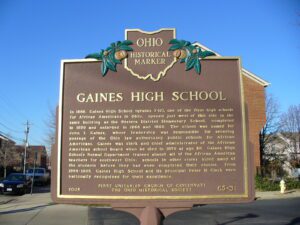
In 1866, Gaines High School (grades 7-12), one of the first high schools for African Americans in Ohio, opened just west of this site in the same building as the Western District Elementary School, completed in 1859 and enlarged in 1866 and 1868. The school was named for John I. Gaines, whose leadership was responsible for securing passage of the Ohio law authorizing public schools for African Americans. Gaines was clerk and chief administrator of the African American school board when he died in 1859 at age 38. Gaines High School’s Normal Department trained almost all of the African American teachers for southwest Ohio; schools in other states hired many of the students before they had even completed their studies. From 1866-1886, Gaines High School and its principal Peter H. Clark were nationally recognized for their excellence.
, OH
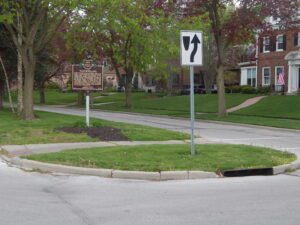
In 1915, real estate developers William B. Welles and Badger C. Bowen formed the Ottawa Park Realty Company and in 1917 platted 323 residential lots near Toledo, Ohio. Named “Westmoreland” for the similarities with the rolling landscapes of Westmoreland County, Virginia, the neighborhood was placed on the National Register of Historic Places in 1986. Westmoreland features 215 original homes, most representing architectural Revival styles of the early 20th century including those of the Colonial, Jacobethan/Tudor, Italianate, French, and Spanish Revivals. This marker commemorates the centennial of the founding of Westmoreland. (Continued on other side)
, OH
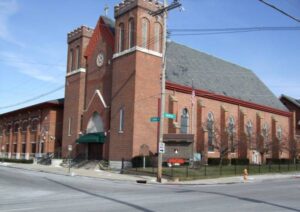
Built in 1852 and dedicated a year later, St. Patrick Church is the second oldest Roman Catholic Church in Columbus. Founded as the English speaking parish, this church of Norman Gothic design served as the home for three future bishops. Located on Naghten Street, the “Irish Broadway” of the nineteenth century, St. Patrick’s parish provided a vital place for the acculturation of the neighborhood Irish immigrants into mainstream American society. The Irish heritage is remembered through the shamrocks that emblazon the heads of each pew. Severely damaged by “the Great Fire” in 1935, the church was quickly restored and serves today as a vibrant religious center for central Ohio. The Dominican Fathers have staffed St. Patrick Church since 1885.
, OH
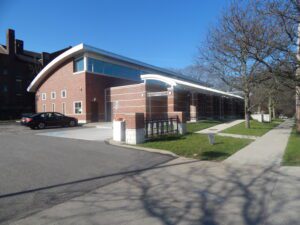
One of the most recognized figures of the Harlem Renaissance, Langston Hughes was born in Joplin, Missouri on February 1, 1902 and moved to Cleveland by the time he was in high school. An avid traveler, he credited his years at Central High School for the inspiration to write and dream. The consummate Renaissance man, Hughes incorporated his love of theater, music, poetry, and literature in his writings. As an activist, he wrote about the racial politics and culture of his day. He was awarded the Spingarn Medal by the NAACP. He published over 40 books, for children and adults. Known as the “Poet Laureate of the Negro People,” Hughes most famous poem is “The Negro Speaks of Rivers.” Langston died on May 22, 1967, and his remains were interred beneath the commemoratively designed “I’ve Known Rivers” tile floor in the Schomburg Center for Research in Black Culture in Harlem.
, OH
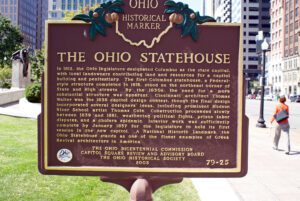
In 1812, the Ohio legislature designated Columbus as the state capital, with local landowners contributing land and resources for a capitol building and penitentiary. The first Columbus statehouse, a Federal-style structure completed in 1816, stood on the northeast corner of State and High streets. By the 1830s, the need for a more substantial structure was apparent. Cincinnati architect Thomas Walter won the 1838 capitol design contest, though the final design incorporated several designers’ ideas, including prominent Hudson River School artist Thomas Cole. Construction proceeded slowly between 1839 and 1861, weathering political fights, prison labor disputes, and a cholera epidemic. Interior work was sufficiently complete by January 1857 for the legislature to hold its first session in the new capitol. A National Historic Landmark, the Ohio Statehouse stands as one of the finest examples of Greek Revival architecture in America.
, OH
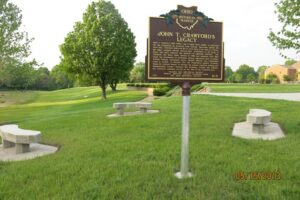
John T. Crawford (1813-1880), was a white Union soldier. In gratitude for the kindnesses he received from African-Americans during the Civil War, Crawford willed his 18 1/2-acre farm to be used as a “home, for aged, indigent worthy colored men, preference to be given to those who have suffered the miseries of American Slavery.” The Crawford Old Men’s Home opened in 1888 and operated until 1964 under the trusteeship of prominent African-Americans such as lawyer William Parham, newspaper editor Wendell Dabney, and Ambassador Jesse D. Locker. It merged with the Progressive Benefit Society’s Home for Colored Women to become the Lincoln Crawford Nursing and Rehabilitation Center. Pleasant Hill Academy, College Hill Library, and Crawford Commons are all on the site of the Crawford farm.
, OH
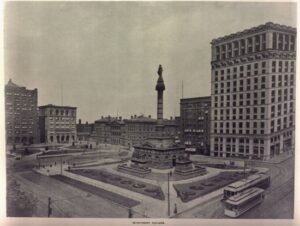
This monument, dedicated July 4, 1894, honors Cuyahoga County men and women, who performed military and patriotic duties during the Civil War (1861-1865). William J. Gleason (1846-1905), army veteran and local businessman, proposed its creation in 1879. Captain Levi Tucker Scofield (1842-1917), Cleveland architect and sculptor, designed the structure and supervised its 19-month construction by contractors, A. McAllister and Andrew Dall. George T. Brewster of Boston and George Wagner of New York, professional artists, assisted Scofield as sculptors. A 12-member Monument Commission, appointed by Governor Joseph B. Foraker in 1888, oversaw the project, which included the removal of William Walcutt’s 1860 marble statue of Commodore Oliver Hazard Perry from the site. The monument’s cost of $280,000 was raised by a countywide property tax levy. An 11-member commission maintains the monument funded by the county. (continued on other side)