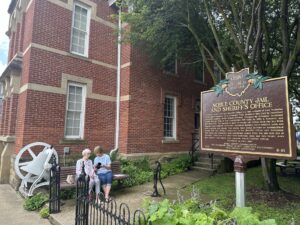
The Noble County Jail and Sheriff’s Office is a fine example of Late Victorian architecture designed by a prominent Ohio architect and built by important nineteenth century Noble County builders. Designed by Columbus architect Joseph Warren Yost, it was constructed 1881-1882 by Mills & Summers and cost $9,477.55. The building is made of orange-red bricks from the Ava Brick Company and features horizontal sandstone banding and a detailed gable end with brackets and finials. The Queen Anne design includes an asymmetrical façade with two distinct entrances to the Sheriff’s Office and Residence. The office and residence face courthouse square while the jail cells are at the rear. There are four first-floor individual cells and two larger men’s and women’s cells above with concrete barrel-vaulted ceilings. (Continued on other side)
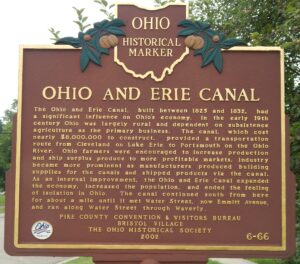
The Ohio and Erie Canal, built between 1825 and 1832, had a significant influence on Ohio’s economy. In the early 19th century Ohio was largely rural and dependent on subsistence agriculture as the primary business. The canal, which cost nearly $8,000,000 to construct, provided a transportation route from Cleveland on Lake Erie to Portsmouth on the Ohio River. Ohio farmers were encouraged to increase production and ship surplus produce to more profitable markets. Industry became more prominent as manufacturers produced building supplies for the canals and shipped products via the canal. As an internal improvement, the Ohio and Erie Canal expanded the economy, increased the population, and ended the feeling of isolation in Ohio. The canal continued south from here for about a mile until it met Water Street, now Emmitt Avenue, and ran along Water Street through Waverly.
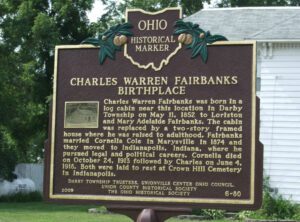
Charles Warren Fairbanks was born in a log cabin near this location in Darby Township on May 11, 1852 to Loriston and Mary Adelaide Fairbanks. The cabin was replaced by a two-story framed house where he was raised to adulthood. Fairbanks married Cornelia Cole in Marysville in 1874 and they moved to Indianapolis, Indiana, where he pursued legal and political careers. Cornelia died on October 24, 1913 followed by Charles on June 4, 1918. Both were laid to rest at Crown Hill Cemetery in Indianapolis.
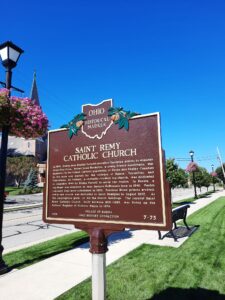
In 1839, Bishop John Baptist Purcell recruited European priests to minister to his Ohio flock. Father Louis Navarron, a young French missionary, was appointed to the French Catholic population of Darke and Shelby Counties in the area now marked by the villages of Russia, Versailles, and Frenchtown. St. Valbert, a centrally-located log church, was dedicated in December 1840 by Bishop Purcell to serve the region. In Russia, a log chapel was dedicated on Jean Jacques DeBrosse’s farm in 1846. Parish boundary lines were established in 1850, Precious Blood priests arrived, and a new church was dedicated to Saint Remigius in August 1852. As the congregation grew, so did the church buildings. The current Saint Remy Catholic Church, built between 1891-1892, was listed on the National Register of Historic Places in 1979.
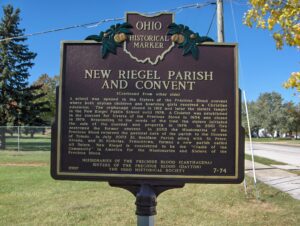
St. Boniface Catholic Church began in 1834 as a mission of several area churches and in 1836, the parish built its first church. In 1844 Bishop John Purcell commissioned Swiss born, Father Francis de Sales Brunner, a Missionary of the Precious Blood, to take pastoral charge of St. Boniface. Under the leadership of Father Brunner, the Missionaries of the Precious Blood, established in Italy in 1815, and the Sisters of the Precious Blood, founded in Switzerland in 1834, began ministry here in New Riegel (Wolfscreek) in 1844. Over two hundred acres of land were purchased for the priests, brothers, and sisters. The Missionaries brought spiritual support, farm labor, and education to the German immigrants of New Riegel. The sisters began their ministry of prayer in the convent, Mary at the Crib, on December 22, 1844. (Continued on other side)
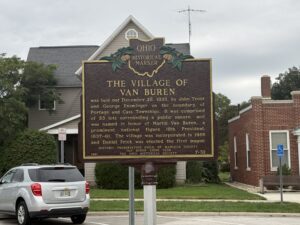
The Village of Van Buren was laid out December 28, 1833, by John Trout and George Ensminger on the boundary of Portage and Cass Townships. It was comprised of 53 lots surrounding a public square, and was named in honor of Martin Van Buren, a prominent national figure (8th President, 1837-41). The village was incorporated in 1866 and Daniel Frick was elected the first mayor.
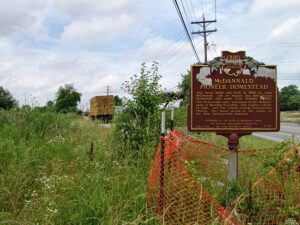
This brick home was built in 1856 by John McDannald, son of Samuel and Bell (Craig) McDannald who came from Virginia in 1813. The McDannalds were prominent in the development of Blendon Township, The Central College of Ohio, and The Central College Presbyterian Church. This house served as one station on the Ohio Underground Railroad.
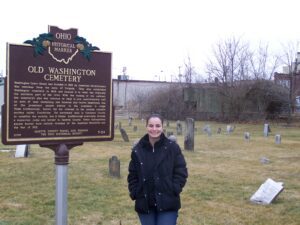
Washington Court House was founded in 1810 by American Revolutionary War veterans from the state of Virginia. They also established Washington Cemetery in 1810 and located it in what was originally the southern part of the town. With the coming of the railroad, the cemetery’s size was reduced to what is now approximately half an acre of land containing one hundred and twelve headstones. One of the prominent people buried in the cemetery is Judge Wade Loofborough, known for his interest in the utopian socialist society called Fourierism. He purchased land in Clermont County to establish the society, but it failed. Loofborough eventually became a respected judge and lawyer in Fayette County. Other distinguished people buried here include veterans of the American Revolution and the War of 1812.