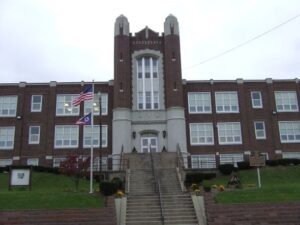
An October 23, 1927, ceremony was held for the laying of the cornerstone for the Dennison High School Building. It opened in the fall of 1928 and was called “Angel’s Castle” in honor of school superintendent William Hiram Angel. The building was designed by J.K. Griffin, an architect from Canton, Ohio, in a style that has the elements of Collegiate Gothic that was popular for school and college buildings during the early twentieth century. The distinguishing architectural features of the entrance towers enhance the school’s prominent location above the street level. Dennison High School is an important visual landmark in the community, as its towers are visible from the downtown area and surrounding neighborhoods. It has retained its integrity of location, materials, design, and association and conveys the early twentieth century ideals of education that the original design of the building was intended to inspire. (Continued on other side)
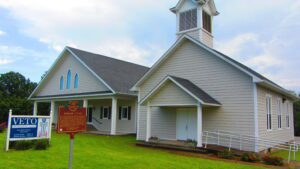
Ephraim Cutler (1767-1853) arrived in Marietta from Connecticut in 1795. Prominent in southeast Ohio, Cutler was appointed judge of the court of common pleas and justice of the peace, surveyed land for the Ohio Company, and was a trustee of Ohio University. In 1802, Cutler was chosen as a Washington County delegate to Ohio’s constitutional convention in Chillicothe. A contested issue at the convention was whether to permit or exclude slavery in the new state of Ohio. As a member of the committee that introduced Article VIII, or the bill of rights, of Ohio’s Constitution, Cutler drafted Section 2, which specifically excluded slavery or involuntary servitude in Ohio on the basis that the Ordinance of 1787 forbade it. The section passed through the convention by one vote. Veto Lake was named for Cutler’s role in having slavery vetoed in Ohio.
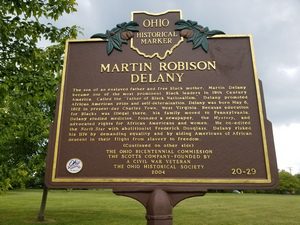
The son of an enslaved father and free Black mother, Martin Delany became one of the most prominent Black leaders in 19th Century America. Called the “Father of Black Nationalism,” Delany promoted African American pride and self-determination. Delany was born May 6, 1812 in present-day Charles Town, West Virginia. Because education for Blacks was illegal there, his family moved to Pennsylvania. Delany studied medicine, founded a newspaper, the “Mystery,” and advocated rights for African Americans and women. He co-edited the “North Star” with abolitionist Frederick Douglass. Delany risked his life by demanding equality and by aiding Americans of African descent in their fight from slavery to freedom. (Continued on other side)
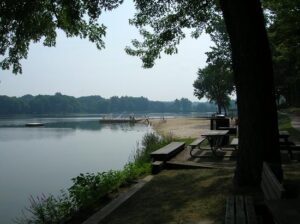
Silver Lake was previously known as Wetmore’s Pond, named for Judge William Wetmore, an agent for the Connecticut Land Company. In 1808, Wetmore built a cabin overlooking the spring-fed lake, which was then a part of Portage County. Local lore records his friendship and conscientious dealings with the Native Americans, likely Seneca, who inhabited a populous village between the lake and the Cuyahoga River. The tribe left the area to join the British during the War of 1812, but later sided with the United States.
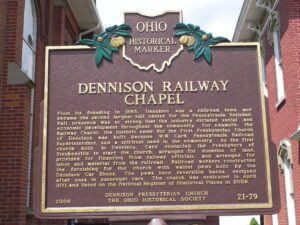
From its founding in 1865, Dennison was a railroad town and became the second largest rail center for the Pennsylvania Railroad. Rail presence was so strong that the industry dictated social and economic development throughout the community. For example, the Railway Chapel, the historic name for the First Presbyterian Church of Dennison was built because W.W. Card, Pennsylvania Railroad Superintendent, saw a spiritual need in the community. As the first church built in Dennison, Card contacted the Presbytery of Steubenville to start the church, arranged for donation of land, provided for financing from railway officials, and arranged for labor and material from the railroad. Railroad workers constructed the furnishing for the church with walnut pews built by the Dennison Car Shops. The pews have reversible backs, designed after ones in passenger cars. The church was dedicated in April 1871 and listed on the National Register of Historical Places in 2009.
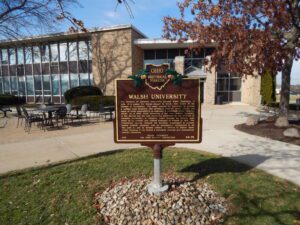
The Brothers of Christian Instruction founded Walsh University in 1958. It is named for Bishop Emmett M. Walsh, then leader of the Diocese of Youngstown. The order created the institution to provide a college-level education that developed students’ moral virtues and sense of social responsibility as embodied in traditional Judeo-Christian values. As of 2015, Walsh University is the only Catholic university in the diocese and the only university sponsored by the Brothers of Christian Instruction, a religious order founded by the Fathers Jean Marie de la Mennais and Gabriel Deshayes in France in 1819. The University’s mission reflects the Brothers’ commitment to provide quality Catholic education with an international perspective to all who seek it, and to develop leaders in service to others. Since Walsh’s founding, it has become a successful regional and international Catholic university.
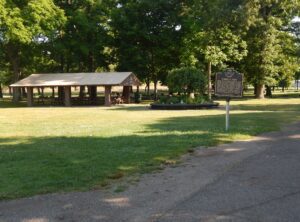
Nimisilla Park was established in 1894. Prior to its founding, the site was the location of the county fair from 1859 to 1893. Throughout its history, Nimisilla Park hosted horse races, live music, soldier reunions, and a zoo, among other events. Prominent political figures, such as Rutherford B. Hayes, James A. Garfield, William McKinley, and Eugene V. Debs, made speeches at the park. In 1918, Debs delivered a famous anti-war speech for which he was arrested and jailed. As of 2016, the park continues to serve as a gathering place for the community.
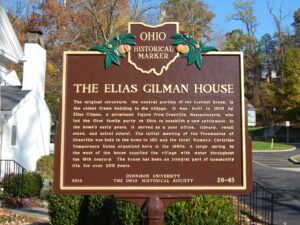
The original structure, the central portion of the current house, is the oldest frame building in the village. It was built in 1808 by Elias Gilman, a prominent figure from Granville Massachusetts, who led the first family party to Ohio to establish a new settlement . In the home’s early years, it served as a post office, library, retail store, and select school. The initial meeting of the Freemasons of Granville was held in the home in 1811 and the local Women’s Christian Temperance Union organized here in the 1880s . A large spring to the west of the house supplied the village with water throughout the 19th century . The house has been an integral part of community life for over 200 years.