

, OH
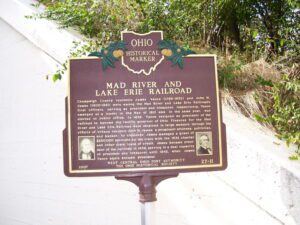
Champaign County residents Joseph Vance (1786-1852) and John H. James (1800-1881) were among the Mad River and Lake Erie Railroad’s first officers, serving as president and treasurer, respectively. Vance emerged as a leader in the War of 1812 and, in the same year, was elected to public office. In 1836, Vance resigned as president of the railroad to become the twelfth governor of Ohio. Finances for the Mad River and Lake Erie Railroad were obtained in large measure through the efforts of Urbana resident John H. James, a prominent attorney, politician, and banker. As treasurer, James managed a grant of $200,000 provided by the state with the 1832 charter and other state loans of credit. James became president of the railroad in 1836, serving in a dual capacity of president and treasurer until 1842, when James Vance again became president.
, OH
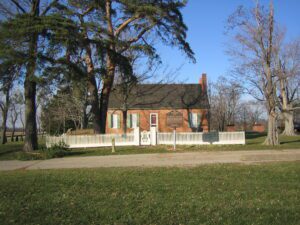
As Oxford Township was developing in the mid-1800s, a cluster of farmsteads near its northern border developed and was designated the “Doty Settlement.” As was the custom, the community took its name from a prominent family in the area. In or near the settlement were a church and cemetery, a school, a blacksmith shop, a sawmill, a distillery, a furniture shop, and a fulling mill for cleansing, shrinking, and thickening cloth. With the frontier spirit of self-reliance, it was seldom necessary to travel several miles into Oxford village for additional goods or services. Working together, the community farmed local fields and bartered for other items. Men, women, and children worked long, hard hours in the fields harvesting corn and wheat. It is evident that these families, living in an agricultural society, possessed many useful skills for surviving in the Ohio country.
, OH
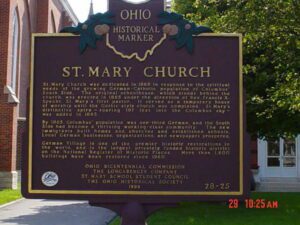
St. Mary Church was dedicated in 1868 in response to the spiritual needs of the growing German-Catholic population of Columbus’ South Side. The original schoolhouse, which stands behind the church, was erected in 1865 under the direction of Rev. Francis X. Specht, St. Mary’s first pastor. It served as a temporary house of worship until the Gothic-style church was completed. St. Mary’s distinctive spire – soaring 197 feet into the Columbus sky – was added in 1893. By 1865, Columbus’ population was one-third German, and the South Side had become a thriving working-class community. The new immigrants built homes and churches and established schools. Local German businesses, organizations, and newspapers prospered. German Village is one of the premier historic restorations in the world, and is the largest privately funded historic district on the National Register of Historic Places. More than 1,600 buildings have been restored since 1960.
, OH
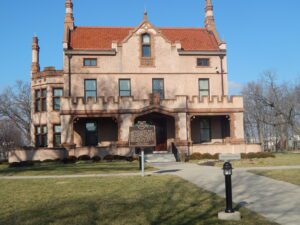
Katharine Kennedy Brown (1891-1986), born in Dayton, was a leading figure in local, state, and national Republican politics. Soon after the 19th Amendment was passed in 1920, she earned a seat on the Montgomery County Republican Executive Committee; moving up to the Ohio State Republican Central Committee in 1928 and the Republican National Committee in 1932 ─ serving on both until 1968. She founded the first Republican Women’s Club in the county. (Continued other side)
, OH
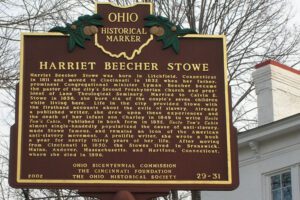
Harriet Beecher Stowe was born in Litchfield Connecticut in 1811 and moved to Cincinnati in 1832 when her father, prominent Congregational minister Lyman Beecher became the pastor of the city’s Second Presbyterian Church and president of Lane Theological Seminary. Married to Calvin E. Stowe in 1836, she bore six of the couple’s seven children while living here. Life in the city provided Stowe with the firsthand accounts about the evils of slavery. Already a published writer, she drew upon these experiences and the death of her infant son Charley in 1849 to write Uncle Tom’s Cabin. Published in book form in 1852, Uncle Tom’s Cabin almost single-handedly popularized the cause of anti-slavery, made Stowe famous, and remains an icon of the American anti-slavery movement. A prolific writer, she wrote a book a year for nearly thirty years of her life. After moving from Cincinnati in 1850, the Stowes lived in Brunswick, Maine, Andover, Massachusetts, and Hartford, Connecticut, where she died in 1896.
, OH
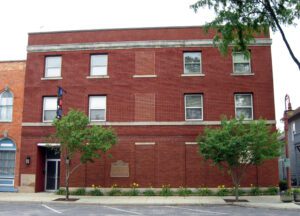
On March 5, 1817, Lieutenant Almon Gibbs, formerly of Army Lodge No. 24 at Fort Meigs, Perrysburg, formed Northern Light Lodge No. 40 “at Waynesfield” (now Maumee). Gibbs served as Worshipful Master, William Griffith as Senior Warden, and Charles Gunn, Junior Warden. The lodge was founded under a dispensation from Henry Brush, Ohio Grand Master and Captain of the Ohio Militia. Among many prominent early members was General James B. Steadman of Chickamauga fame. Almon Gibbs later became Maumee’s first postmaster and Justice of the Peace. [Masonic Symbol]
, OH
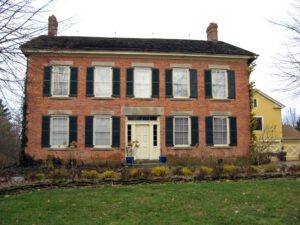
Born in Jefferson, Ohio, Theodore E. Burton graduated from Oberlin College and became a prominent Cleveland attorney. He was elected to Congress in 1888 and served from 1889-91, 1895-1909, and 1921-28. He was elected U.S. Senator in 1908 and 1928 and was a leading contender for the U.S. Presidency in 1916. Due to his work in saving Niagara Falls from development and his opposition to wasteful waterways projects, President Theodore Roosevelt appointed Burton chairman of the Inland Waterways Commission in 1907 and the National Waterways Commission in 1909. Burton is credited with pushing legislation through Congress that authorized the construction of the Panama Canal and negotiating agreements to ensure its neutrality. He lobbied to fight wasteful spending and influence of big business and sponsored the Sherman Anti-Trust Act of 1890. As president of the American Peace Society, Burton hosted the First World Conference on International Justice in Cleveland in 1928, attended by 13,000, including world leaders.
, OH
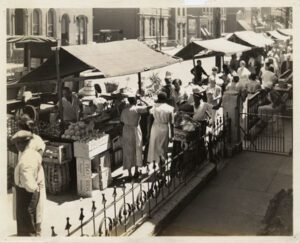
Public markets housing butchers, fish merchants, and produce vendors were once the primary source of perishable foods for residents of America’s cities. Cincinnati operated nine in 1859. Only Findlay Market, built here in 1852, survives. Cincinnati’s lost indoor markets include: Fifth Street Market: 1829 to 1870, Fifth between Vine and Walnut Wade Street Market: 1848 to 1898, corner of Wade and Bauer Avenue Canal Market: 1829 to 1864, Court between Vine and Walnut Court Street Market: 1864 to 1914, replaced Canal Market Jabez Elliott Flower Market: 1890 to 1950, Sixth between Elm and Plum Sixth Street Market: 1895 to 1960, Sixth between Plum and Western Row Pearl Street Market: 1901 to 1934, Market between Sycamore and Broadway