

, OH
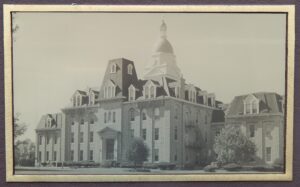
Fr. John Henni founded St. Aloysius Orphanage in 1837 to care for German-speaking Catholic children who were left abandoned by the cholera epidemics of the 1830s. The orphanage has occupied its main building since 1856. All of the orphanage’s other buildings were constructed by 1930. In 1864, additional land was purchased, making the orphanage a self-sufficient farm growing fruits and vegetables as well as livestock.
, OH
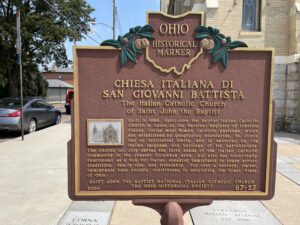
The National Italian Catholic parish of Saint John the Baptist was founded in October 1896 by the Reverend Father Alexander Cestelli, D.D. Father Cestelli was born in Fiesole, Italy and came to America in 1888 to serve as a professor at St. Paul’s Seminary in Minnesota. In January 1896, founding Rector Monsignor John Joseph Jessing invited Father Cestelli to serve at the Pontifical College Josephinum in Columbus, Ohio as a professor of moral theology. In October 1896, the Right Reverend John Ambrose Watterson, D.D., Bishop of Columbus, appointed Father Cestelli as pastor of the Italian Catholic community. Sunday Mass was celebrated in the baptistery of Saint Joseph Cathedral until September 18, 1898, when the Most Reverend Sebastiano Martinelli, Apostolic Delegate to the United States, dedicated this historic church.
, OH
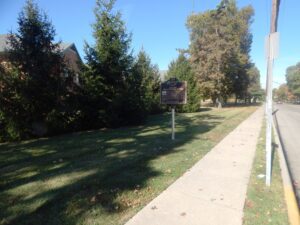
The Sisters of Notre Dame de Namur were founded in 1804 by Saint Julie Billiart to spread the message “Ah, how good it is to serve God.” In 1840, at the request of Bishop John B. Purcell in 1840, the Sisters travelled to Cincinnati, Ohio to help educate the city’s growing Catholic population. Choosing to serve the poor, the Sisters turned down land in Brown County and instead founded schools at Sixth Street in Cincinnati. Since the start of the 21st century, the Sisters serve in twenty-seven other states, the District of Columbia, and in South America, Europe, Africa and Asia. Sister Dorothy Stang, while working for land reforms for the poor in Brazil, was martyred in 2004.
, OH
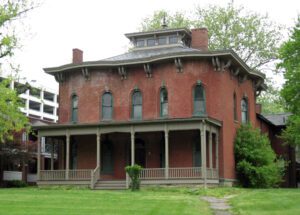
The Cozad-Bates House is one of the oldest remaining structures in Cleveland’s University Circle. The original section, built circa 1853, is the only pre-Civil War residential structure left in the neighborhood. Built by Samuel and Jane Cozad’s son, Andrew Cozad, the first section used locally made brick to form a simple two-story, one-room-deep, vernacular English-I house. The family owned a large portion of the land which is now occupied by University Circle. Justus Cozad, Andrew’s son, returning from the west where he worked as a railroad superintendent and civil engineer, built the later section on Mayfield Road for his larger family in 1872. It is a rare surviving example of Italianate-influenced residential architecture, including a hipped roof, curved bay windows, paired eave brackets, and prominent belvedere. The house was listed on the National Register of Historic Places in 1974 and designated as a Cleveland Landmark in 2006.
, OH
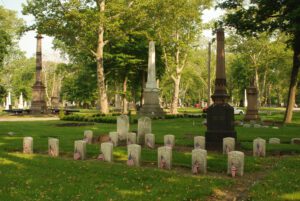
Howard Daniels, who lived from 1815-1863, was a noted architect and landscape gardener. Over the course of his life, he designed six Ohio and New York cemeteries, including Woodland that began in 1852 when he laid out 20 of its 60 acres into fashionable “rural cemetery” style. Later acreage in the cemetery adapted his curvilinear design. “As beautifully prepared for a burial place as fancy and taste could desire,” Woodland was dedicated on June 14, 1853, and became Cleveland’s primary cemetery. An ornate gatehouse, chapel, and fountains came later. Generations of Clevelanders, pioneering and prominent, as well as veterans onward from the War of 1812, are buried here. For more than a century, Woodland, in its original and newly platted sections, has embraced people from every race, the rich and poor, natives and immigrants, and the famous and obscure. It has truly become a community cemetery. [continued on other side]
, OH
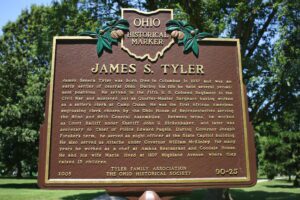
James Seneca Tyler was born free in Columbus in 1837 and was an early settler of central Ohio. During his life he held several prominent positions. He served in the Fifth U.S. Colored Regiment in the Civil War and mustered out as Quarter-Master Sergeant having worked as a sutler’s clerk at Camp Chase. He was the first African American engrossing clerk chosen by the Ohio House of Representatives serving the 62nd and 66th General Assemblies. Between terms, he worked as Court Bailiff under Sheriff John U. Rickenbaker, and later was secretary to Chief of Police Edward Pagels. During Governor Joseph Foraker’s term, he served as night officer at the State Capitol building. He also served as Attache under Governor William McKinley. For many years he worked as a chef at Ambos Restaurant and Goodale House. He and his wife Maria lived at 1107 Highland Avenue where they raised 13 children.
, OH
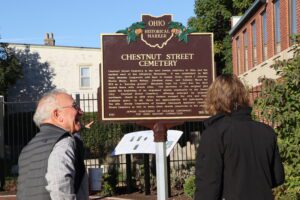
Chestnut Street Cemetery is the first Jewish cemetery in Ohio and the earliest west of the Allegheny Mountains. It was established in 1821 when Nicholas Longworth sold land to Joseph Jonas, David I. Johnson, Morris Moses, Moses Nathan, Abraham Jonas, and Solomon Moses for $75 as a “burying ground.” Benjamin Lape (or Leib) was the first buried there with Jewish rites. The purchase of the original plot marks the beginning of an organized Jewish community in the Queen City. Chestnut Street Cemetery, although enlarged by adjacent purchases, closed in 1849 when cholera ravaged the city and filled available space. In all, there are approximately 100 interments on the site. Jewish Cemeteries of Greater Cincinnati maintains Chestnut Street Cemetery as well as many other Jewish cemeteries in the region.
, OH
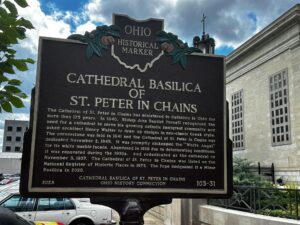
The Cathedral of St. Peter In Chains has ministered to Catholics in Ohio for more than 175 years. In 1840, Bishop John Baptist Purcell recognized the need for a cathedral to serve his growing catholic immigrant community and asked architect Henry Walter to draw up designs in neo-classic Greek style. The cornerstone was laid in 1841 and the Cathedral of St. Peter in Chains was dedicated November 2, 1845. It was promptly nicknamed the “White Angel” for its white marble façade. Abandoned in 1938 due to deteriorating conditions, it was renovated during the 1950s, and rededicated as the cathedral on November 3, 1957. The Cathedral of St. Peter in Chains was listed on the National Register of Historic Places in 1973. The Pope designated it a Minor Basilica in 2020.