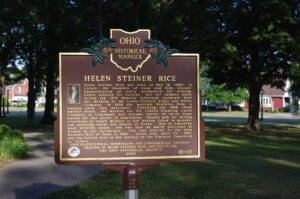
Helen Steiner Rice was born on May 19, 1900, in Lorain, the daughter of Anna and John Steiner. Demonstrating an early propensity for writing, Helen planned for college, but her father’s death during the 1918 Spanish Influenza epidemic kept her working at the Lorain Electric Light and Power Company. In 1929 she married Franklin Rice, a Dayton bank vice president. Following the 1929 stock market crash, she worked for the Gibson Greeting Cards Company in Cincinnati and became editor of verse lines. Known for her words of inspiration, Helen’s gift for writing continues to reach millions in her poetry found in modern-day greeting cards and dozens of books. One of America’s most prolific poets, she was also an early advocate of women in the workplace. She was elected to the Ohio Women’s Hall of Fame in 1992. Helen died April 23, 1981, and was buried next to her parents at the Elmwood Cemetery in Lorain.
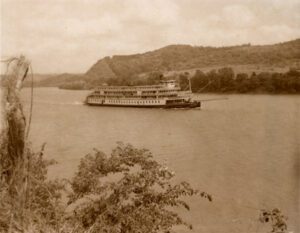
Captain Gordon C. Greene, a veteran riverman, was born in Newport, Ohio, on September 8, 1862. In 1890 he started the “Greene Line” with the “Henry K. Bedford,” a small shallow draft steamer; he owned twenty-five packets in his lifetime. The “Greene Line” later became the “Greene Steamboat Line” then the “Delta Queen Steamboat Company,” with the original port at the Newport Landing. The Greene family launched packets for tours on the Ohio River and its tributaries. Captain Greene died in 1927 at Hyde Park, Cincinnati, and is buried in Newport Cemetery. (continued on other side)
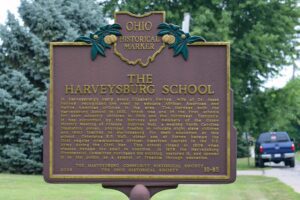
The Quaker village of Harveysburg was founded in 1829 on land originally a part of Colonel Abraham Buford’s Revolutionary War Land Grant. Levi Lukens, a Virginia Quaker, purchased the 1000 – acre survey in 1812 and sold a portion to Rhoden Ham in 1815. Ham then sold a portion of his holdings to William Harvey, a Quaker originally from North Carolina, who developed 47 lots for a village which thrived from its beginnings. Early businesses included grist mills, a tin shop, hardware store, blacksmith shop, a large pork packing plant, a bank, and a dry goods store owned by William Harvey. Its first post office opened in 1839. Harveysburg was incorporated in 1844. The village received its name from a merchant in Cincinnati who told William Harvey that he should add burg to his name and call the place Harveysburg.
20190 Middleburg-Plain City Rd (SE part of Milford Ctr)
Milford Center
, OH
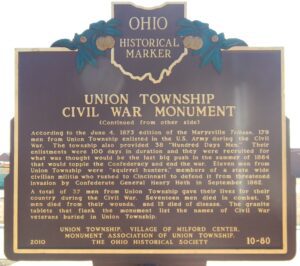
The following notice appeared in the Marysville Tribune newspaper, February 5, 1873: To Arms! To Arms! The Monument Association of Union Township propose holding a Fair and Festival in Milford Centre on Feb 20 and 21…the proceeds to be applied to the fund already raised to erect a Monument in memory of the fallen heroes of Union Tp. Said Monument to be unveiled on the 30th of May, 1873. It is desired that every citizen have an opportunity to contribute something in aid of such a worthy object. It is therefore hoped that every person, male and female, will send in their donations of such articles as they may have to lay upon the alter of our departed Heroes. Bring Wheat, Corn, fancy work, mitts, Hoods, articles for children, anything, to the value of a horse…. On May 30, 2003—130 years later—the Monument Association of Union Township rededicated the refurbished monument.
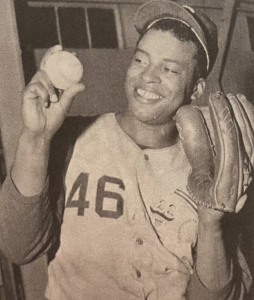
Ulysses Brooks Lawrence was born in Springfield on January 30, 1925. Nicknamed “The Bull,” he broke numerous color barriers throughout his baseball career. In 1976, Lawrence was the first Black player inducted into the Cincinnati Reds Hall of Fame. An all-around athlete at Springfield High School, Lawrence lettered in basketball, track, and football (the school’s first Black starting quarterback). After graduation in 1943, he was drafted into the U.S. Army and earned a Bronze Star in Guam during World War II. Lawrence enrolled at Ohio’s Miami University, becoming that school’s first Black baseball player (1947-1949), before signing with the Cleveland Indians. Acquired by the St. Louis Cardinals (1954), he was assigned to the Columbus Red Birds Triple-A farm team, breaking another team’s color barrier. (Continued on other side)
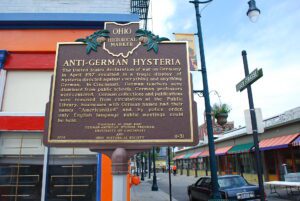
The United States’ declaration of war on Germany in April 1917 resulted in a tragic display of hysteria directed against everything and anything German. In Cincinnati, German teachers were dismissed from public schools, German professors were censored, German collections and publications were removed from circulation at the Public Library, businesses with German names had their names “Americanized” and, by police order, only English language public meetings could be held. (Continued on other side)
St. Mary of the Assumption parish — Ohio’s second and Fairfield County’s first — was founded circa 1817-1820 by Father Edward Dominic Fenwick. Dominican priests from Somerset began ministering regularly to Lancaster faithful and a small church was dedicated during Easter 1819. Construction on the parish’s third church building, The Basilica of St. Mary of the Assumption, began in February 1854 under the pastorate of Rev. Henry Lange. On August 15, 1859, the Very Rev. John Purcell, Bishop of Cincinnati, laid the cornerstone and it was blessed by former pastor Rev. Josue M. Young, Bishop of Erie, Pennsylvania. Construction proved slow as the Civil War depleted both parish funds and available workers. Father Lange rallied his parishioners, enlisted local contracters Guy and George Blair, and continued the work until his death in February 1864. (Continued on other side)
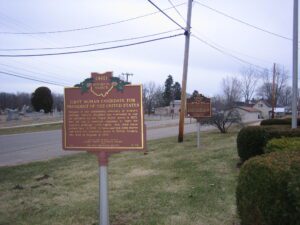
Soldier, engineer, and statesman, W.S. Rosecrans was born in Delaware County in 1819 and grew up in Homer. He graduated from West Point in 1842. During the Civil War, Rosecrans commanded the federal Army of the Cumberland. Popular with his troops, who called him “Old Rosy,” he was a cautious commander and, though victorious at, Corinth, Murfreesboro, and Chattanooga, he suffered major defeat at Chickamauga in 1863. A skilled engineer, Rosecrans developed coal properties in western (now West) Virginia before the war and helped design St. Joseph’s Cathedral in Columbus for his brother, Bishop Sylvester Rosecrans. Following the war he served as minister to Mexico and represented California in Congress from 1881 to 1885. He died in 1898 and is interred at Arlington National Cemetery.