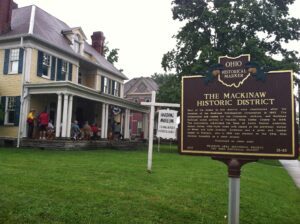
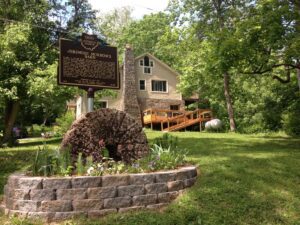
Most of the homes in this district were constructed after the creation of the Mackinaw Development Corporation in 1887. The corporation was named for the Cincinnati, Jackson, and Mackinaw Railroad which arrived in Franklin from Darke County in 1886. The corporation subdivided the farm of Lewis Gaston Anderson, whose Italian Villa-style home still stands at the northwest corner of Miami and Lake Avenues. Anderson was a grain and lumber dealer in Franklin, who in 1881 was elected to the 65th Ohio General Assembly as a state senator. (Continued on other side)
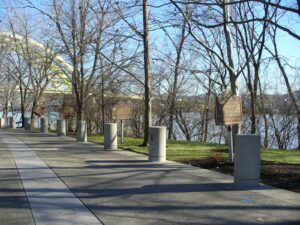
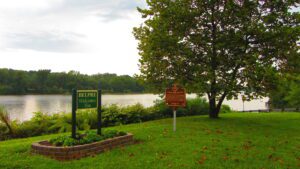
801 E. Pete Rose Way, Bicentennial Commons at Sawyer Point
Cincinnati
, OH
In memory of the Irish people who left a country where only their rivers run free. The Irish came to Cincinnati where they contributed to housing, education, employment, religious freedom, medical care and recreation, and embraced all aspects of life in the city. The descendants of Irish immigrants hope that our hands will ever be extended in friendship and never in want.
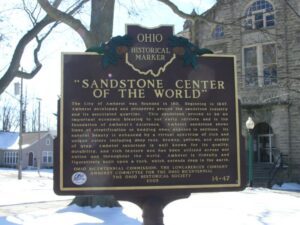
The City of Amherst was founded in 1811. Beginning in 1847, Amherst developed and prospered around the sandstone industry and its associated quarries. This sandstone proved to be an important economic blessing to our early settlers and is the foundation of Amherst’s existence. Amherst sandstone shows lines of stratification or bedding when exposed in sections. Its natural beauty is enhanced by a virtual spectrum of rich and unique colors including deep reds, browns, yellows, and shades of gray. Amherst sandstone is well known for its quality, durability, and rich texture and has been utilized across our nation and throughout the world. Amherst is literally and figuratively built upon a rock, which extends deep in the earth.
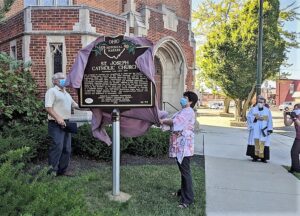
St. Joseph Catholic Church has been located here since the parish’s formation in 1845. Tiffin was established by Josiah Hedges in 1822, and shortly after, many German Catholic families began to settle in the area. They formed part of St. Mary’s parish until 1845, when they obtained permission from Bishop John Purcell of the Diocese of Cincinnati to organize as the separate congregation of St. Joseph. In May 1845, parishioners bought two acres of land at the conjunction of Melmore and South Washington Streets. Within the month, they laid the cornerstone for a 40-foot by 66-foot brick church that would be completed by August of that year. As the congregation grew, Rev. Joseph Bihn, pastor from 1856 to 1873, saw the need for a new church. (Continued on other side)
In 1795, at the age of 23, Jeremiah Morrow came to the Northwest Territory from Pennsylvania. He purchased land along the Little Miami River in Deerfield Township and in 1799 married Mary Parkhill of Pennsylvania. Around 1800 he built this barn which is one of Warren County’s oldest standing structures. In 1801, Morrow was sent to the Second Territorial Assembly and to the first Ohio Constitutional Convention in 1802. In 1803, he was elected the new state’s first U. S. Congressman and was Ohio’s only congressman for ten years. In 1813 the Ohio legislature elevated him to U.S. Senate. In 1822 he became Ohio’s ninth governor. He went on to serve in both the Ohio House and Senate and at age 69 returned to Congress. An extraordinary man, Jeremiah Morrow gave his country 43 years of public service.
Born in Massachusetts in 1805, Sala Bosworth spent all but nineteen years of his eighty-five years in Washington County. After studying at the Philadelphia Academy of Fine Arts, he returned to the county to paint many full size and miniature portraits of prominent Washington County citizens. His historical drawings were used in Samuel P. Hildreth’s Pioneer History. He is also known for his mural in what is now the Unitarian Universalist Church in Marietta. Bosworth moved to Cincinnati late in life and started to paint with watercolors. He died there in 1890. Charles Sullivan also studied at the Philadelphia Academy and became a fast friend of Bosworth after coming to Washington County in 1833. While he also painted portraits, he excelled in his landscapes, including views of Blennerhassett Island, the Blennerhassett mansion, and the mounds at Marietta. Sullivan died in Marietta in 1867.
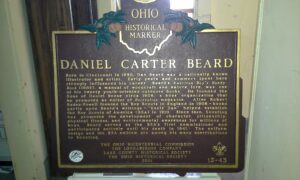
Born in Cincinnati in 1850, Dan Beard was a nationally known illustrator and artist. Early years and summers spent here strongly influenced his career. Beard’s American Boy’s Handy-Book (1882), a manual of woodcraft and nature lore, was one of his twenty youth-oriented outdoors books. He founded the Sons of Daniel Boone circa 1906, a boys’ organization that he promoted as editor of Recreation magazine. After Robert Baden-Powell founded the Boy Scouts in England in 1908-based partly upon Beard’s writings-“Uncle Dan” helped establish the Boy Scouts of America (BSA) in 1910. Since then, Scouting has promoted the development of character, citizenship, physical fitness, and environmental awareness for millions of boys. Beard served as the BSA’s first commissioner and participated actively until his death in 1941. The uniform design and the BSA emblem are among his many contributions to Scouting.
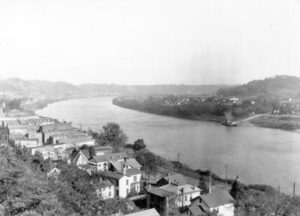
The Ohio River begins at the confluence of the Allegheny and Monongahela rivers in Pittsburgh, Pennsylvania, and flows 981 miles to join the Mississippi River at Cairo, Illinois. The Iroquois called the river “Oyo” or “Ohio,” which the French translated as “La Belle Riviere,” the Beautiful River. It was an important transportation route for countless generations of Native Americans and, beginning in the 1780s, for Euro-American settlers. It was the main route to the opening West and the principal outlet for the region’s growing farm output. Congress first acted to improve navigation in 1824 and, later, by canalizing the river with a series of locks and dams beginning in 1878. River commerce has increased with industrialization, moving up to 150 million tons annually.