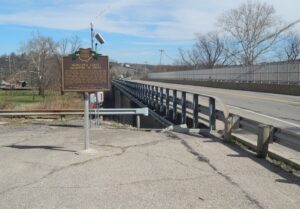
Confederate Brigadier General John Hunt Morgan’s Indiana-Ohio Raid, or Great Raid, from July 2-26, 1863 covered nearly 1,000 miles and penetrated deeper into the North than any other Confederate incursion during the Civil War. The raid was also the only significant military action of the war in Ohio. Union cavalry chased Morgan’s 2,000 cavalrymen across twenty-four Ohio counties after the troopers entered the state from Indiana. On July 13, 1863 Morgan’s main column encountered no resistance as it passed through New Haven, about five miles north from this site. (Continued on other side)
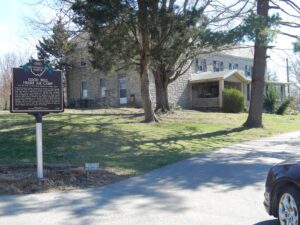
Reverend Richard E. Scully, founder of the Cincinnati Goodwill operated a Fresh Air Camp for women and children in the 1930s and 40s. The camp was part of a 100-acre site with vegetable fields, a swimming pool, tennis courts and horseshoe pits. The farm house on site was used as lodging for visitors. Men who worked at the camp received food and other forms of relief for their families. Vegetables produced on site were distributed at the Goodwill location at Ninth Street and Freeman Avenue in Cicinnati. According to family stories, Ruth Ann Eldridge, the frist child of Edison and Anna Eldridge, was buried on the site of the camp in 1933. Rev. Scully had officiated at Edison and Anna’s wedding and was a friend of the family.
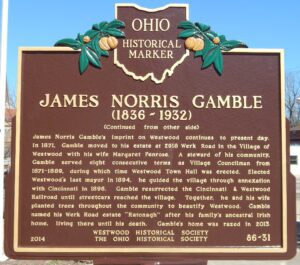
James Norris Gamble, entrepreneur, industrialist, philanthropist and civic leader, is best known for inventing Procter & Gamble’s Ivory Soap, the “soap that floats,” in 1878. Applying a scientific approach, Gamble transformed P&G into a nationally recognized corporate leader and creator of consumer products for a rapidly growing America. Beyond P&G, Gamble financed early efforts to educate freed southern slaves as an original sponsor of the Freedmen’s Aid Society. Later, he underwrote civil rights leader Mary McLeod Bethune’s work to educate poor African American women. In Cincinnati, Gamble’s philanthropy included endowment of Christ Hospital and the founding of its Institute of Medical Research. Gamble funded completion of University of Cincinnati’s Nippert Stadium in 1924 as a tribute to his late grandson.
Sisters of Notre Dame de Namur, 701 East Columbia Avenue
Reading
, OH
The Sisters of Notre Dame de Namur were founded in 1804 by Saint Julie Billiart to spread the message “Ah, how good it is to serve God.” In 1840, at the request of Bishop John B. Purcell in 1840, the Sisters travelled to Cincinnati, Ohio to help educate the city’s growing Catholic population. Choosing to serve the poor, the Sisters turned down land in Brown County and instead founded schools at Sixth Street in Cincinnati. Since the start of the 21st century, the Sisters serve in twenty-seven other states, the District of Columbia, and in South America, Europe, Africa and Asia. Sister Dorothy Stang, while working for land reforms for the poor in Brazil, was martyred in 2004.
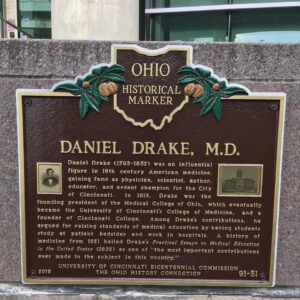
Daniel Drake, M.D.. Daniel Drake (1785-1852) was an influential figure in 19th century American medicine, gaining fame as physician, scientist, author, educator, and ardent champion for the City of Cincinnati. In 1819, Drake was the founding president of the Medical College of Ohio, which eventually became the University of Cincinnati’s College of Medicine, and a founder of Cincinnati College. Among Drake’s contributions, he argued for raising standards of medical education by having students study at patient bedsides and work in hospitals. A history of medicine from 1921 hailed Drake’s Practical Essays on Medical Education in the United States (1832) as one of “the most important contributions ever made to the subject in this country.”
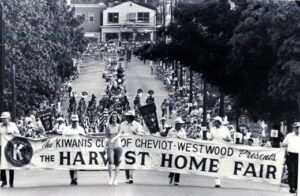
In 1804, Enoch (1764-1817) and Achsah (c.1767-1839) Carson and their seven children journeyd from New Jersey to Cincinnati. In 1805, they settled in the western hills in a large grove near Beech Flats, in what would become Green Township in 1809 and Cheviot in 1818. Game was plentiful and fertile soil yielded abundant crops. By 1806, Carson had cleared and cultivated nearly 20 acres of his land. That fall, he began a tradition that has continued into the 21st century. Echoing the ancient custom of harvest home, Carson brought together a fledging community to celebrate its good fortune and abundant harvests. Each passing year the community gathered in Carson’s grove to give thanks, rejoice, and uphold the tradition of harvest home. (Continued on other side)
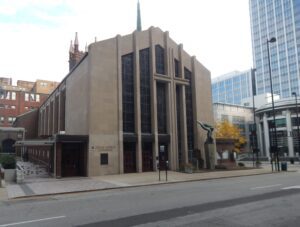
In 1817 twenty-two men, including future President William Henry Harrison, chartered Cincinnati’s first Episcopal parish, Christ Church. In 1835 members erected a Gothic Revival-style church on this site. The neighborhood evolved as the city grew with the influx of immigrants. Parish women raised funds to teach, feed, clothe, and shelter tenement families, and alleviate suffering during floods and disease outbreaks. In 1883 the women helped establish what became Cincinnati Children’s Hospital. In 1909 members opened the Late Gothic-style Parish House, a community center with kitchen, classrooms, library, auditorium, clinic, gymnasium, and bowling alley. By the parish’s centennial in 1917, music had expanded beyond worship to public concerts. In 1940 the annual Boar’s Head Festival of music and pageantry began. Since the 1960s, members have collaborated with local agencies to advocate for social and economic justice, a mission continuing into the 21st century. (Continued on other side)
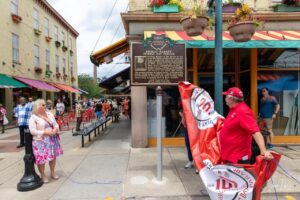
Findlay Market is the heart of the Over-the-Rhine neighborhood and has been a gathering place for political, religious, and social events since opening in 1855. Inspired by the Cincinnati Reds World Championship in 1919, a group of fans –“rooters” – from Findlay Market organized a parade to celebrate the start of the team’s 1920 season. The parade became an annual event, with marching bands, horse-drawn “Tally-Ho” wagons and rooters processioning to Redland and later Crosley Field, where they presented gifts to Reds officials. (Continued on other side)