

, OH
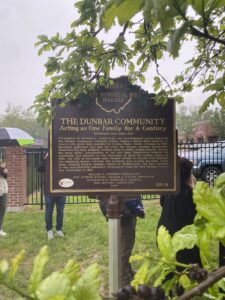
Dunbar, or Corsica Hollow, was an African American neighborhood on the western edge of Madisonville. Its streets and lots were laid out in 1886 after Mahlon and Anna Leonard subdivided their 10-acre tract near Duck Creek and sold lots to African Americans. Many early Dunbar residents were from the South; some born there prior to emancipation. Prominent early citizens included Harriet Deatherage, Elihu Parks, Gandison Embry, Thomas Duett, and James Murphy. Dunbar was home to the New Mission Missionary Baptist Church, founded in 1907. Originally meeting in a one-room building, the extant congregation relocated to Ravenna Street in 1963. By the late 1920s, Dunbar had about forty houses, a grocery run by Henry Lowman, and a hair salon run by Flora Hector. (Continued on other side)
, OH
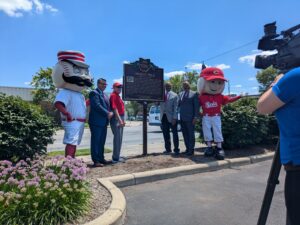
Crosley Field was the home of the Cincinnati Reds for almost 58 years. Opened in 1912 as Redland Field, the ballpark was renamed in 1934 when famed Cincinnati industrialist Powel Crosley Jr. purchased the team. Over its years of service, Crosley Field was home to Reds teams that won National League Championships in 1919, 1939, 1940, and 1961, and World Series titles in 1919 and 1940. The park also played host to the Major League Baseball All-Star Game in 1938 and 1953. Crosley Field famously held what was then acknowledged as the first night game under lights on May 24, 1935. Such visiting legends as “Shoeless” Joe Jackson, Babe Ruth, Joe DiMaggio, Willie Mays, and Jackie Robinson played at Crosley Field. (Continued on other side)
, OH
In 1792, Captain Jacob White claimed land traditionally home to the Shawnee, Delaware (Lenni Lenape), Potawatomi, Miami, Wyandot, Seneca, Chippewa (Ojibwe or Anishinaabeg), Ottawa, and Wapakoneta indigenous nations. Located at the third crossing of Mill Creek, White’s Station, with a blockhouse and six cabins, served as a supply depot to nearby Cincinnati. On October 18, 1793, indigenous groups attacked the settlement in an effort to defend their ancestral lands. During the conflict, five people died: three members of David Flin’s family – Andrew Gobel and two of the Pryer children — as well as a tribal leader and his son whose names were not recorded. Andrew Pryer rushed to Fort Washington 10 miles away and returned with infantrymen who remained while a stockade was built to fortify the settlement.
, OH
The Cincinnati Club, a prominent Jewish social club founded in 1889, opened their clubhouse at 2840 Melrose Avenue in 1894. A.E. Elzner designed the brick and stone building in the Norman-Gothic style. It featured massive round towers, wide porches, a ballroom, billiard rooms, bowling alley, as well as ornate club rooms. The Cincinnati Club hosted lavish events that celebrated Jewish identity and community. As the Jewish population migrated north and east of Walnut Hills, the club dissolved. In 1922, the vacant clubhouse was purchased by the Disabled American Veterans of the World War (DAV). The DAV Clubhouse provided recreation, resources, and shelter to disabled veterans for over twenty years. The organization, founded in Cincinnati in 1920, led to the establishment of the Veterans Administration and improved support for wounded veterans nationwide.
, OH
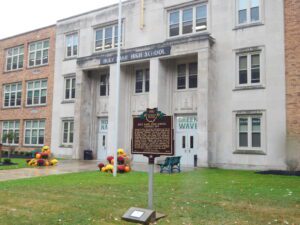
Founded in 1914, Holy Name High School was one of the first co-educational Roman Catholic high schools in Cleveland. Originally located at Harvard and Broadway Avenues, the school opened under the direction of Holy Name Parish with educational leadership of the Sisters of Charity from Cincinnati. In 1978, Holy Name High School moved to its present location in Parma Heights, the former home of Nazareth Academy. Throughout its history, Holy Name High School has served the community by providing a Catholic, college-preparatory education. The Holy Name spirit lives on through its alumni, who have made a difference around the world.
, OH
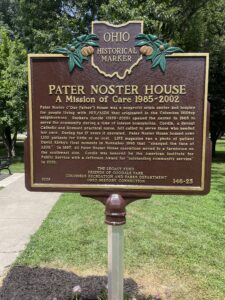
Pater Noster (“Our Father”) House was a nonprofit crisis center and hospice for people living with HIV/AIDS that originated in the Columbus Hilltop neighborhood. Barbara Cordle (1939-2020) opened the center in 1985 to serve the community during a time of intense homophobia. Cordle, a devout Catholic and licensed practical nurse, felt called to serve those who needed her care. During the 17 years it operated, Pater Noster housed over 1,100 patients for little or no cost. LIFE magazine ran a photo of patient David Kirby’s final moments in November 1990 that “changed the face of AIDS.” In 1997, all Pater Noster House operations moved to a farmhouse on the southwest side. Cordle was honored by the American Institute for Public Service with a Jefferson Award for “outstanding community service” in 2002.