

, OH
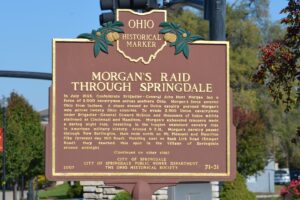
In July 1863, Confederate Brigadier-General John Hunt Morgan led a force of 2,000 cavalrymen across southern Ohio. Morgan’s force entered Ohio from Indiana. A chase ensued as Union cavalry pursued Morgan’s men across twenty Ohio counties. To evade 2,500 Union cavalrymen under Brigadier-General Edward Hobson and thousands of Union militia stationed at Cincinnati and Hamilton, Morgan’s exhausted troopers made a daring night ride, resulting in the longest sustained cavalry ride in American military history. Around 9 P.M., Morgan’s cavalry passed through New Burlington, then rode north on Mt. Pleasant and Hamilton Pike (present day Mill Road). Heading east on Bank Lick Road (Kemper Road), they reached this spot in the Village of Springdale around midnight. (Continued on other side)
, OH
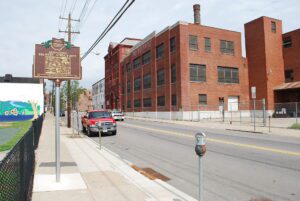
The Brewery District contains the majority of Cincinnati’s remaining breweries and associated structures such as icehouses, bottling buildings, offices, and stables. With the first brewery north of Liberty Street founded in1829, German immigrants fueled the growth of the brewing industry; by 1891, Cincinnati breweries produced over four barrels of beer per resident annually, almost twice as much as any other city in the nation. The brick breweries were typically designed in the Romanesque Revival style, and larger complexes often covered multiple city blocks. To produce the lager style beer common by 1860, typically very deep basements were dug or tunnels were cut into hillsides for the lagering process. At the height of production, 18 of the 36 breweries in greater Cincinnati were operating in Over-the-Rhine and the West End. Prohibition in 1919 closed most of the breweries permanently.
, OH
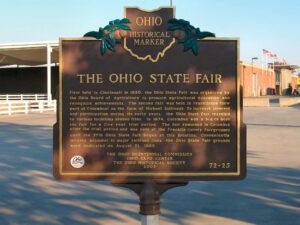
First held in Cincinnati in 1850, the Ohio State Fair was organized by the Ohio Board of Agriculture to promote agricultural education and recognize achievements. The second fair was held in Franklinton (now part of Columbus) on the farm of Michael Sullivant. To increase interest and participation during its early years, the Ohio State Fair traveled to various locations around Ohio. In 1874, Columbus won a bid to host the fair for a five-year trial period. The fair remained in Columbus after the trial period and was held at the Franklin County Fairgrounds until the 37th Ohio State Fair began at this location. Conveniently located adjacent to major railroad lines, the Ohio State Fair grounds were dedicated on August 31, 1886.
, OH
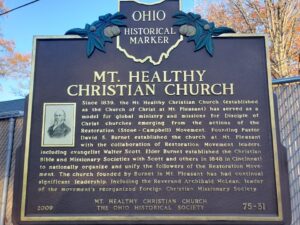
Since 1839, the Mt. Healthy Christian Church (established as the Church of Christ at Mt. Pleasant) has served as a model for global ministry and missions for Disciple of Christ churches emerging from the actions of the Restoration (Stone-Campbell) Movement. Founding Pastor David S. Burnet established the church at Mt. Pleasant with the collaboration of Restoration Movement leaders, including evangelist Walter Scott. Elder Burnet established the Christian Bible and Missionary Societies with Scott and others in 1848 in Cincinnati to nationally organize and unify the followers of the Restoration Movement. The church founded by Burnet in Mt. Pleasant has had continual significant leadership, including the Reverend Archibald McLean, leader of the movement’s reorganized Foreign Christian Missionary Society.
, OH
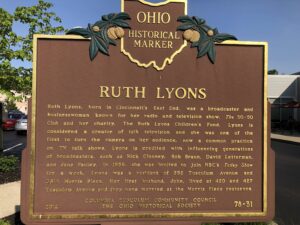
Ruth Lyons, born in Cincinnati’s East End, was a broadcaster and businesswoman known for her radio and television show, The 50-50 Club and her charity, The Ruth Lyons Children’s Fund. Lyons was considered a creator of talk television and she was one of the first to turn the camera on her audience, now a common practice on TV talk shows. Lyons is credited with influencing generations of broadcasters, such as Nick Clooney, Bob Braun, David Letterman, and Jane Pauley. In 1858, she was invited to join NBC’s Today Show for a week. Lyons was a resident of 332 Tusculum Avenue and 3614 Morris Place. Her first husband, John lived at 420 and 427 Tusculum Avenue and they were married at the Morris Place residence.
, OH
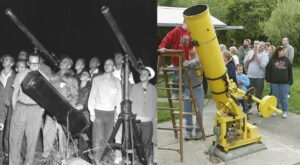
On October 4, 1957 the Soviet Union surprised the world with the launching of Sputnik 1, the world’s first artificial satellite. The Cincinnati Astronomical Society’s Moonwatch Team, organized in 1956 as part of its participation in the International Geophysical Year, was immediately activated by the Smithsonian Astrophysical Observatory (S.A.O.). First observations of satellites were made December 15, 1957. On these grounds, from 1957 to 1964, the Cincinnati Moonwatch Team, principally under the leadership of Tom Van Flandern (1940-2009), spent thousands of man-hours optically observing and recording data to verify the positions of satellites in space. Many times the team compiled the best satellite tracking records in the world. Because of this work The Moonwatch Team and the Cincinnati Astronomical Society were recognized by the S.A.O. as one of its leading teams worldwide.
, OH
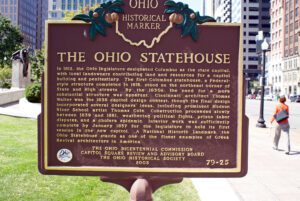
In 1812, the Ohio legislature designated Columbus as the state capital, with local landowners contributing land and resources for a capitol building and penitentiary. The first Columbus statehouse, a Federal-style structure completed in 1816, stood on the northeast corner of State and High streets. By the 1830s, the need for a more substantial structure was apparent. Cincinnati architect Thomas Walter won the 1838 capitol design contest, though the final design incorporated several designers’ ideas, including prominent Hudson River School artist Thomas Cole. Construction proceeded slowly between 1839 and 1861, weathering political fights, prison labor disputes, and a cholera epidemic. Interior work was sufficiently complete by January 1857 for the legislature to hold its first session in the new capitol. A National Historic Landmark, the Ohio Statehouse stands as one of the finest examples of Greek Revival architecture in America.
, OH
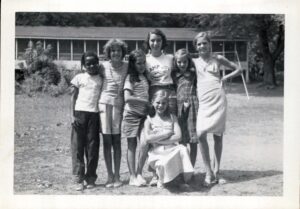
Camp Joy was born at the site of Seven Hills Neighborhood House and original location of St. Barnabas Episcopal Mission Church. Displacement and loss caused by Ohio River flood of 1937 inspired St. Barnabas’ rector and his wife, Laurence “Cap” and Sadie Hall, to act on behalf of the children of Cincinnati’s West End. The Halls conceived of Camp Joy as a haven where kids could find a respite from impoverished surroundings in the city and its sweltering summer heat. The camp was a success and continued after the Halls’ assignment to another parish. From 1940-1944, Rev J. Brooke and Mrs. Betty Mosley continued to nurture the people of the West End through St. Barnabas and Camp Joy. (Continued on other side)