

, OH
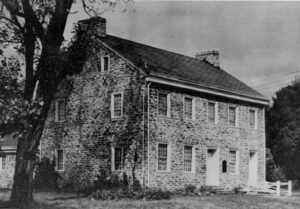
Waldschmidt Cemetery is located on land purchased from former New Jersey judge and Congressman John Cleves Symmes in 1795 by Christian Waldschmidt, one of the first settlers in the Little Miami River Valley. Waldschmidt, from Lancaster, Pennsylvania, was a veteran of the American Revolution, and he and his family are buried here. During the Civil War this area, named for Governor William Dennison, served as a training site and hospital for the Union effort. A portion of the cemetery was the temporary interment site for 349 Union soldiers and 31 Confederate prisoners of war, most of whom died at the camp hospital. On July 4, 1869, the Union soldiers were moved to Spring Grove Cemetery in Cincinnati. About the same time, the Confederate soldiers were reinterred in Chase Cemetery in Columbus, Ohio.
, OH
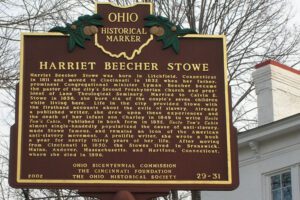
Harriet Beecher Stowe was born in Litchfield Connecticut in 1811 and moved to Cincinnati in 1832 when her father, prominent Congregational minister Lyman Beecher became the pastor of the city’s Second Presbyterian Church and president of Lane Theological Seminary. Married to Calvin E. Stowe in 1836, she bore six of the couple’s seven children while living here. Life in the city provided Stowe with the firsthand accounts about the evils of slavery. Already a published writer, she drew upon these experiences and the death of her infant son Charley in 1849 to write Uncle Tom’s Cabin. Published in book form in 1852, Uncle Tom’s Cabin almost single-handedly popularized the cause of anti-slavery, made Stowe famous, and remains an icon of the American anti-slavery movement. A prolific writer, she wrote a book a year for nearly thirty years of her life. After moving from Cincinnati in 1850, the Stowes lived in Brunswick, Maine, Andover, Massachusetts, and Hartford, Connecticut, where she died in 1896.
, OH
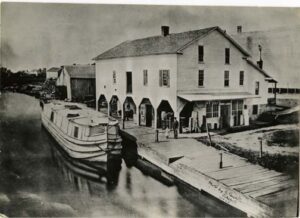
The Wabash & Erie Canal opened between Toledo and Lafayette, Indiana, May 8, 1843. The Miami Extension Canal was completed to Junction, Ohio, on July 4, 1845, linking the Wabash & Erie Canal with Cincinnati and resulting in changing the canal’s name to the Miami and Erie Canal. Prosperity reigned until the 1850s when railroad competition caused a slow decline in commerce. The canal branch to Indiana was in disuse by 1858 and totally abandoned in 1888. The canal system was revived from 1906-1909 with much reconstruction and improvement only to be badly damaged by severe statewide flooding in 1913. The canal was maintained from here to Maumee for generating hydro-electric power until it was drained in 1929. Twelve miles of canal and the Maumee Side Cut Canal have been leased to the Toledo Area Metroparks since 1932.
, OH
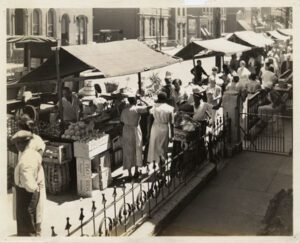
Public markets housing butchers, fish merchants, and produce vendors were once the primary source of perishable foods for residents of America’s cities. Cincinnati operated nine in 1859. Only Findlay Market, built here in 1852, survives. Cincinnati’s lost indoor markets include: Fifth Street Market: 1829 to 1870, Fifth between Vine and Walnut Wade Street Market: 1848 to 1898, corner of Wade and Bauer Avenue Canal Market: 1829 to 1864, Court between Vine and Walnut Court Street Market: 1864 to 1914, replaced Canal Market Jabez Elliott Flower Market: 1890 to 1950, Sixth between Elm and Plum Sixth Street Market: 1895 to 1960, Sixth between Plum and Western Row Pearl Street Market: 1901 to 1934, Market between Sycamore and Broadway
, OH
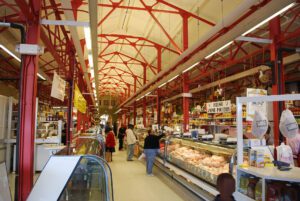
Ohio’s oldest surviving municipal market house, Findlay Market was designed under the direction of City Civil Engineer Alfred West Gilbert (1816-1900). It was listed on the National Register of Historic Places in 1972. The structure was among the first market houses in the United States to use iron frame construction technology. Originally an open pavilion, much of the market was erected in 1852, but disputes with contractors delayed its opening until 1855. The center masonry tower was built in 1902. Soon after, public health concerns prompted enclosure of the market stalls and the addition of plumbing and refrigeration. Until then, vendors found cool storage in deep cellars beneath nearby breweries. The tower bell was brought from Cincinnati’s Pearl Street Market in 1934. Findlay Market was renovated in 1973-74 and again in 2002-03.
, OH
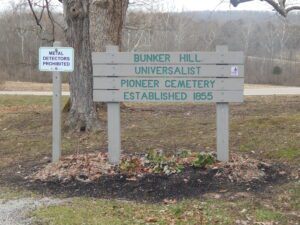
The Bunker Hill Society was organized about 1845 and fellowshipped in 1854. A frame meeting house, capable of seating 300, was dedicated in 1855. Thirty people united with the church during the 1859 Annual Meeting. The membership suffered greatly during the Civil War, many enlisting in the Union Army. Some members, Like John G. Agnew, were Peace Democrats (Copperheads). Agnew withdrew from the church on July 5, 1863 saying, “I feel the course I am and have been pursuing does not comport with the Christian character. Nor do I think that I can be better while this war lasts. I do not wish to be a reproach upon the church.” The church was re-fellowshipped in 1900. The last sermon was delivered October 23, 1910. Fire destroyed the building May 8, 1924.
, OH
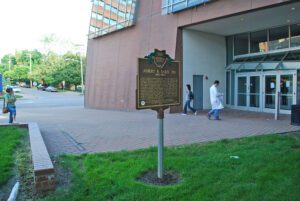
Albert B. Sabin developed the oral, live-virus polio vaccine at the University of Cincinnati College of Medicine and Children’s Hospital Research Foundation, where between 1939 and 1969, he conducted his most significant research. His vaccine has nearly eradicated the dreaded “infantile paralysis” that killed or maimed millions of children. Dr. Sabin, who considered Cincinnati his home, made many other significant medical discoveries here, particularly in the area of tropical diseases. Presidents and royalty worldwide honored him, including President Bill Clinton who said he was “one of the great heroes of American medicine.” His numerous awards include the U.S. National Medal of Medicine (1970), Presidential Medal of Freedom (1986), Medal of Liberty (1986), and Order of Friendship among Peoples awarded by the President of the Supreme Soviet of the U.S.S.R.
, OH
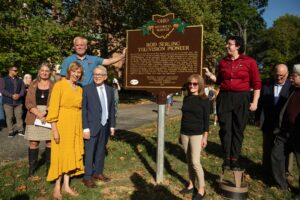
Rodman Edward Serling (1924-1975) enrolled at Antioch College in 1946 following military service in World War II. He began college as a physical education major, but soon discovered writing as a way of working through his war experiences. As a student, he contributed short fiction to The Antiochian literary magazine, managed the student-run Antioch Broadcasting System, and wrote and produced award-winning radio dramas. In July 1948, Serling married classmate Carolyn “Carol” Kramer. Shortly after earning his degree in 1950, he took a copy writer job at Cincinnati’s WLW radio. Serling quickly focused on selling scripts to national television networks. After eight years in Ohio, he and his wife moved to Connecticut. He returned to Antioch after the third season of The Twilight Zone to teach writing, drama, and media during the 1962-1963 academic year.