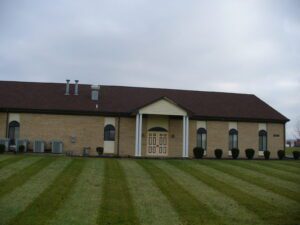
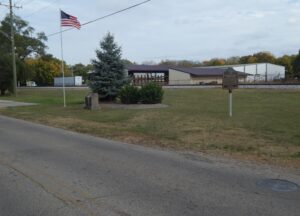
The Jain Center of Cincinnati and Dayton was established on April 22, 1979 as a non-profit tax-exempt organization under the laws of the United States and the State of Ohio. The foundation stone of the Jain temple, the first of its kind in Ohio, was laid down on August 21-22, 1994. The temple was dedicated on September 2 – 4, 1995 when more than one thousand people from all over Ohio and many other states participated in holy rituals to install three idols of Jinas (Gods). The Jain Center is a place for the teaching of non-violence, reverence for life, and compassion for all beings. The center was the home of the twelfth biennial convention for the Federation of Jain Associations in North America, which was held on July 3 – 6, 2003. (Continued on the other side)
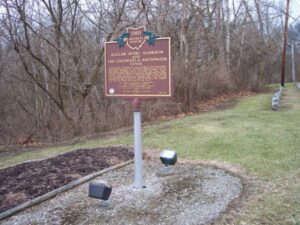
In 1837, Cincinnati merchants projected a branch canal to join the Whitewater Canal at West Harrison, Indiana, with the goal of tapping commerce from Indiana’s Whitewater Valley. The major obstacle on this route was the ridge between North Bend and Cleves, just northeast of this site. Engineer Darius Lapham designed a 1,782-foot tunnel though this barrier. Lined with brick made on site, the tunnel, 24 feet wide and 20 1/2 feet high, was the first canal tunnel in Ohio. Six workers died in its construction. The Cincinnati & Whitewater Canal opened in 1843 but was abandoned by 1856, after the main Whitewater Canal had been rendered useless by repeated flooding. The canal tunnel was subsequently used as a railroad tunnel from 1863 until 1888, illustrating the progression of transportation technology in the mid-nineteenth century.
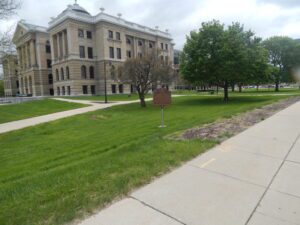
The first canal boat arrived in Toledo from Indiana in 1843 via the Wabash & Erie Canal. The Miami & Erie Canal from Cincinnati was completed in 1845. It joined the W & E Canal near Defiance and they shared the same course along the Maumee River. The final section of the canal from Toledo’s Swan Creek Side Cut to Manhattan and passed across the present courthouse square.
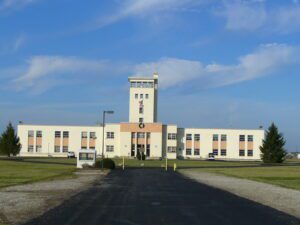
During the height of World War II, President Franklin Roosevelt turned to the innovative engineers of the Crosley Broadcasting Corporation to build powerful short wave radio transmitters capable of delivering broadcasts overseas. On farm fields near Crosley’s WLW facility, six 200 kilowatt transmitters and 24 directional reentrant rhombic antennas were built and on September 23, 1944, the Voice of America Bethany Station was dedicated. The first broadcast was directed at Nazi Germany and began with, “We shall speak to you about America and the war. The news may be good or it may be bad, but we will tell you the truth.” For more than fifty years, the Voice of America Bethany Station delivered “truthful news” to the people of Europe, Africa, South America, and parts of Asia, despite some like Adolf Hitler who referred to the VOA as those “Cincinnati Liars.” New technology and budget cuts resulted in the silencing of the Bethany Station in 1994.
Carlisle Area Historical Society Museum, 453 Park Drive
Carlisle
, OH
Carlisle Station Depot. The Carlisle depot for the Cincinnati, Hamilton & Dayton (CH&D) railroad was located nearby. The CH&D started operations in 1851 and was the second railroad through Warren County. Carlisle Station was a passenger and freight-shipping depot and was joined in 1872 by another, when Cincinnati & Springfield Railroad (later part of the Big Four and the New York Central Railroads) erected a depot in nearby Franklin. Carlisle was originally known as the “Jersey Settlement,” because many settlers in the early 1800s were from New Jersey. George Carlisle, vice-president of the CH&D, purchased a large tract of land here. After Carlisle and his wife Sarah donated a lot to the community in 1856, residents renamed the place “Carlisle Station.” The Carlisle Literary Association built a hall on the lot c. 1856, which, as of 2019, remains as the older section of Carlisle’s municipal building. Side B: Schenck-Stanton Rally, October 3, 1868.
801 E. Pete Rose Way, Bicentennial Commons at Sawyer Point
Cincinnati
, OH
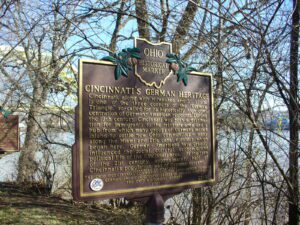
Cincinnati, along with Milwaukee and St. Louis, is one of the three corners of the “German Triangle,” so-called for its historically high concentration of German-American residents. During the 19th century, Cincinnati was both a destination for immigrants to the tri-state area and a hub from which many groups of Germans moved inland to settle new Ohio communities-many along the Miami and Erie canal corridor which began here. German-Americans have greatly influenced the social, cultural, economic and political life of the Cincinnati area. At the turn of the 21st century, approximately half of Cincinnati’s population was of German descent. (Continued on other side)
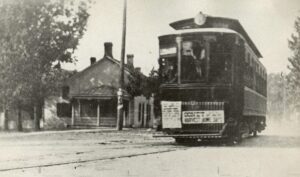
The Rapid Railway began operation in 1903 and was the Interurban Railway and Terminal Company’s (IR&T) northernmost traction line. The IR&T began near Pleasant Ridge and Kennedy Heights in Cincinnati and connected to a street car line that originated downtown, on Sycamore Street, and passed through a total of fourteen municipalities. The interurban cars ran down Main Street through Mason before turning south onto Dawson Street, crossing Muddy Creek, and traveling to Kings Mills. From Kings Mills, the line continued to Lebanon where it terminated. The full ride from downtown Cincinnati to Lebanon took approximately one hour and fifty minutes. (Continued on other side)
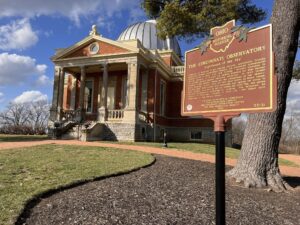
Prompted by response to his popular lectures, astronomer Ormsby MacKnight Mitchel (1809-1862) founded the Cincinnati Astronomical Society (CAS) in 1842. With CAS funding, Mitchel traveled to Munich, Bavaria, to acquire the optical elements for what became the world’s second largest refractor telescope. In 1843 former president John Quincy Adams laid the cornerstone of the observatory building, located upon the hill since known as Mount Adams. The Cincinnati Observatory was completed and opened for study in 1845. Mitchel, who died in service during the Civil War, was among the first to popularize astronomy in America. The telescope he brought to Cincinnati remains in daily use, the oldest such instrument in the United States.