

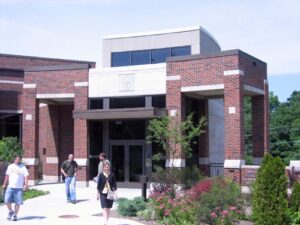
, OH
Dr. Jacob Rader Marcus (1896-1995), pioneering historian of the American Jew, founded the American Jewish Archives (AJA) in Cincinnati in 1947. In the aftermath of World War II and the brutal destruction of European Jewry, Marcus anticipated the need to establish a central repository dedicated to preserving the history of North American Jewry. The AJA, which began with a few boxes of documents, has become one of the world’s largest catalogued collections of primary source material on the history of American Jewry. An international community of scholars, researchers, and students utilizes the AJA’s vast archival holdings.
, OH
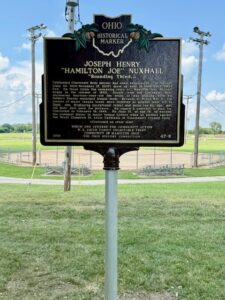
Celebrated Cincinnati Reds pitcher and radio broadcaster, Joe Nuxhall (July 30, 1928 – November 15, 2007) grew up here in Hamilton’s North End. On these fields the endearing story of “Hamilton Joe” Nuxhall began in the summer of 1943. Scouts from the Cincinnati Reds discovered fourteen-year-old Joe while he was playing with his father’s Sunday municipal league team. Because of World War II, the rosters of major league teams were depleted as players went off to fight. Joe, displaying exceptional talent and poise for his age, met the Reds’ dire need for pitchers. He signed a contract to play for Cincinnati on February 18, 1944. On June 10, at age 15, he became the youngest player in major league history when he pitched against the World Champion St. Louis Cardinals at Cincinnati’s Crosley Field. (Continued on other side)
, OH
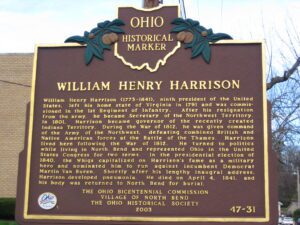
William Henry Harrison (1773-1841), ninth president of the United States, left his home state of Virginia in 1791 and was commissioned in the 1st Regiment of Infantry. After his resignation from the army, he became Secretary of the Northwest Territory. In 1801, Harrison became governor of the recently created Indiana Territory. During the War of 1812, he was given command of the Army of the Northwest, defeating combined British and Native American forces at the Battle of the Thames. Harrison lived here following the War of 1812. He turned to politics while living in North Bend and represented Ohio in the United States Congress for two terms. In the presidential election of 1840, the Whigs capitalized on Harrison’s fame as a military hero and nominated him to run against incumbent Democrat Martin Van Buren. Shortly after his lengthy inaugural address, Harrison developed pneumonia. He died on April 4, 1841, and his body was returned to North Bend for burial.
, OH
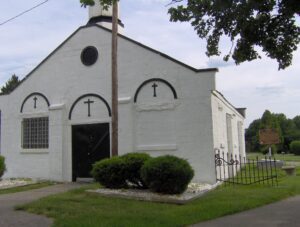
Born in Richmond, Virginia, Powhatan Beaty moved to Cincinnati in 1849, where he spent the majority of his life. Beaty enlisted as a private in the Union Army in June 1863, and two days later was promoted to first sergeant, Company G, 5th United States Colored Troops (USCT). All the officers of Company G were killed or wounded during an attack on Confederate forces at New Market Heights, Virginia, in September 1864. Beaty took command of his company, and for his valor received the Congressional Medal of Honor. Beaty was one of two African-Americans buried in Ohio to receive the Medal of Honor for service in the Civil War. He died on December 6, 1916, leaving two sons, attorney and state representative A. Lee Beaty and John W. Beaty. He is buried in Union Baptist Cemetery along with nearly 150 USCT veterans.
, OH
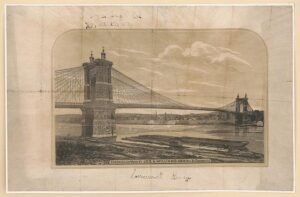
The Covington-Cincinnati Bridge Company under the leadership of Amos Shinkle built the first Ohio River bridge linking the North and South following the Civil War. The bridge was privately operated until purchased in 1955 by Kentucky and later renamed the “John A. Roebling Suspension Bridge.” Completed in 1866, this National Civil Engineering Landmark was the only bridge in service over the Ohio River during the 1937 flood. Since 1976, its national and local heritage has been commemorated with beautification lighting and flags sponsored by the citizens and institutions for which the bridge stands as a community symbol. (Continued on other side)
, OH
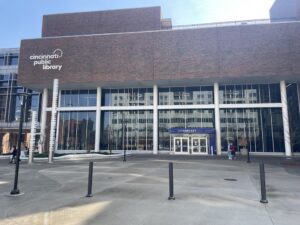
Among the first in America, Cincinnati’s public library dates from March 14, 1853. A public reading room opened in 1856, but funding remained a problem until 1867, when local school board president Rufus King II secured legislation for a renamed Cincinnati Public Library. In 1869, King lured leading librarian William Frederick Poole to organize Cincinnati as a national model for the growing public library movement. Poole designed 19th century America’s most advanced library at 629 Vine Street, which fully opened in 1874. Becoming a countywide system in 1898, the Public Library of Cincinnati and Hamilton County was a pioneer in the 20th century with special services for the blind and for children, bookmobile services, and circulation of audiovisual materials. (continued on other side)
, OH
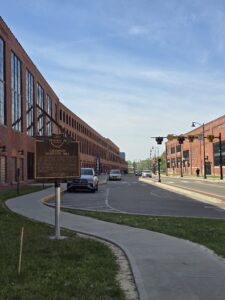
The Champion Coated Paper Company began production April 15, 1894, with less than a dozen employees under the direction of Peter Gibson Thomson (December 16, 1851-July 10, 1931). A Cincinnati businessman, bookseller, and publisher, Thomson recognized that recent changes in half-tone printing would increase the demand for coated paper. In 1893, he acquired the patent rights to a card coating machine, incorporated his new company, and set-aside 45 acres along Seven Mile Pike (now North B Street) to build a plant that would coat paper produced by other mills in the Great Miami Valley. The Champion Hamilton Mill shipped its first coated paper order on May 4, 1894. Within a few years, Thomson had dramatically increased plant capacity and, by 1900, Champion was regarded as the largest coated paper mill in the country.
, OH
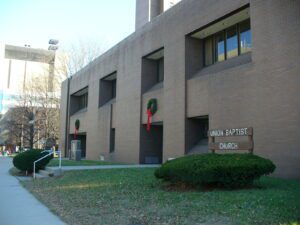
George Washington Williams was born in 1849 in Bedford, Pennsylvania. At age 14, he enlisted in the Union Army to fight in the Civil War and received a medical discharge in 1868. In 1874, he became the first African American to graduate from the Newton Theological Institution in Cambridge, Massachusetts, and shortly after married Sarah. A. Sterrett. He became pastor of the Twelfth Baptist Church in Boston before moving to Washington, D.C. to serve as editor of a newspaper called The Commoner. He then moved to Cincinnati to become pastor of the Union Baptist Church and while there served as the first black member of the Ohio Legislature from 1879-1881. Williams went to the Belgian Congo in 1890 where he criticized King Leopold II in an Open Letter for his inhumane policies in the Congo. He died in 1891 in England.