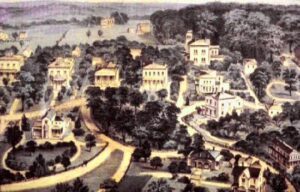
Established in 1851 after the addition of the Cincinnati, Hamilton, and Dayton Railway, Glendale incorporated in 1855 as Ohio’s first planned community and one of the nation’s first planned villages. The original planning included forested greenbelts and parks, curvilinear streets meandering around established trees, large lots, and superior building standards. Glendale is designated as a National Historic Landmark community from the Department of Interior and a Certified Local Government through the Ohio Historic Preservation Office, all owed to Glendale’s persistent adherence to the plan and faithful preservation of original infrastructure. Much of today’s preserved infrastructure includes the original 59 pivotal buildings, curvilinear streets, tree canopy, stone gutters, gas streetlights, and railroad depot.
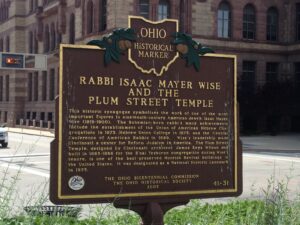
This historic synagogue symbolizes the work of one of the most important figures in nineteenth-century American Jewry, Isaac Mayer Wise (1819-1900). The Bohemian-born rabbi’s many achievements include the establishment of the Union of American Hebrew Congregations in 1873, Hebrew Union College in 1875, and the Central Conference of American Rabbis in 1889. Wise’s leadership made Cincinnati a center for Reform Judaism in America. The Plum Street Temple, designed by Cincinnati architect James Keys Wilson and built in 1865-1866 for the B’nai Yeshurun congregation during Wise’s tenure, is one of the best-preserved Moorish Revival buildings in the United States. It was designated as a National Historic Landmark in 1975.
Approximately 700′ south of Albany Street on S Edwin C Moses Blvd
Dayton
, OH
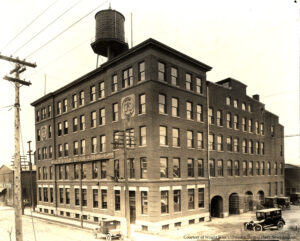
Green & Green Company invented the Cheez-It in the 1920s. John Green and his son Weston founded their company in 1897 to produce a hard cracker recipe created by Dr. William Wolf of Dayton. Originally based in Chicago, the Greens moved production to their hometown two years later, opening a small factory above downtown Dayton’s Victory Theater. In 1907, Green & Green built a new bakery on the corner of Cincinnati and Concord streets in the Edgemont neighborhood. As their “Wolf” or “Dayton” cracker grew in popularity, Green & Green added the flakier line of “Edgemont” Crackers, which included the Cheez-It. In 1921, Weston Green applied for a trademark patent on the name “Cheez-It,” and the popular snack was born. (Continued on other side)
801 E. Pete Rose Way, Bicentennial Commons at Sawyer Point
Cincinnati
, OH
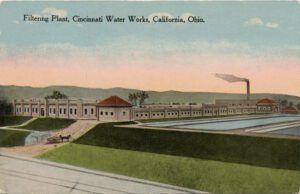
On June 25, 1839, Greater Cincinnati Water Works became the first publicly owned water system in Ohio, when the city purchased a privately owned water company in operation since 1821. This purchase required approval of the voters of Cincinnati and authorization by the Ohio State Legislature. The Water Works, with two steam pumps at this site, three and a half miles of iron pipe, and 19 miles of wooden pipe, provided one million gallons of water per day. Front Street Pumping Station (ruins at this site) replaced earlier facilities and operated from 1865 to1907.
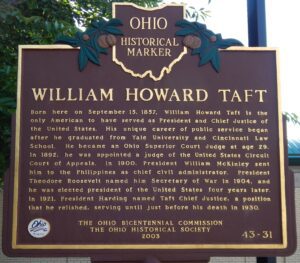
Born here on September 15, 1857, William Howard Taft is the only American to have served as President and Chief Justice of the United States. His unique career of public service began after he graduated from Yale University and Cincinnati Law School. He became an Ohio Superior Court Judge at age 29. In 1892, he was appointed a judge of the United States Circuit Court of Appeals. In 1900, President William McKinley sent him to the Philippines as chief civil administrator. President Theodore Roosevelt named him Secretary of War in 1904, and he was elected president of the United States four years later. In 1921, President Harding named Taft Chief Justice, a position that he relished, serving until just before his death in 1930.
Hebrew Union College (HUC), founded in Cincinnati in 1875, is the oldest institution of higher Jewish learning in the United States. Its founder, Rabbi Isaac Mayer Wise (1819-1900), was a leading proponent of Reform Judaism in America. In 1950, the college merged with the Jewish Institute of Religion (JIR), a liberal Jewish seminary in New York founded by Rabbi Stephen S. Wise (1874-1949) in 1922. A third center opened in Los Angeles in 1954 to serve Jewry on the West Coast and, in 1963, a fourth campus opened in Jerusalem. As of 2003, HUC-JIR educates rabbis, cantors, communal, and educational professionals. It also offers advanced academic training for scholars of all faiths. The holdings of the school’s Klau Library constitute one of the most extensive Jewish libraries in the world.
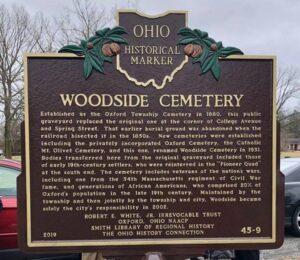
Established as the Oxford Township Cemetery in 1880, this public graveyard replaced the original one at the corner of College Avenue and Spring Street. That earlier burial ground was abandoned when the railroad bisected it in the 1850s. New cemeteries were established including the privately incorporated Oxford Cemetery, the Catholic Mt. Olivet Cemetery, and this one, renamed Woodside Cemetery in 1931. Bodies transferred here from the original graveyard included those of early 19th-century settlers, who were reinterred in the “Pioneer Quad” at the south end. The cemetery includes veterans of the nation’s wars, including one from the 54th Massachusetts regiment of Civil War fame, and generations of African Americans, who comprised 20% of Oxford’s population in the late 19th century. Maintained by the township and then jointly by the township and city, Woodside became solely the city’s responsibility in 2002.
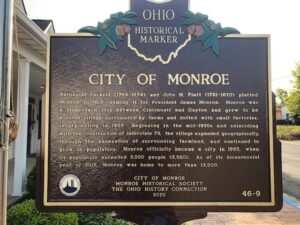
Nathanial Sackett (1768-1854) and John H. Piatt (1781-1820) platted Monroe in 1817, naming it for President James Monroe. Monroe was a stagecoach stop between Cincinnati and Dayton and grew to be a rural village surrounded by farms and dotted with small factories, incorporating in 1907. Beginning in the mid-1950s and coinciding with the construction of Interstate 75, the village expanded geographically, through the annexation of surrounding farmland, and continued to grow in population. Monroe officially became a city in 1995, when its population exceeded 5,000 people (5,380). As of its bicentennial year of 2017, Monroe was home to more than 13,000.