

, OH
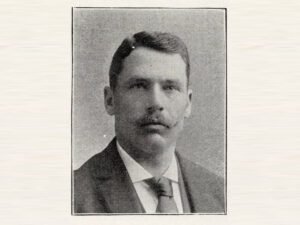
William Ellsworth “Dummy” Hoy was born in Houcktown on May 23, 1862. Although spinal meningitis as a toddler left him deaf and mute, Hoy became one of the great 19th century professional baseball players. He played centerfield for such teams as the Chicago White Stockings, Louisville Colonels, and Cincinnati Reds. In his 1888 Washington Senators season he led the league with 82 stolen bases and is one of the all-time leaders in that art. The defensive star’s record includes: 3,959 outfield putouts; 73 double plays; 2,054 hits; 40 home runs; 597 stolen bases; and, 210 strike-outs. Hoy is a member of the American Athletic Association for the Deaf Hall of Fame, as well as those of the Cincinnati Reds, Ohio Baseball, and Ohio School for the Deaf. He died in Cincinnati at the age of 99.
, OH
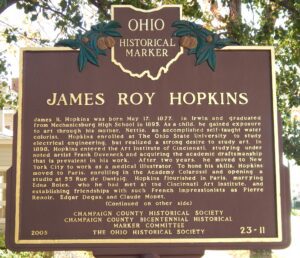
James R. Hopkins was born May 17, 1877, in Irwin and graduated from Mechanicsburg High School in 1895. As a child, he gained exposure to art through his mother, Nettie, an accomplished self-taught water colorist. Hopkins enrolled at The Ohio State University to study electrical engineering, but realized a strong desire to study art. In 1898, Hopkins entered the Art Institute of Cincinnati, studying under noted artist Frank Duveneck and acquiring the academic draftsmanship that is prevalent in his work. After two years, he moved to New York City to work as a medical illustrator. To hone his skills, Hopkins moved to Paris, enrolling in the Academy Colarossi and opening a studio at 55 Rue de Dantzig. Hopkins flourished in Paris, marrying Edna Boies, who he had met at the Cincinnati Art Institute, and establishing friendships with such French Impressionists as Pierre Renoir, Edgar Degas, and Claude Monet. [continued on other side]
, OH
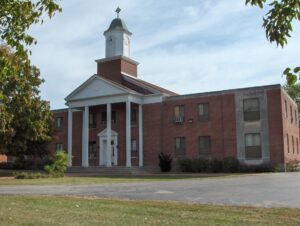
Payne Theological Seminary was originally established as Union Seminary in West Jefferson, Ohio, by the Ohio Conference of the African Methodist Church (AME) on October 18, 1844. The Cincinnati Conference of the Methodist Episcopal Church North met to establish a school for people of African descent, and in 1856, purchased Tawawa Springs, a defunct health resort, to open Wilberforce University, named for the early nineteenth century British abolitionist, William Wilberforce. In 1862 the institution closed due to low enrollment and dwindling funds. AME Bishop Daniel Alexander Payne purchased the school for $10,000, and the school was reopened in 1863 by closing the Union Seminary and merging the assets. In 1895, the department of theology separated from Wilberforce University and became Payne Theological Seminary, named in honor of Bishop Payne. Payne is the oldest, free standing African American Seminary in the United States.
, OH
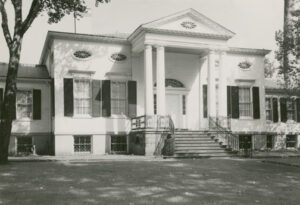
This Federal house was begun about 1820 for Martin Baum (1765-1831), one of Cincinnati’s early merchants. Art patron and abolitionist Nicholas Longworth (1782-1863) lived here for more than thirty years and commissioned the notable landscape murals in the foyer painted by African-American artist Robert S. Duncanson (1821-1872). Iron magnate David Sinton (1808-1900), the subsequent owner, bequeathed the house to his daughter Anna Sinton Taft (1852?-1931). She and her husband Charles Phelps Taft (1843-1929), older half-brother of William Howard Taft (1857-1930), who accepted his party’s nomination for president from the portico in 1908, assembled the acclaimed art collection displayed here. Bequeathed to the people of Cincinnati in 1927, the Taft Museum of Art opened to the public in 1932. It was designated a National Historic Landmark in 1973.
, OH
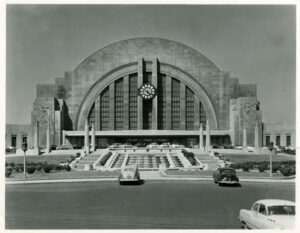
The Cincinnati Union Terminal opened in March 1933 and integrated rail travel in the city, which previously operated from five separate passenger terminals. Built when rail travel was already in decline, Union Terminal stopped operating as a passenger railroad station in 1972. Only during WWII was the terminal used to capacity with as many as 34,000 people travelling through the building daily in 1944. As part of preservation efforts, 14 mosaics depicting Cincinnati industry of the 1930s by Winold Reiss were saved from the concourse and moved to the Greater Cincinnati Airport. The restored Union Terminal became a Museum Center in November 1990 with the opening of the renovated Cincinnati Museum of Natural History and new Cincinnati History Museum. Cincinnati Union Terminal has been described as one of the most outstanding examples of Art Deco train stations in the nation and was listed on National Register of Historic Places in 1972.
, OH
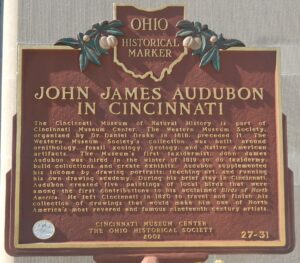
The Cincinnati Museum of Natural History is part of Cincinnati Museum Center. The Western Museum Society, organized by Dr. Daniel Drake in 1818, preceded it. The Western Museum Society’s collection was built around ornithology, fossil zoology, geology, and Native American artifacts. The Museum’s first taxidermist, John James Audubon was hired in the winter of 1819 to do taxidermy, build collections, and create exhibits. Audubon supplemented his income by drawing portraits, teaching art, and running his own drawing academy. During his brief stay in Cincinnati, Audubon created five paintings of local birds that were among the first contributions to his acclaimed Birds of North America. He left Cincinnati in 1820 to travel and finish his collection of drawings that would make him one of North America’s most revered and famous nineteenth century artists.
, OH
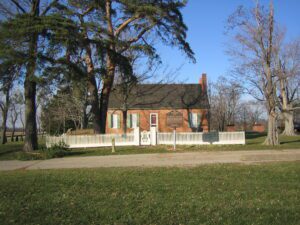
As Oxford Township was developing in the mid-1800s, a cluster of farmsteads near its northern border developed and was designated the “Doty Settlement.” As was the custom, the community took its name from a prominent family in the area. In or near the settlement were a church and cemetery, a school, a blacksmith shop, a sawmill, a distillery, a furniture shop, and a fulling mill for cleansing, shrinking, and thickening cloth. With the frontier spirit of self-reliance, it was seldom necessary to travel several miles into Oxford village for additional goods or services. Working together, the community farmed local fields and bartered for other items. Men, women, and children worked long, hard hours in the fields harvesting corn and wheat. It is evident that these families, living in an agricultural society, possessed many useful skills for surviving in the Ohio country.
, OH
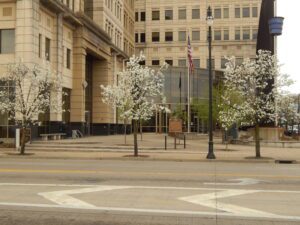
Abraham Lincoln spoke from the rear of a Cincinnati, Hamilton & Dayton Railroad passenger train on Saturday, September 17, 1859, to about 1000 people at South Fourth and Ludlow streets (about 785 feet south of here). Lincoln, elected president of the United States a year later, made five Ohio speeches, considered an extension of his 1858 debates with Stephen A. Douglas while they competed for a U.S. Senate seat from Illinois. After Douglas defeated Lincoln, he toured Ohio supporting 1859 Democratic candidates. The Republican response was to ask Lincoln to do the same for his party. He spoke twice in Columbus on September 16, and in Dayton, Hamilton, and Cincinnati the next day. Later, Republicans swept the 1859 elections, selecting William Dennison Jr., an 1835 Miami University graduate, as governor and winning majorities in the legislature. When Lincoln became president, he appointed Dennison postmaster general in 1864. [Continued on other side]