

, OH
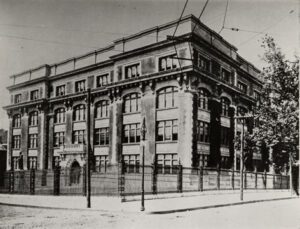
William and Abigail Cutter Woodward founded Woodward High School, the first public high school west of the Allegheny Mountains, on this site October 24, 1831. Concerned that the poor of Cincinnati had no avenues for education, the Woodwards donated land, time, funding, and expertise to this venture that brought the arts and sciences to “those who have not the means of procuring such advantages themselves.” Notables include Dr. Joseph Ray, principal, 1851-1855, author of several popular mathematics texts; Professor William McGuffey, author of the well-known readers and spellers; and William Howard Taft, Class of 1874, former U.S. President. From 1856-1863, the home of Levi and Catherine Coffin was also located on this site. Both were legendary abolitionishts who helped enslaved people escape to freedom in Canada. Levi is often referred to as the “President of the Underground Railroad.”
, OH
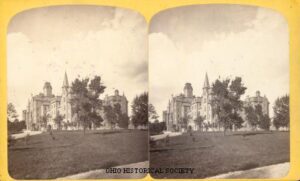
In 1835, Dr. William Awl of Columbus and Dr. Daniel Drake of Cincinnati presented recommendations to the Ohio General Assembly to establish a school for the blind. Legislation, signed by then governor of Ohio Duncan McArthur on April 3, 1837, provided funding to create the first state-supported residential school for the blind in the United States. The Institution for the Education of the Blind opened July 4, 1837, with five students. A year later, the first permanent structure, housing 60 students, was built on a nine-acre tract of land on the eastern edge of the city, and that was followed in 1874 with a larger facility near Fulton and Main streets. The school was honored and recognized in 1937 as being one of the finest schools for the blind in the country. In 1953, a new school for the blind was built at its present location at 5220 North High Street.
, OH
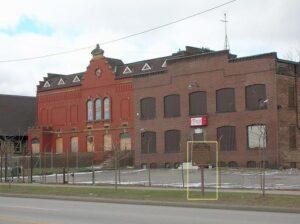
Garrett Augustus Morgan was an African American businessman and prolific inventor of devices that made people’s lives safer and more convenient. Born on March 4, 1877 in Claysville, the Black segregated section of Paris, Kentucky, Morgan migrated north first to Cincinnati and then Cleveland in 1895. He lived and worked in this house at 5204 Harlem Avenue. In 1906, Morgan started the G.A. Morgan Hair Refining Company to market the hair straightener he had invented. The following year he opened a sewing machine repair shop. In 1908, he and his wife Mary opened Morgan’s Cut Rate Ladies Clothing Store. (continued on other side)
, OH
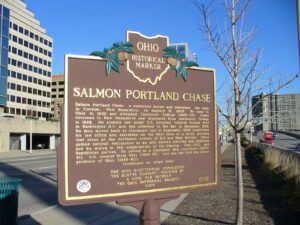
Salmon Portland Chase, a renowned lawyer and statesman, was born in Cornish, New Hampshire, on January 13, 1808. He came to Ohio in 1820 and attended Cincinnati College (1822-23). Chase returned to New Hampshire and graduated from Dartmouth College in 1826. He studied law under U.S. Attorney General William Wirt in Washington D.C. and was admitted to the bar in December 1829. He then moved back to Cincinnati and in September 1830 established his law office and residence on the first floor of a brick building that stood at the northeast corner of 3rd and Main Streets. Chase gained national recognition as an anti-slavery attorney and politician and by aiding in the organization of the Liberty, Free-Soil, and Republican parties. He served as a Cincinnati city councilman (1840-41), U.S. senator from Ohio (1849-55), and was the first Republican governor of Ohio (1856-60). (continued on other side)
, OH
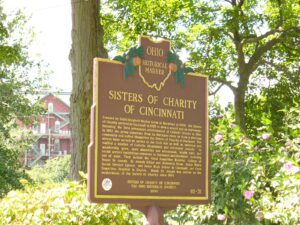
Founded by Saint Elizabeth Bayley Seton in Maryland in 1809, the Sisters of Charity arrived in Cincinnati in 1829 to open a school and an orphanage, becoming the first permanent establishment of Catholic sisters in Ohio. In 1852 the group separated from its Maryland roots to form a diocesan community and called themselves the Sisters of Charity of Cincinnati. The sisters later served as nurses in the Civil War as well as operated and staffed a number of Catholic elementary and secondary schools. As membership grew, their ministries and educational, health care, and social service institutions expanded in Cincinnati and elsewhere, including out of state. They include the Good Samaritan Hospital, College of Mount St. Joseph, St. Joseph Infant and Maternity Home, Santa Maria Social Service Agency, and Seton High School in Cincinnati and Good Samaritan Hospital in Dayton. Mount St. Joseph has served as the motherhouse of the Sisters of Charity since 1884.
, OH
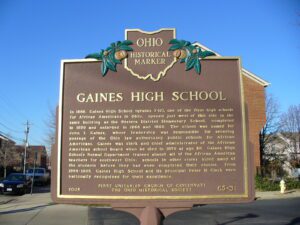
In 1866, Gaines High School (grades 7-12), one of the first high schools for African Americans in Ohio, opened just west of this site in the same building as the Western District Elementary School, completed in 1859 and enlarged in 1866 and 1868. The school was named for John I. Gaines, whose leadership was responsible for securing passage of the Ohio law authorizing public schools for African Americans. Gaines was clerk and chief administrator of the African American school board when he died in 1859 at age 38. Gaines High School’s Normal Department trained almost all of the African American teachers for southwest Ohio; schools in other states hired many of the students before they had even completed their studies. From 1866-1886, Gaines High School and its principal Peter H. Clark were nationally recognized for their excellence.
, OH
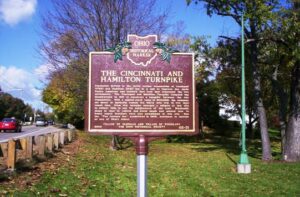
Population growth in the newly settled communities of Cincinnati (1788) and Hamilton (1791) led to a call to improve the early Native American and military foot trail that connected the two settlements. The Cincinnati and Hamilton Turnpike Company was incorporated in 1817 to construct a turnpike between the two communities. With a capital-stock value of $100,000, the company set about to markedly reduce the thirty mile trip to two days travel time. From this turnpike emerged a tollgate at this site to collect tolls to pay for maintenance of the road. Blacksmith shops to tend to vehicle and horse needs and several inns to house weary travelers were also established at this site. One inn, “The Century Inn,” established in 1806, continues to operate as one of Ohio’s oldest.
, OH
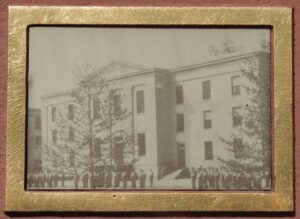
The first in a succession of schools that eventually gave College Hill its name was CARY’S ACADEMY FOR BOYS. Freeman Cary opened this school in his home on Hamilton Avenue in 1832. Success necessitated larger quarters and in 1833 PLEASANT HILL ACADEMY was built at the corner of Hamilton and Colerain (now Belmont) Avenues. Continuing growth and a distinguished faculty led to formation of a college. Money was raised by selling shares, mostly bought by local farmers. FARMERS COLLEGE OF HAMILTON COUNTY was chartered on February 23, 1846 and Cary Hall was built on this Belmont Avenue site in 1847. Future President of the United States, Benjamin Harrison, attended the college from 1848 to 1850. During the 1860s Cary Hall served as a station on the Underground Railroad. (Continued on other side)