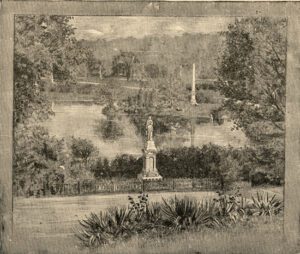
Spring Grove received its charter by an act of the Ohio Legislature in January 1845. Motivated by crowded conditions of small cemeteries created by the cholera epidemics of the 1830s and 1840s, the Cincinnati Horticultural Society formed a cemetery association in 1844 to find a location for a rural cemetery. Under the guidance of Robert Buchanan, local attorney Salmon P. Chase drafted the charter that was granted, and Spring Grove, consisting of 166 acres designed with a natural setting embellished with shrubbery, flowers, trees, and walks, was dedicated on August 28, 1845. A leader in cemetery design and the landscape “lawn plan” concept, Spring Grove officially changed its name to Spring Grove Cemetery & Arboretum in 1987.
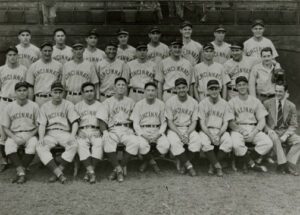
The 1869 Cincinnati Red Stockings made history not only as the most dominant baseball club of its time, but also as the first band of professional ballplayers. Cincinnati’s decision to pay players proved to be a success, and other cities soon began establishing their own professional clubs throughout America. In 1876, the Reds joined the newly formed National League. Baseball soon became one of Cincinnati’s most popular entertainment venues, aided in part by the team’s World Series titles in 1919 and 1940. Cincinnati’s “Big Red Machine,” featuring players such as Johnny Bench, Joe Morgan, and Pete Rose, dominated baseball in the 1970s, picking up additional titles in 1975 and 1976. A surprise wire-to-wire title again in 1990 strengthened the Reds’ legacy and helped ensure future generations of Reds fans.
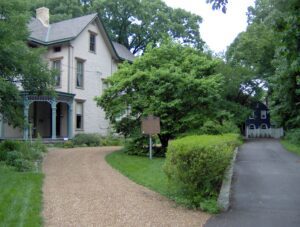
Dr. Winthrop Smith Sterling (1859-1943) founded Mu Phi Epsilon International Professional Music Fraternity on November 13, 1903, at the Metropolitan School of Music in Cincinnati, where he served as dean. The Victorian frame house was built by his parents, Samuel Gano and Eliza Smith Sterling in 1867, and was home to Sterling family members until the early 1940s. A highly respected organist and university teacher, Dr. Sterling taught piano and organ in this home in which he had installed a 12-foot hydraulic pump organ in the “music room.”
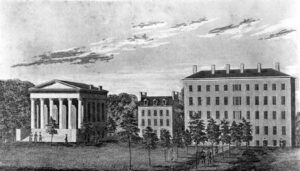
The Lanes, Baptist merchants from New Orleans, and the Kempers, a Presbyterian family from Cincinnati, gave money and land respectively for Cincinnati’s first manual labor theological seminary and high school, which opened in suburban Walnut Hills in 1829. The Reverend Lyman Beecher came from Boston as its first president. The president’s house, now known as the Stowe House after Beecher’s daughter Harriet Beecher Stowe, author of Uncle Tom’s Cabin, still remains at Gilbert and Foraker. Lane Theological Seminary, bound by present day Gilbert, Chapel, Park, and Yale streets, continued to educate Presbyterian ministers until 1932, when it was merged with McCormick Theological Seminary in Chicago.
Mary Harlan Doherty was born in 1862 in the Dayton Street neighborhood of Cincinnati. She graduated from Woodward High School in 1880 at a time when women were not expected to go to college, but rather to marry, raise children, and take care of household duties. Miss Doherty, as she was known, saw the world differently. She felt strongly that women should not only possess solid social skills, but also be prepared for college. She graduated from Cornell University in 1899. In 1906 she established the College Preparatory School for Girls in the former home of Superior Court Judge and Ohio Governor George Hoadley, with a class of 125 students. Enrollment doubled by 1920, with Miss Doherty guiding her students under the school’s motto, Ad Summum, meaning “To the Highest Point,” or, as she viewed it, to strive for excellence, hard work, and service.
801 E. Pete Rose Way, Bicentennial Commons at Sawyer Point
Cincinnati
, OH
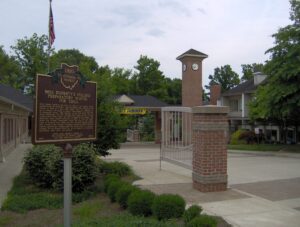
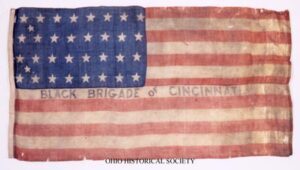
Following the success of Confederate forces in eastern Kentucky and General John Hunt Morgan’s raids there in 1862, Cincinnatians believed that Southern invasion was imminent. Anxious officials ordered Cincinnati citizens to form home guards, but black men willing to volunteer were rebuffed when they attempted to join a defense force. Instead, police serving as provost guards rounded up many and marched them by bayonet to build fortifications in Kentucky. Reacting to the shameful treatment of the blacks eager to support the Union, the commander of the Department of Ohio dispatched Major General Lewis Wallace to command the civilians and to liberate black men forced into service. (continued on other side)
John Malvin (1795-1880) was an operative on the Underground Railroad and an ardent member of anti-slavery and abolitionist causes. Born in Dumfries, Virginia of a free mother and enslaved father, Malvin was apprenticed at an early age to learn carpentry and taught himself to read and write. In 1827, he moved to Cincinnati where he became an ordained preacher and an activist in the cause of freedom. In 1831, with his wife Harriet, he moved to Cleveland where he became a charter member of the First Baptist Church, a sawmill operator, and captain and owner of the canal boat Auburn. (continued on other side)
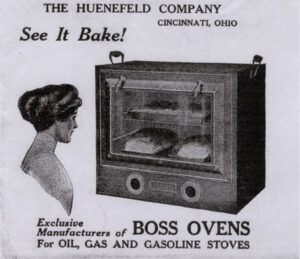
The first full-size glass door oven was invented and manufactured here by Ernst H. Huenefeld of The Huenefeld Company in 1909. Specially designed and patented sheet metal frames in the door allowed for expansion and contraction of the glass. The large window, guaranteed against steaming up or breaking from heat, allowed users to view their baking without opening the oven door. Huenefeld had acquired this property in 1903 for a new factory. The Huenefeld Company, established in 1872 on Pearl Street, moved its manufacturing here in 1904 from its downtown Cincinnati locations. The company, in operation until its sale in 1966, was widely known as a manufacturer of ranges, stoves, ovens, heaters, furnaces, refrigerators, washing machines, and other household products. A standard feature in homes today, the glass door oven was a technological breakthrough in 1909.