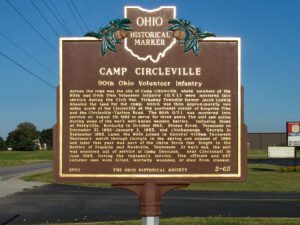
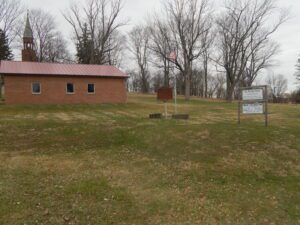
Across the road was the site of Camp Circleville, where members of the 90th and 114th Ohio Volunteer Infantry (O.V.I.) were mustered into service during the Civil War. Pickaway Township farmer Jacob Ludwig donated the land for the camp, which was then approximately two miles south of the Circleville at the southwest corner of Kingston Pike and the Circleville-Tarlton Road. The 90th O.V.I was mustered into service on August 29, 1862 to serve for three years. The unit saw action during some of the war’s well-known western battles, including those at Perryville, Kentucky in October 1862; Stones River, Tennesee on December 31, 1862-January 2, 1863, and Chickamauga, Georgia in September 1863. Later, the 90th joined in General William Tecumseh Sherman’s march through Georgia in the spring and summer of 1864 and later that year was part of the Union force that fought in the Battles of Franklin and Nashville, Tennesee. At war’s end, the unit was mustered out of service at Camp Dennison, near Cincinnati in June 1865. During the regiment’s service, five officers and 247 enlisted men were killed, mortally wounded, or died from disease.
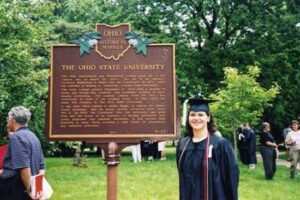
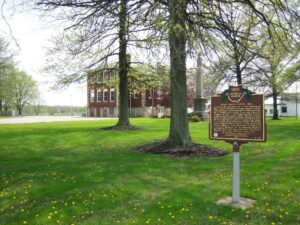
The Ohio Agricultural and Mechanical College grew out of the Cannon Act of March 22, 1870. “But let it be started,” Governor Rutherford B. Hayes told the Legislature in 1873, “with the intention of making it a great State University.” The little college opened September 17, 1873 with a faculty of seven and twenty-four students. One academic building at first housed everything. The campus, remote from the city, was surrounded by some of the original forest. In May, 1878 the name was changed to The Ohio State University. It was after 1900 before it really began to realize its educational potential, and its major growth occurred after World War II. By 1970, the Centennial Year, the university had more then met the hopes of its founders. A leading university with great manpower and physical resources, it had earned high standing in many fields covering a wide range of educational and research activities.
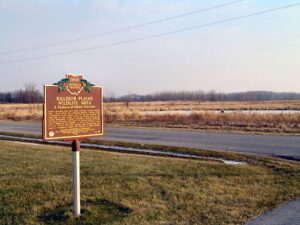
Prairie grasslands were once widely scattered across western Ohio. One of Ohio’s best remaining prairies, Killdeer Plains is dominated by tall grasses such as the big bluestem and plays host to some unique species of wildlife such as the eastern massasauga or swamp rattlesnake. Prairie grasslands are one of the most rare types of wildlife habitats in the state. Named for the killdeer, a shore bird, this is part of a wet prairie that once spanned some 30,000 acres and boasts a tremendous number and diversity of native wildlife.
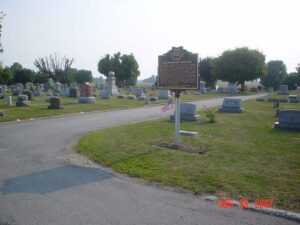
The Bloomingburg Presbyterian Church and cemetery were established in the northwest corner of the current cemetery grounds on March 7, 1818. Several years later it became a center for anti-slavery activity. The Reverend William Dickey, who presided over the church and other members, devoted their lives to the anti-slavery cause not only in voice but also in abolitionist activity. By the mid-1800s, their work, as well as the fact that Bloomingburg had become home to a vibrant African American community, led to the town becoming the area center for the Underground Railroad, which helped transport many fugitive slaves to freedom in the north. Six soldiers from the American Revolutionary War, nineteen from the War of 1812, and over 100 from the Civil War and Spanish-American War are buried in the Bloomingburg Cemetery, including Henry Casey, who was awarded the Congressional Medal of Honor for his valor at Vicksburg.
About a mile south in St. Paul’s Cemetery, the Reverend Father Edward J. Fenwick, “Pioneer Apostle of Ohio,” organized the first Catholic parish in northern Ohio. The first mass was celebrated in the log house of Daniel McCallister. A century and a half later the cabin was dismantled, moved here, rebuilt, and rededicated in May, 1967 as the Log Cabin Shrine of Dungannon.
Myron T. Herrick, Governor of Ohio from 1904 to 1906, was born in Huntington Township in 1854 and lived here until age 12. A respected Cleveland attorney and businessman, Herrick was a friend and confidant to Senator Mark Hanna and Presidents McKinley, Taft, and Harding. His public service career culminated in two appointments as ambassador to France, from 1912 through the outbreak of World War I in 1914, and again from 1921 until his death in 1929. Enormously popular with the French people, Herrick escorted Charles Lindbergh in Paris after his historic 1927 transatlantic flight.
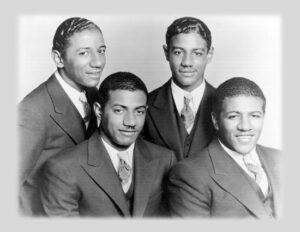
Born in Piqua, Ohio, the Mills Brothers grew up and attended school in Bellefontaine. The brothers — John, Jr., Herbert, Harry, and Donald Mills — were the first African-American vocal group to perform on a national radio broadcast and achieve commercial success. Enjoying worldwide fame throughout their career, the Mills Brothers popularized such hits as “Tiger Rag,” “Paper Doll,” and “You Always Hurt the One You Love.” After the death of John, Jr. in 1936, the remaining brothers were joined by their father, John, Sr. In all, the Mills Brothers recorded over 1,200 songs.
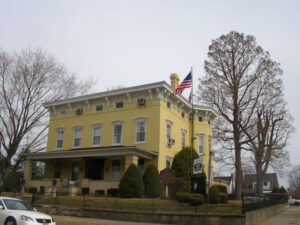
John Campbell (1818-1891), founder of Ironton, was an ironmaster and president of the Ohio Iron & Coal Company, a Presbyterian, and an abolitionist. This house and barn, which he built in 1850, became a stop on the Underground Railroad for slaves crossing the Ohio River from Kentucky. Fugitives were concealed here and furnace wagons transported the escapees northward by way of Campbell’s furnaces in Lawrence and Jackson counties.