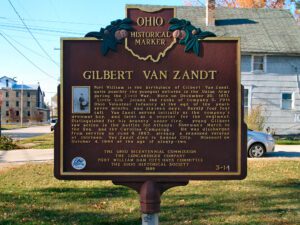
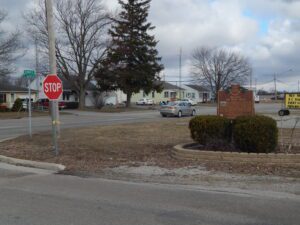
Port William is the birthplace of Gilbert Van Zandt, quite possibly the youngest enlistee in the Union Army during the Civil War. Born on December 20, 1851, “Little Gib” joined the ranks of Company D, 79th Ohio Volunteer Infantry at the age of ten years, seven months, and sixteen days. Barely four feet tall, Van Zandt served initially as the company’s drummer boy, and later as a courier for the regiment. Distinguished for his bravery under fire, young Gilbert saw action in the battles for Atlanta, Sherman’s March to the Sea, and the Carolina Campaign. He was discharged from service on June 9, 1865, already a seasoned veteran at thirteen. Van Zandt died in Kansas City, Missouri on October 4, 1944 at the age of ninety-two.
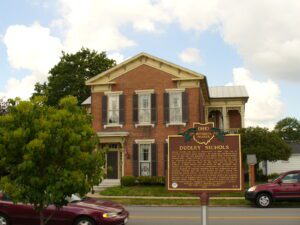
Dudley Nichols was born in Wapakoneta in 1895, the son of Dr. Grant and Mary Mean Nichols. He spent his childhood in a home on this site and graduated from Blume High School before leaving Ohio. After working as a journalist in New York City, he relocated to Hollywood to become a screenwriter for such films as Stagecoach, For Whom the Bell Tolls, and The Bells of St. Marys. In 1936 Nichols won an Oscar in the category Best Adapted Screenplay. He refused recognition for his work on The Informer because of strained relations with the Hollywood establishment. Nichols was the first person to ever refuse the prestigious award saying, “As one of the founders of the Screen Writers’ Guild, which was conceived in revolt against the Academy, and born out of disappointment with the way it functioned against employed talent-I deeply regret I am unable to accept the award.”
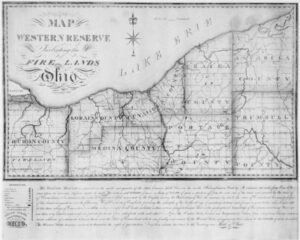
On July 4, 1796, Moses Cleaveland and his survey party landed at the mouth of Conneaut Creek on the southern shore of Lake Erie in what is today Conneaut, Ohio. The Connecticut Land Company, a private land speculation enterprise, had hired General Cleaveland as its agent to survey the Connecticut Western Reserve lands and to found a settlement along the Cuyahoga River, later named Cleveland. Group members pitched tents and erected a crude shelter to protect the provisions and survey equipment before celebrating the independence of the new country with toasts and salutes. The next day they organized into field groups to begin the historic survey of measuring the townships and ranges of the Western Reserve.
Conceived by leaders of the automobile industry to encourage the building of “good roads,” the Lincoln Highway was established in 1913 as the first transcontinental automobile route in the United States. It traversed twelve states and 3,389 miles from New York to San Francisco. The first route across Ohio connected Van Wert, Delphos, Lima, Ada, Upper Sandusky, Bucyrus, Galion, Mansfield, Ashland, Wooster, Massillon, Canton, Minerva, Lisbon, and East Liverpool. By the 1930s much of the original route had become part of the Federal Highway System and U.S. Route 30–many miles of which have, in turn, been bypassed by modern four-lane highways.
Here, on September 6, 1918, Bryan’s Air Mail Field began operations as one of Ohio’s first official airfields with the arrival of a survey flight to establish air mail service between New York and Chicago. Scheduled service began on July 1, 1919, and stretched west to San Francisco on September 8, 1920, completing the 2,666 mile U.S transcontinental air mail route. Flying the Curtiss JN-4H “Jenny,” R-4, Standard JR-1B, and later, the De Havilland DH-4, aviators pioneered cross continental flight in open cockpit biplanes without radios or electronic navigational aids and reduced coast to coast mail delivery from 87 hours by rail to 33 hours by air.
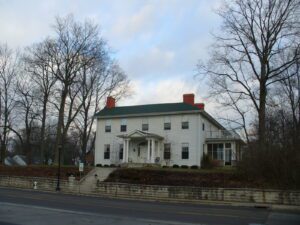
One of the most effective political orators of his era, Tom Corwin (nicknamed “the Wagon Boy” for his War of 1812 service) resided here from 1839 until his death. A Whig stump speaker known for his wit and eloquence, he was elected governor of Ohio in 1840 and campaigned for William Henry Harrison in his presidential victory that year. Corwin served six terms in Congress and one in the Senate, where he spoke out against the Mexican War in 1847. He also served as secretary of the treasury in the Fillmore administration and as President Lincoln’s minister to Mexico. Built and first occupied by Corwin’s brother-in-law Phineas Ross in 1818, the Corwin House is representative of Federal-style architecture of this period.
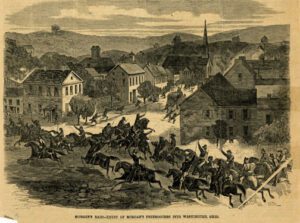
During the summer of 1863, General John Hunt Morgan, a Confederate cavalry leader from Kentucky, invaded southern Ohio with 2,460 mounted men. Throughout the campaign Morgan’s men plundered and looted before being captured by Union forces. On July 17, Morgan led his troops into Wilkesville stealing horses, sacking stores, and robbing private citizens. That night Morgan and some of his troops took lodging and meals with his first cousin Ruth Virginia Althar Cline and her husband Dr. William Cline. Morgan’s troops camped near the house of John and Elzia Levis where Elzia cooked for the men for fear they would harm her family. Additional soldiers of the raiding party stayed on the village square. Legend has it that while Morgan slept at the Cline Mansion, his black servant stole his looted money, and abolitionists Dr. Cline and Abraham Morris, helped him escape to freedom on the Underground Railroad.
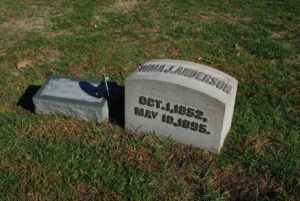
Named for Major General James B. McPherson, buried here July 29, 1864. Here also are graves of George Burton Meek, U.S.N., first American serviceman killed in the War with Spain; Congressional Medal of Honor recipients Charles H. McCleary, Civil War, and Rodger W. Young, World War II; Emma Anderson, mother of author Sherwood Anderson.