

, OH
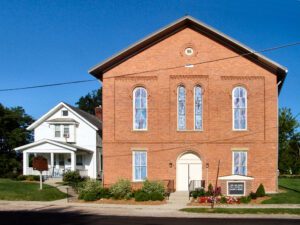
Organized in 1845, Zion African Methodist Episcopal Church is the oldest congregation of African descent in Delaware, with Reverend Daniel Winslow serving as the first minister. In 1853 the cornerstone of the first church was laid, which was dedicated in 1855. Three former Pastors of Zion became Bishops in the AME Church–James A. Shorter, 1868; John Mifflin Brown, 1868; and Cornelius T. Shaffer, 1900. In 1876 the existing church was razed and carpenter, brick mason, and plaster church members built the present edifice. A fire destroyed the interior on December 19, 1983, and for two years the congregation met in the recreation building of the Londontown Apartments, undercroft of the William Street Methodist Church, and sanctuary of the Victory Seventh Day Adventist Church. On the first Sunday in October 1985, Presiding Elder Virgil Cummins, Pastor Rodney Thomas, and the congregation marched from the Adventist Church back into the restored sanctuary.
, OH
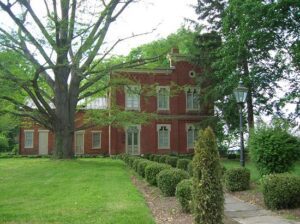
This classic Gothic Revival home built in the early 1850s, was one of Ohio’s early wineries with terraced hillside vineyards overlooking the city of Chillicothe. From 1919 until his death in 1966, it served as the home and working studio of noted American craftsman, artist, and historian Dard Hunter. A major artistic contributor to the Arts and Crafts Movement of the early twentieth century, Hunter gained international recognition when in 1916 he became the first individual in the history of printing to produce all aspects of a book by hand. Eight of the twenty books he wrote on the history of paper were printed at this site. Hunter is regarded as the world’s leading authority on the history of paper and his artistic achievements have had an enduring impact on American Graphic Arts.
, OH
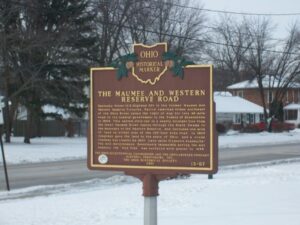
Sandusky Street (U.S. Highway 20) is the former Maumee and Western Reserve Turnpike. Native American tribes northwest of the Ohio River ceded the right of way for this 46-mile road to the federal government in the Treaty of Brownstown in 1808. This narrow strip ran in a nearly straight line from the lower Maumee River rapids through the Black Swamp to the boundary of the Western Reserve, and included one mile of land on either side of the 120-foot wide road. In 1823 Congress gave the land to the state of Ohio, and a crude roadway was cleared by 1827. Land sales financed roadbuilding and maintenance. Notoriously impassible during the wet seasons, the “Mud Pike” was surfaced with gravel in 1838.
, OH
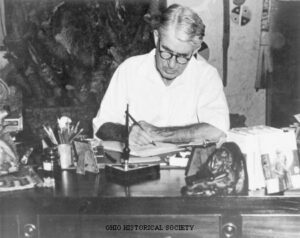
Born Pearl Zane Grey in 1872 at this site and raised in Zanesville, author Zane Grey established the western novel as a twentieth century American literary genre. Trained as a dentist and practicing in New York City, Grey began writing full time following his marriage in 1905 to Lina Elise “Dolly” Roth, who served as his editor and agent. Grey’s novels featured rich western imagery and highly romanticized plots with often pointed moral overtones, inspiring scores of imitators. Of his more than 60 books, Riders of the Purple Sage (1912) is his best know work. Many of Grey’s novels were made into movies in 1920s and ’30s. In addition, Grey was the holder of ten world records for large game fishing, an avocation he pursued when not writing. He died in 1939 at his home in Altadena, California.
, OH
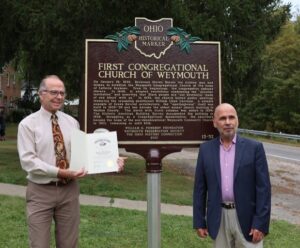
On January 19, 1835, Reverend Steven Barnes led sixteen men and women to establish the Weymouth Congregational Church at the home of Lathrop Seymour. From its beginnings, the congregation opposed slavery. In 1848, it adopted resolutions condemning the “peculiar institution” and asserting that Black people are “our brother[s] ‘made one blood’ with us.” In 1853, the church hosted public meetings featuring the crusading abolitionist William Lloyd Garrison. A notable example of Greek Revival architecture, the “meetinghouse” itself was built in 1835-’36 and has become the oldest extant church building in Medina County. The porch with Doric columns was added in 1854. The Historical American Building Survey documented the building in 1936. Struggling as a Congregational denomination, the sactuary became the home of the non-denominational Weymouth Community Church in 1920, remaining so until 2018.
, OH
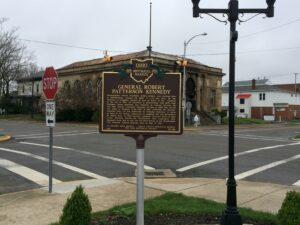
Distinguished citizen, legislator, public servant, and historian born in Bellefontaine, January 23, 1840. A Civil War hero, he was promoted to brigadier general at only 25 years of age. Admitted to the bar in 1866, he practiced in Bellefontaine until 1878 when President Hayes appointed him Collector of Internal Revenue. He was then elected Lieutenant Governor of Ohio in 1885 then served two terms in Congress from 1887 to 1891. Following the Spanish-American War, he was appointed by President McKinley to serve as head of the Insular Commission to establish the new government of Puerto Rico. In 1903 Kennedy published Historical Review of Logan County. Kennedy started the Bellefontaine Tree Commission. Gen. Kennedy’s home was on this site and later served as the Bellefontaine City Building. General Kennedy died on May 6, 1918.
, OH
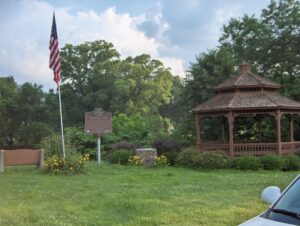
First surveyed in 1849, Powhatan Point was laid out by Franklin Knox. The “point” is the confluence of Captina Creek and the Ohio River. The small but thriving river and farming community served York Township and the rich Captina Valley as a shipping center for its first 75 years. Given impetus by the construction of the Powhatan Enterprise Flouring Mill and Woolen Factory in 1850, local businesses shipped grain, fruit, lumber, cheese, whiskey, livestock, wool, and tobacco to northern and southern ports. There were three boat landings: Boger’s, Hornbrook’s and Dorsey’s, each equipped with an incline car track from the warehouses to the river’s edge. With the opening of North American Coal Corporation’s Powhatan No. 1 Mine in 1922, the village became a mining community that continued to rely on the river. A disastrous mine fire took the lives of 66 men on July 5, 1944.
, OH
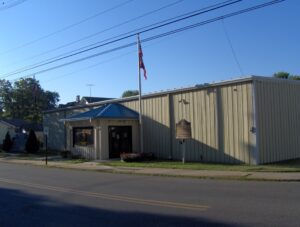
General James V. Hartinger, 1925-2000, was born in Middleport, Ohio, and graduated from Middleport High School in 1943. He graduated from the United States Military Academy at West Point in 1949 and was a career-long fighter pilot with the United States Air Force, flying every type of fighter craft the Air Force procured during his 35 years of active duty. He saw military action during World War II, the Korean War, and the Vietnam War. Named commander-in-chief of the North American Aerospace Defense Command (NORAD) in Colorado Springs in 1979, he was promoted to four stars and became the “founding father” of Air Force Space Command. The headquarters building of Air Force Space Command is named the James V. Hartinger Building in his honor and the Hartinger Medal is awarded annually for extraordinary achievement in space.