

, OH
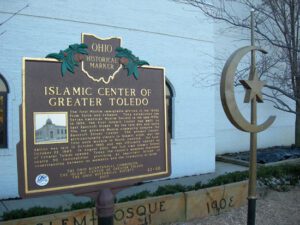
The first Muslim immigrants arrived in the 1900s from Syria and Lebanon. They established the Syrian American Muslim Society in the late 1930s. In 1954, the first Islamic Center was built on East Bancroft Street. By the late 60s and early 70s, the growing Muslim community outgrew the Bancroft Street Center. The present Center, architecturally classic in Islamic style, was the first such mosque in North America. Its foundation was laid in October 1980 and was officially opened on October 22, 1983. In August 2001, the full time Islamic School of Greater Toledo opened. Today, the Center’s members represent nearly 30 nationalities, providing an important bridge of understanding between its members and the community at large.
, OH
In April 1784, the Continental Congress adopted the Report of Government for the Western Territory, a broad plan drafted primarily by Thomas Jefferson for organizing the United States’ new western lands that were ceded by the states and purchased from Native Americans. One of the most far-reaching legislative acts in American history, the resulting Land Ordinance of 1785, passed on May 20th, established the public land system by which all federal land was surveyed and distributed. The Ordinance established a rectilinear survey system that divided land into townships of six miles square aligned by north-south and east-west baselines, and set aside certain lands for Revolutionary War veterans and for public schools.
, OH
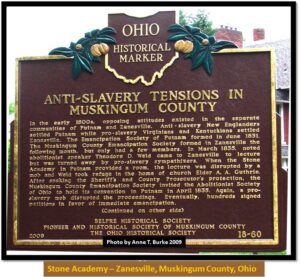
In the early 1800s, opposing attitudes existed in the separate communities of Putnam and Zanesville. Anti-slavery New Englanders settled Putnam while pro-slavery Virginians and Kentuckians settled Zanesville. The Emancipation Society of Putnam formed in June 1831. The Muskingum County Emancipation Society formed in Zanesville the following month, but only had a few members. In March 1835, noted abolitionist speaker Theodore D. Weld came to Zanesville to lecture but was turned away by pro-slavery sympathizers. When the Stone Academy in Putnam provided a room, the lecture was disrupted by a mob and Weld took refuge in the home of church Elder A.A. Guthrie. After seeking the Sheriff’s and County Prosecutor’s protection, the Muskingum County Emancipation Society invited the Abolitionist Society of Ohio to hold its convention in Putnam in April 1835. Again, a pro-slavery mob disrupted the proceedings. Eventually, hundreds signed petitions in favor of immediate emancipation. [continued on other side]
, OH
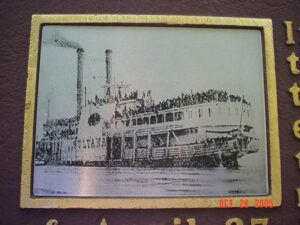
In 1862, less than a mile upriver from this marker, the John Lithoberry Shipyard in Cincinnati constructed the Sultana, a 260-foot, wooden steam transport. At the end of the Civil War, the U.S. Government contracted the Sultana to transport recently freed Federal prisoners north from Confederate stockades. During the night of April 27, 1865, while carrying over 2,300 Union soldiers – over six times its capacity of 376 passengers – a steam boiler aboard the Sultana exploded. The ship erupted in a massive fireball and sank in the cold, flood-swollen Mississippi River ten miles north of Memphis, Tennessee. Over 1,700 individuals died – some 200 more than those lost aboard the Titanic in 1912 – in what remains the worst maritime disaster in American history. Of the total casualties, Ohio lost the most of any state, with 791 dead. Indiana lost 491 persons, with Kentucky suffering 194 dead. It is estimated that, of the Ohio casualties, over fifty were Cincinnatians.
, OH
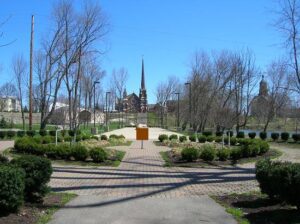
One of America’s most inventive twentieth century writers, Kenneth Patchen was born in Niles and graduated Warren G. Harding High School in 1929. He first published his poetry while studying at an experimental college at the University of Wisconsin in 1929. A pacifist deeply concerned with the human condition in mid-twentieth century America, Patchen blended linguistic and visual elements to create avant-garde works that defied literary conventions of the period, presaging both the “beat” and “concrete” movements of the 1950s. The Journal of Albion Moonlight (1941) and Hallelujah Anyway: Picture Poems (1966) are among the best known of his more than forty works of poetry, prose, and drama.
, OH
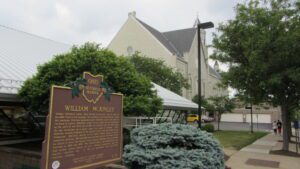
William McKinley’s house, once located at this site, was the scene of his 1896 front porch campaign for President of the United States. During the campaign McKinley addressed about 750,000 people who came to his home in Canton. McKinley’s public service began when he volunteered at the start of the Civil War in 1861 as a private with the Union Army. He was discharged as a major after four years of service. Later McKinley became President of the Canton Y.M.C.A. and the Stark County Prosecutor. McKinley served in the United States House of Representatives between 1877 and 1891 and was then elected Governor of Ohio. He helped to found the Canton Public Library. McKinley won presidential elections in 1896 and 1900. His administration was characterized by high tariffs, money backed by gold, national prosperity, and the Spanish-American War. In 1901 an anarchist shot and killed President McKinley.
, OH
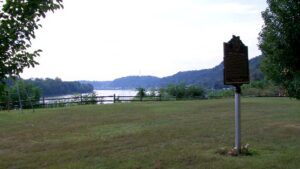
James Edwin Campbell was born on September 28, 1867, in the Kerr’s Run area of Pomeroy to James and Letha Campbell. He graduated from Pomeroy High School with the class of 1884. After graduation, Campbell taught in various parts of Meigs County. Campbell achieved notoriety as an African American poet, editor, author of short stories, and educator. He began his writing in 1887 with the work Driftings and Gleanings. During the 1880s and 1890s, he wrote regularly for daily newspapers in Chicago and was employed on the literary staff of the Chicago Times-Herald. His dialect poetry attracted wide-spread popularity and he published a collection of his best works, Echoes From the Cabin and Elsewhere. Campbell was installed as the first president of the West Virginia Colored Institute (West Virginia State University), serving in the capacity from 1891 to 1894. James Edwin Campbell died in Pomeroy on January 26, 1896.
, OH
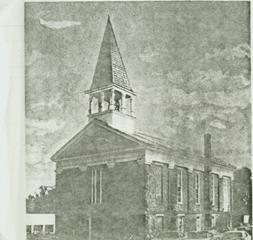
This site has long served the religious, education, and public interests of the residents of Mechanicsburg. A local Methodist congregation built its first church here in 1820, and the townspeople also used the structure as its village school. The Methodists replaced their original structure in 1837, using brick as the main building material. As the Methodist congregation grew, however, it was determined that a larger, more permanent structure was needed. As a result, the Mechanicsburg First Methodist Church was built here in 1858, and it served the congregation until 1894 when an African American based Second Baptist congregation purchased the building at a cost of $2,850. Besides religion and education, the site was also used as Mechanicsburg’s first cemetery. That cemetery lasted until the Maple Grove Cemetery was established and burials at this site were relocated there. [continued on other side]