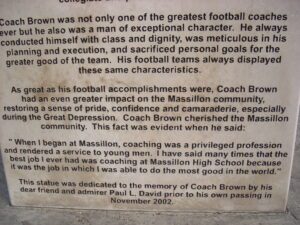
Paul E. Brown, born September 7, 1908 in Norwalk, Ohio, and raised in Massillon, is a member of the Professional Football Hall of Fame and was one of the greatest coaches in the history of football at all levels. From 1932 until 1940, he led Massillon High School to a record of 80-8-2. He coached Ohio State to the 1942 national collegiate championship, and joined the professional football ranks in 1946 as coach of the new franchise in Cleveland. He coached his namesake Cleveland Browns to seven league championships in 17 seasons.
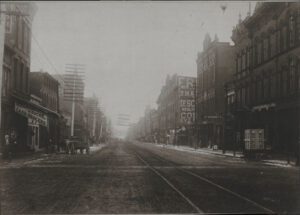
The center of African-American culture in Akron during the mid-20th century, Howard Street was home to many of the city’s black-owned business and entertainment establishments, and provided an atmosphere in which minority-owned businesses could thrive. Attracted to the vitality of the neighborhood, entrepreneur George Mathews (1887-1982) established a barbershop here in 1920 and in 1925 opened the adjoining Mathews Hotel. The hotel quickly became the anchor of the Howard Street district. Mathews’ success allowed him to endow a scholarship fund at the University of Akron in 1964.
The Snowden Family Band was an acclaimed African-American stringband who performed in and around Knox County for nearly seventy years, from the 1850s into the 1920s. Buried in Morris Chapel Cemetery are Thomas Snowden (1803-1856), his wife Ellen Cooper Snowden (1817-1894), and their nine children: Oliver, Sophia, Mary, Ben, Lew, Phebe, Martha, Elsie, and Annie. Born into slavery in Maryland, Thomas and Ellen separately relocated to Knox County and to freedom during the 1820s. They married in 1834. In the 1850s, the six surviving children formed a band under Ellen’s direction. Talented musicians, the Snowden Family performed banjo and fiddle music for public events and at their homestead near Mount Vernon. Many believe that the song “Dixie,” attributed to minstrel Daniel Decatur Emmett (1815-1904), originated with the Snowden Family Band.
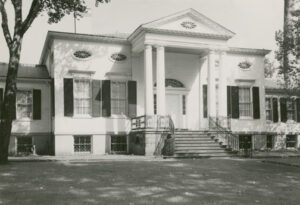
This Federal house was begun about 1820 for Martin Baum (1765-1831), one of Cincinnati’s early merchants. Art patron and abolitionist Nicholas Longworth (1782-1863) lived here for more than thirty years and commissioned the notable landscape murals in the foyer painted by African-American artist Robert S. Duncanson (1821-1872). Iron magnate David Sinton (1808-1900), the subsequent owner, bequeathed the house to his daughter Anna Sinton Taft (1852?-1931). She and her husband Charles Phelps Taft (1843-1929), older half-brother of William Howard Taft (1857-1930), who accepted his party’s nomination for president from the portico in 1908, assembled the acclaimed art collection displayed here. Bequeathed to the people of Cincinnati in 1927, the Taft Museum of Art opened to the public in 1932. It was designated a National Historic Landmark in 1973.
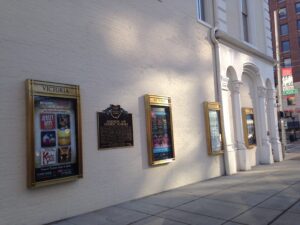
Dayton natives Hermene (1902-1986) and Josephine Schwarz (1908-2004) were pioneers of dance who founded one of the first regional ballet companies in the country. In 1927, they opened the Schwarz School of Dance, which eventually became the Dayton Ballet in 1978. Josephine’s choreography blended classical ballet traditions and contemporary dance, creating a fusion of styles that through her students and other companies shaped the development of dance in the United States. The sisters are credited with introducing organized dance to African-American and underserved children in the Dayton area. As part of the sisters’ legacy, Josephine created a fund at the Dayton Foundation in memory of Hermene to support Dayton arts and artists.
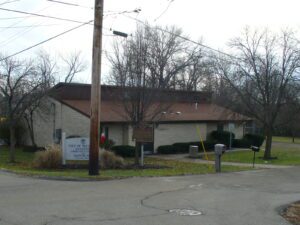
Civic organizations played pivotal roles in the development of the residential community of Hazelwood, founded as a subdivision of Blue Ash in 1888. The Hazelwood Civic Association, initially established as the Brothers Civic Society in 1941, addressed community needs by working for public improvements and promoting civic relations through social events and educational programs. Efforts by the HCA led to the construction of a new civic center and the introduction of the Boy and Girl Scouts and other programs that were previously unavailable to African-American children. Hazelwood’s deterioration and the threat of encroaching industrial development led to the formation of the Hazelwood Improvement Corporation in 1968. The HIC, acting as an agent of the city of Blue Ash, helped to upgrade housing, pave roads, build new homes to ensure a residential nature, install water and sewage systems, and erect streetlights. In 1997, the Hazelwood Community Association was organized to assist residents during Hazelwood’s transition to a racially integrated community.
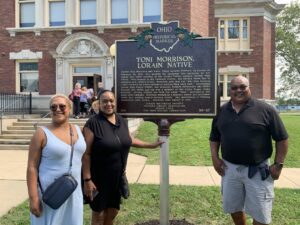
Author Toni Morrison was born, Chloe Ardelia Wofford, in Lorain on February 18, 1931. Her passion for language was nurtured by her family and while working at the Lorain Public Library during high school. Then housed in the Carnegie Center, the library hired her to reshelve and catalog books. Morrison said that she “was slow because I kept reading the books instead of putting them back fast.” Graduating Lorain High School (1949), she attended Howard University (BA 1953), Cornell (MA 1955), and she was a member of the Alpha Kappa Alpha sorority. During college she took the name “Toni,” shortening her saint name Anthony. Morrison worked as a literary editor and professor while also writing award-winning novels. She maintained a lifelong connection with Lorain. Morrison died August 5, 2019.
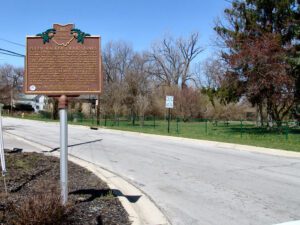
In 1972, Urbancrest’s Ellen Walker Craig-Jones became the first African-American woman to be elected mayor, by popular vote, of a United States municipality. During her term as mayor (1972-1975), Craig-Jones oversaw the modernization of Urbancrest’s various programs and the village rebuilt three main streets, installed streetlights and street signs, and received approval to start a $3 million housing project. Craig-Jones had many years of experience in service to her community, serving twelve years on the Urbancrest Village Council. She was the recipient of dozens of awards and honors, including Who’s Who Among Black Americans.