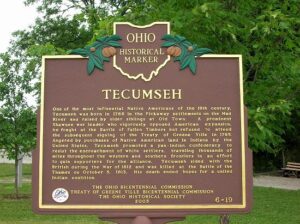
One of the most influential Native Americans of the 19th century, Tecumseh was born in 1768 in the Pickaway settlements on the Mad River and raised by older siblings at Old Town. A prominent Shawnee war leader who vigorously opposed American expansion, he fought at the Battle of Fallen Timbers but refused to attend the subsequent signing of the Treaty of Greene Ville in 1795. Angered by purchases of Native American land in Indiana by the United States, Tecumseh promoted a pan-Indian confederacy to resist the encroachment of white settlers, traveling thousands of miles throughout the western and southern frontiers in an effort to gain supporters for the alliance. Tecumseh sided with the British during the War of 1812 and was killed at the Battle of the Thames on October 5, 1813. His death ended hopes for a united Indian coalition.
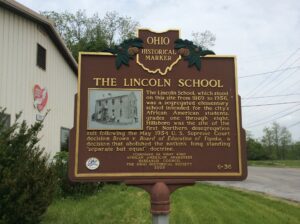
The Lincoln School, which stood on this site from 1869 to 1956, was a segregated elementary school intended for the city’s African American students, grades one through eight. Hillsboro was the site of the first Northern desegregation suit following the May 1954 U.S. Supreme Court decision Brown v. Board of Education of Topeka, a decision that abolished the nation’s long standing “separate but equal” doctrine. (Continued on other side)
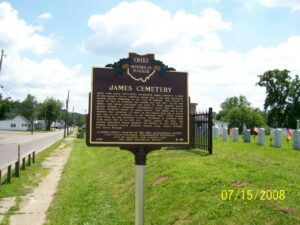
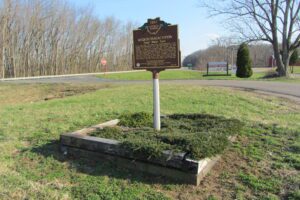
Major John James (1772-1854) established James Cemetery in 1828 on and around a Native American mound that is the only significant ancient mound remaining in the city of Jackson. The mound is about 70 feet in diameter and nearly six feet tall. In the late 1800s, this mound comprised one point of three ancient mound groups forming a triangular configuration along East Broadway Street, formerly known as James Street. One group was a few hundred feet northeast of here on the Watson farm and a second was just to the northwest on the Warnicke farm. These mounds were built by the Hopewell Culture, prominent in southern Ohio from about 100 BC to 400 AD. Major James, his wife, and several immediate family members are buried on the mound including Jackson County pioneers Andrew Long, Daniel Hoffman, and David Mitchell.
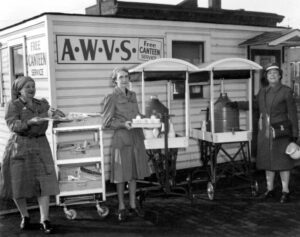
The Lima Chapter of the American Women’s Voluntary Services Organization established a community-based, free canteen during World War II for troops traveling on the Pennsylvania Railroad and adjacent Baltimore & Ohio-Nickel Plate Railroads. Meeting as many as forty trains a day, the ladies served 2.5 million troops between 1942-1945. Food, coffee, and other items were donated to the canteen from a twelve county area. The “AWVS” disbanded in 1945, but succeeding volunteers continued to provide service throughout the Korean Conflict and Viet Nam War. Lima’s “Servicemen’s Free Canteen” was the longest, continuously operated service canteen in the United States. An estimated four million soldiers, sailors, and marines were served between 1942-1970.
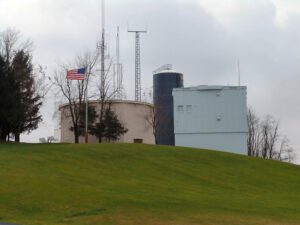
Campbell Hill is named for Charles D. Campbell of Bellefontaine, who owned this land from 1898 to 1937. A marble stone marker atop the hill, set in 1900 by the U.S. Coast and Geodetic Survey, marks it as the highest point in Ohio at an elevation of 1549.09 feet. In 1951, the federal government established the 664th Aircraft Control and Warning (AC&W) Squadron here as part of the North American Air Defense Command (NORAD). Its military and civilian operators used sophisticated radar and computer equipment to locate and identify aircraft as friendly or suspicious, and relayed information to a central site in Battle Creek, Michigan. This Cold War site operated until 1969. It was converted to civilian use as a vocational education center in 1974.
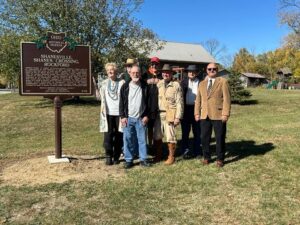
John Chapman (1774 – 1845) leased these three acres to the north and west from William Botts Hedges on April 29, 1828. He paid Hedges by cultivating 1,000 apple trees on the site over the next ten years. Apples provided an important food source. Cut and dried for sauces in the winter, they could be pressed into cider or “apple jack” at a time when water often carried disease. The Hedges Nursery profited the Shanesville area by shipping apples to the major trading posts at Piqua and Ft. Wayne. During his lifetime, Chapman proved an able businessman who established profitable orchards in Ohio, Pennsylvania, and Indiana. In 2009, American Forests, the Johnny Appleseed Foundation, the Museum at Urbana University, and the Village of Rockford planted two “Rambo” apple trees at the Hedges Nursery site.
In the early 1770s, Chief White Eyes (Koquechagachton) of the Delaware tribe founded White Eyes Town approximately two miles southeast of this marker on a plain near present day West Lafayette. A friend of the Moravian leader David Zeisberger, White Eyes was an ardent supporter of Moravian missionary efforts and kept the Delawares neutral during the American Revolutionary War. White Eyes’s dream was to bring his people under the influence of Christianity. He also hoped to establish a fourteenth state for the Indian nations, which would join the other thirteen. White Eyes died at the height of his career in November 1778 near Pittsburgh. The cause of his death remains open to question.
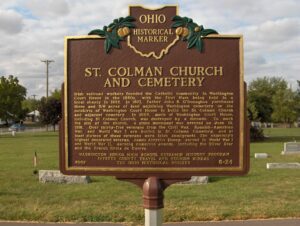
Irish railroad workers founded the Catholic community in Washington Court House in the 1850s, with the first Mass being held in a local shanty in 1852. In 1871, Father John B. O’Donoghue purchased three and 5/8 acres of land adjoining Washington cemetery on the outskirts of Washington Court House to build the St. Colman Church and adjacent cemetery. In 1885, much of Washington Court House, including St. Colman Church, was destroyed by a tornado. To mark the site of the church, a stone monument was erected on June 19, 1916. Over thirty-five veterans from the Civil War, Spanish-American War, and World War I are buried in St. Colman Cemetery, and at least sixteen of these veterans were Irish immigrants. The cemetery’s highest decorated veteran, James Aloysius Ducey, served in World War I and World War II, earning numerous awards, including the Silver Star and the French Croix de Guerre.