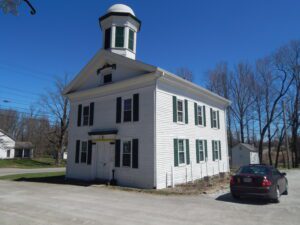
The most notable feature of Mantua Center is the “Village Green,” which harkens back to the New England heritage of Mantua Center’s early settlers. The Green sets upon land donated by Hezekiah Nooney Sr. and was important to both the social and commercial interests of the town. The businesses located here were a furniture and cabinet maker’s shop, harness shop, blacksmith shop, post office, tannery, ashery, dry goods store, and distillery. The Methodist Episcopal Church, now the Mantua Civic Center, stands at the southwest corner of the green. Eastlawn cemetery, with a burial that dates to 1816, sits along the south border. The cemetery serves as the final resting place for soldiers of several wars, including the American Revolution, as well as many other early citizens. In 1835 Horace Sizer constructed the stone wall around the cemetery adjacent to Mantua Center Road. [continued on other side]
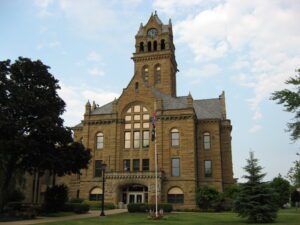
As the county seat, Port Clinton is home to the present Ottawa County Courthouse, completed on May 20, 1901 and listed on the National Register of Historic Places in 1974. Constructed in the Richardson Romanesque style, the exterior of the courthouse was built using sandstone quarried at Amherst, Ohio. Pink marble wainscoting, an ornate staircase, and stenciling enhance the interior. A copy of William Powell’s mural, “Perry’s Victory on Lake Erie,” is featured along with smaller murals depicting early county industries – farming, fishing, fruit growing, and quarrying. Memorial tablets honor veterans from the Spanish-American War and Civil War.
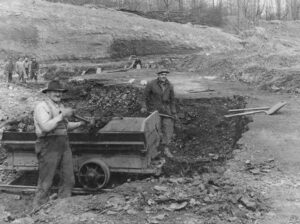
Agriculture dominated the economy of southeastern Ohio’s Morgan County until the 1940s when harvests dwindled, the population declined, and land values dropped. Surface mining the area’s rich underground coal deposits replaced agriculture as the major industry and revitalized the declining local economy. As the nation’s demand for electricity grew over the next half-century, so did the demand for coal as fuel for nearby power generation plants. During mining’s heyday in the 1960s to the late 1980s, American Electric Power’s former Central Ohio Coal Company subsidiary employed nearly 1,000 people. Nearby communities-such as Cumberland, Caldwell and Chandlersville-thrived. As time passed, however, the robust coal industry was hit hard by environmental regulations that reduced the market for the area’s high-sulfur coal. In turn, mine work forces shrank considerably and local businesses closed. (continued on other side)
Established in 1879 by Chicago industrialist William P. Rend as a coal mining town, Rendville became a place where African Americans broke the color barrier. In 1888, Dr. Isaiah Tuppins, the first African American to receive a medical degree in Ohio, was elected Rendville’s mayor, also making him the first African American to be elected a mayor in Ohio. Richard L. Davis arrived in Rendville in 1882 and became active in the Knights of Labor. He was one of the labor organizers from the Little Cities of Black Diamonds region who helped found the United Mine Workers of America in 1890. An outstanding writer and orator, Davis was elected to UMWA’s national executive board and organized thousands of African Americans and immigrants to join the union. (continued on other side)
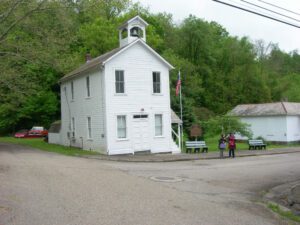
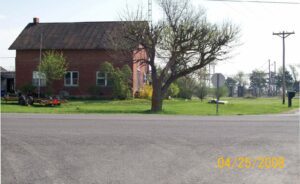
Built in 1886 by direct descendants of slaves, the Black and White schoolhouse provided education for local youth until 1928. Denied admission to white schools in the area, local African-American families first built a log schoolhouse across the road in 1883 in which to educated their children. Three years later, this brick building was constructed. The black families allowed white children to attend and, as a result, the school became known as the Black and White school. It is an early integrated school in Ohio.
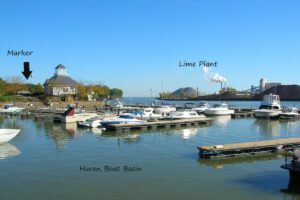
In the early 1800s, Jabez Wright, an early Huron County judge, purchased a large tract of lakeside land on the north side of what is now Cleveland Road. There Wright built an eight-room farmhouse that later served as a “station” on the fabled Underground Railroad, playing a vital role in aiding fugitive African-American slaves to freedom. Beneath Wright’s farmhouse was a sixteen foot-wide and ninety foot-long tunnel. Escaped slaves entered the passage through a trap door in the home’s basement and exited into a corn crib located a mere one hundred feet from Lake Erie. There the slaves awaited the arrival of rowboats transporting them to vessels heading north to Canada. (Continued on side two)
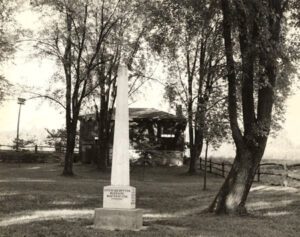
Following the American Revolution, the new Federal government, in need of operating funds, sold millions of acres of western lands to land companies. One such company, the Ohio Company of Associates, brought settlement to Marietta in 1788. Two years later, despite warnings of Native American hostility, an association of 36 Company members moved north from Marietta to settle “Big Bottom,” a large area of level land on the east side of the Muskingum River. The settlers were acquainted with Native American warfare, but even so, built an unprotected outpost. They did not complete the blockhouse, put pickets around it, or post a sentry. On January 2, 1791, a war party of 25 Delaware and Wyandot Indians from the north attacked the unsuspecting settlers, killing nine men, one woman, and two children. War raged throughout the Ohio Country until August 1794 when the tribes were defeated at the Battle of Fallen Timbers.
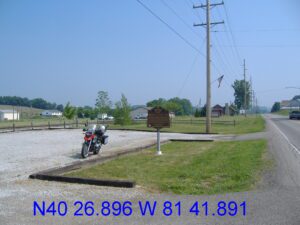
Unsatisfied by the terms of the treaty that ended the French and Indian War, Ottawa chief Pontiac led a confederacy of Native American tribes in attacks against British frontier forts during 1763, a campaign known as “Pontiac’s Conspiracy.” In October 1764, Colonel Henry Bouquet led a 1500-man army into the Ohio country from Fort Pitt (present-day Pittsburgh) as a demonstration of British force and to free captives held by several tribes. Informed of possible attack, Bouquet diverted his army overland from his Tuscarawas River valley route and here deployed his forces into three lines: a group of scouts on each ridge and the main force along present Route 93. Evidence of artillery emplacements and infantry breastworks remained visible for many years.