

, OH
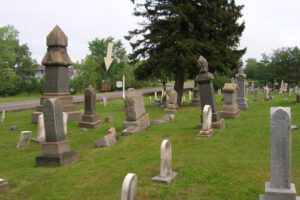
Settlers from Connecticut were the first to come to Canfield Township in the late 1700s, and they were followed by a second wave of immigrants, Swiss-German pioneers who began arriving from Berks and Leigh counties in Pennsylvania in 1804. In 1810, these “Pennsylvania Dutch” established The Zion Lutheran and Reformed Church and built a log church and cemetery on this site. The church was destroyed by fire in 1845 and a new church served the congregation well until it too was destroyed by fire in 1894. The cemetery, known as The Old Dutch and German Burying Ground, German Cemetery, and Lynn Cemetery and now Old North Cemetery, is all that remains. Among the dozens of old stone markers, some in German, are markers for veterans of the American Revolution, War of 1812, Civil War, and other wars.
, OH
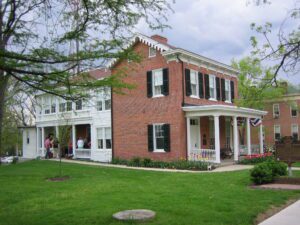
William Holmes McGuffey (1800-1873) was a Miami University faculty member in 1836 when he compiled the first edition of the McGuffey Eclectic Reader in this house. His Reader taught lessons in reading, spelling, and civic education by using memorable stories of honesty, hard work, thrift, personal respect, and moral and ethical standards alongside illustrative selections from literary works. The six-edition series increased in difficulty and was developed with the help of his brother Alexander Hamilton McGuffey. After the Civil War the Readers were the basic schoolbooks in thirty-seven states and by 1920 sold an estimated 122 million copies, reshaping American public school curriculum and becoming one of the nation’s most influential publications. (Continued on other side)
, OH
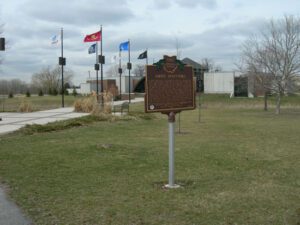
In 1810, early settlers here were Major Amos Spafford (1753-1818), his wife Olive (1756-1823), and their children Samuel, Aurora , Chloe (Mrs. Almon Gibbs), and Anna (Mrs. Richard Craw). In 1796, Spafford, a native of Connecticut, was a surveyor for the Connecticut Land Company. He drew the first map laying out Cleveland and named the city. He left there in 1810 following appointment as custom’s collector and postmaster for the new port at the foot of the Maumee River rapids, Port Miami of Lake Erie. Spafford was granted a 160 acre land patent on River Tracts #64 and #65 in Waynesfield township, signed by President James Monroe and was able to purchase it following the 1817 Treaty of the Rapids that extinguished Native American claim. Two years later, 67 families lived in the area, but most fled at the outbreak of the War of 1812.
, OH
“I thought of the great bandits of the old West [like] the James Brothers…They knocked over trains, and I was going to pull the same stunt,” exclaimed notorious gangster Alvin “Creepy” Karpis. On November 7, 1935, Karpis and his bandits held up Erie Train #626 at this former location of the Garrettsville Train Depot, escaping with over $46,000 in cash and securities. Because of this last great train heist in American history, FBI Director J. Edgar Hoover and his Government Men (G-Men) improved their surveillance methods to capture Karpis. Once labeled “Public Enemy Number One,” Alvin Karpis became Hoover’s first arrest on May 1, 1936. Local legend holds that FBI agents flooded this town searching for Karpis and his accomplices, and this led the James A. Garfield School District to adopt the G-Men as the mascot for its athletic teams.
, OH
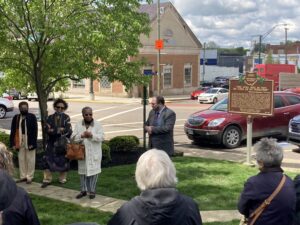
Ellamae Simmons, born and raised in Mount Vernon, became the first African American woman physician to specialize in asthma, allergy, and immunology in the country. Graduating in the top of her high school class, she dreamed of attending Ohio State University to become a nurse but was rejected as that program “did not have the facilities for training” the young black girl. Whenever Simmons encountered a barrier in life she refused to accept rejection, tenaciously steered the course of her own life, and blazed new trails for others. She ultimately earned degrees in nursing (Hampton, 1940), pre-med biological sciences (OSU, 1948), social work (OSU, 1950), and medicine (Howard University, 1959). Dr. Simmons again broke gender and racial barriers when hired by Kaiser Permanente in 1965. She practiced there until retiring in 1989. Simmons died aged 101.
, OH
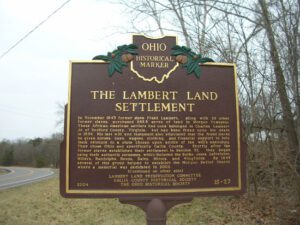
In November 1843 former slave Frank Lambert, along with 29 other former slaves, purchased 265.5 acres of land in Morgan Township. These African American settlers had once belonged to Charles Lambert Jr. of Bedford County, Virginia, but had been freed upon his death in 1839. His last will and testament also stipulated that the freed slaves be given horses, oxen, wagons, clothing, and financial support to help them relocate to a state chosen upon advise of the will’s executors. They chose Ohio and specifically Gallia County. Shortly after the former slaves established their settlement in Section 32, they began using their authentic surnames, which included the Burks, Jones, Leftwiches, Millers, Randolphs, Reeds, Sales, Minnis, and Wingfields. By 1845 several of this group helped to establish the Morgan Bethel Church where a memorial was dedicated in 2002. (continued on other side)
, OH
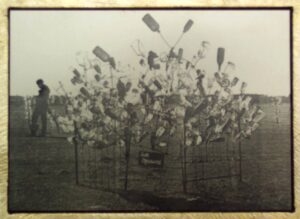
A direct descendent of original settlers in Jackson Township, Winter Zellar (Zero) Swartsel was born in 1876. Throughout his life he was a natural born showman, teacher, eccentric, anarchist, and “possibly the grandfather of American Pop Culture.” At a young age and tired of the routines of Farmersville, he declared that, “He would live by his wits while his brothers lived by the sweat of their brows.” He and a friend bicycled first to New York City and then turned around to head west and eventually the world. Later his home would overflow with items collected while traveling the world. Outside was a similar story. While chiding the American people for their wastefulness and abusing their environment, his 22 acres of farmland became his artist’s canvas filled with the thousands of items he collected from the “wasteful.” [continued on other side]
, OH
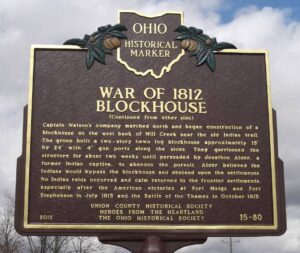
Following the American surrender of Fort Detroit in August 1812, panic spread along the Ohio frontier in fear of possible Indian attacks. The boundary of the Indian territory lay approximately 14 miles to the north at the Greenville Treaty line. Ohio Governor Return Jonathan Meigs, Jr. called out the Ohio Militia to defend the frontier and to construct blockhouses to guard against Indian attacks. A local militia company of 70 men was raised in present Union and Madison Counties to protect the settlements along Big Darby Creek. David Watson served as captain with Frederick Lloyd as first lieutenant.