

, OH
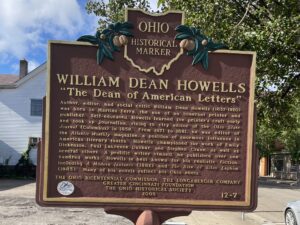
Author, editor, and social critic William Dean Howells (1837-1920) was born in Martins Ferry, the son of an itinerant printer and publisher. Self-educated, Howells learned the printer’s craft early and took up journalism, rising to city editor of the Ohio State Journal (Columbus) in 1858. From 1871 to 1881, he was editor of the Atlantic Monthly magazine, a position of enormous influence in American literary tastes. Howells championed the work of Emily Dickenson, Paul Laurence Dunbar, and Stephen Crane, as well as several others. A prolific writer himself, he published over one hundred works. Howells is best known for his realistic fiction, including A Modern Instance (1882) and The Rise of Silas Lapham (1885). Many of his novels reflect his Ohio roots.
, OH
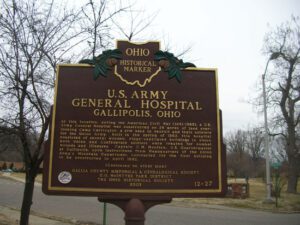
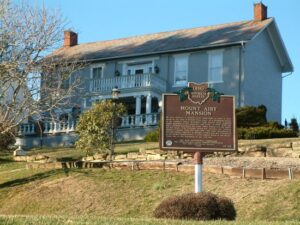
At this location, during the American Civil War (1861-1865), a U.S. Army General Hospital was constructed on 29 acres of land overlooking Camp Carrington, a site used to recruit and train soldiers for the Union Army. Built in the spring of 1862, this hospital consisted of several wooden, ridge-ventilated buildings in which both Union and Confederate soldiers were treated for combat wounds and illnesses. Captain C.M. Moulton, U.S. Quartermaster at Gallipolis, upon instructions from Headquarters of the Union Army’s Mountain Department, contracted for the first building to be constructed in April 1862. (continued on other side)
, OH
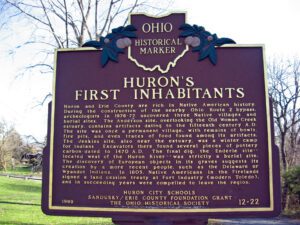
Huron and Erie County are rich in Native American history. During the construction of the nearby Ohio Route 2 bypass, archeologists in 1976-77 uncovered three Native villages and burial sites. The Anderson site, overlooking the Old Woman Creek estuary, contains artifacts dating to the fifteenth century A.D. The site was once a permanent village, with remains of bowls, fire pits, and even traces of food found among its artifacts. The Jenkins site, also near the estuary, was a winter camp for Indians. Excavators there found several pieces of pottery carbon-dated to 1470 A.D. The final dig, the Enderle site — located west of the Huron River — was strictly a burial site. The discovery of European objects in its graves suggests its creation by a more recent people, such as the Delaware or Wyandot Indians. In 1805, Native Americans in the Firelands signed a land cession treaty at Fort Industry (modern Toledo), and in succeeding years were compelled to leave the region.
, OH
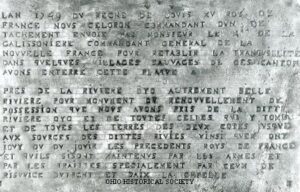
In 1749, the French in North America perceived a threat by British expansion west of the Allegheny Mountains to the Ohio River Valley and beyond. The French commander, Pierre Joseph Celeron, sieur de Blainville, with 250 men, left Montreal, New France, to establish French claims. They buried inscribed lead plates at the mouths of six important tributaries to the Ohio River. Three lead plates have been recovered, one was sent to England, and two are in American historical societies. The final plate was buried just west of here at the mouth of the Great Miami River, before the detachment turned north. However, after the British captured Montreal in 1760, French claims east of the Mississippi River were ceded to Britain by the 1793 Treaty of Paris. British Parliament annexed to Quebec (now Canada) and controlled all lands north of the Ohio River until 1776.(Continued on other side)
, OH
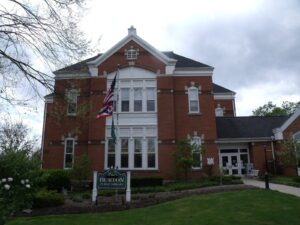
This Queen Anne style building with segmental-arched windows and steep hipped roof was Burton’s second high school. Completed in 1885 at a cost of $12,500, it is wood framed with a brick and stone exterior, modeled after an academy in River Falls, Wisconsin. Its basement and two upper floors contained 12,720 square feet of space, enough for all twelve grades. There were two separate entrances; girls entered on the left and boys on the right. Electricity was installed in 1921 by the superintendent and students. Classes met here until 1936. During its history, the building housed various organizations, including the Red Cross, Opportunity School of Geauga County (later Metzenbaum), Geauga County Historical Society, American Legion, and County Extension Office. In 1937, it became the home of the Burton Public Library and in 1983 was expanded with a north wing designed to be architecturally consistent with the original 1885 structure.
, OH
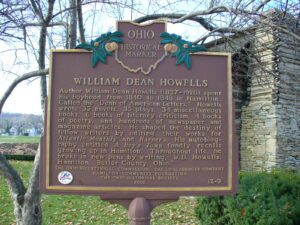
Author William Dean Howells (1837-1920) spent his boyhood from 1840 to 1848 in Hamilton. Called the “Dean of American Letters,” Howells wrote 35 novels, 35 plays, 34 miscellaneous books, 6 books of literary criticism, 4 books of poetry, and hundreds of newspaper and magazine articles. He shaped the destiny of fellow writers by editing their works for Atlantic Monthly and Harper’s. His autobiography entitled A Boy’s Town fondly recalls growing up in Hamilton. Throughout life, he broke in news pens by writing, “W. D. Howells, Hamilton, Butler County, Ohio.”
, OH
One of Ohio’s earliest proponents of women’s rights, Frances Dana Gage (1808-1884) was born in Marietta and married McConnelsville attorney James L. Gage in 1829. She immersed herself in the major social issues of the day – temperance, abolition, and universal suffrage – while raising eight children. At a women’s rights convention in 1850, Gage gained national attention by proposing that the words “white” and “men” be removed from Ohio’s constitution. She later served as the editor of an Ohio agricultural journal, as an educator for newly emancipated African Americans, and wrote children’s tales under the pen name “Aunt Fanny.” An enormously influential woman, Gage led the way for Ohio’s next generation of social activists.
, OH
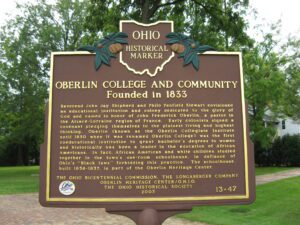
Reverend John Jay Shipherd and Philo Penfield Stewart envisioned an educational institution and colony dedicated to the glory of God and named in honor of John Frederick Oberlin, a pastor in the Alsace-Lorraine region of France. Early colonists signed a covenant pledging themselves to the plainest living and highest thinking. Oberlin (known as the Oberlin Collegiate Institute until 1850 when it was renamed Oberlin College) was the first coeducational institution to grant bachelor’s degrees to women and historically has been a leader in the education of African Americans. In fact, African American and white children studied together in the town’s one-room schoolhouse, in defiance of Ohio’s “Black laws” forbidding this practice. The schoolhouse, built 1836-1837, is part of the Oberlin Heritage Center.