

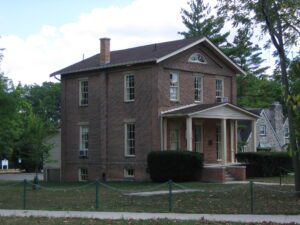
, OH
Reverend Lorenzo Langstroth, renowned as “The Father of American Beekeeping,” lived in this simple two-story, eight-room house with his wife, Anne, and their three children from 1858 to 1887. Unchanged externally, the Greek Revival cottage features brick pilasters and pediments and a fan-shaped front window. In his garden workshop, Langstroth made experimental beehives, established an apiary, and on the ten acres that surrounded his home, grew buckwheat, clover, an apple orchard, and a “honey garden” of flowers. He imported Italian queen bees in efforts to improve native bees and shipped his queens to keepers across the United States and around the world. The Langstroth Cottage was placed on the National Register of Historic Places in 1976 and designated a National Historic Landmark in 1982. (Continued from other side)
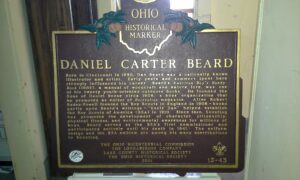
, OH
Born in Cincinnati in 1850, Dan Beard was a nationally known illustrator and artist. Early years and summers spent here strongly influenced his career. Beard’s American Boy’s Handy-Book (1882), a manual of woodcraft and nature lore, was one of his twenty youth-oriented outdoors books. He founded the Sons of Daniel Boone circa 1906, a boys’ organization that he promoted as editor of Recreation magazine. After Robert Baden-Powell founded the Boy Scouts in England in 1908-based partly upon Beard’s writings-“Uncle Dan” helped establish the Boy Scouts of America (BSA) in 1910. Since then, Scouting has promoted the development of character, citizenship, physical fitness, and environmental awareness for millions of boys. Beard served as the BSA’s first commissioner and participated actively until his death in 1941. The uniform design and the BSA emblem are among his many contributions to Scouting.
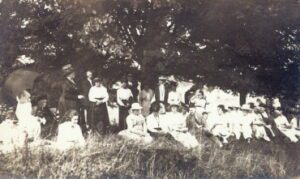
, OH
After embracing the cause of women’s suffrage, Harriet Taylor Upton (1854-1945) devoted her life to the movement. Born in Ravenna, she moved to Warren as a child and lived in this house beginning in 1873. Upton was treasurer of the National American Woman Suffrage Association from 1895 to 1910 and brought its headquarters to Warren in 1903, where it remained until 1910. She served as president of the Ohio Woman Suffrage Association for 18 years. As the first woman vice chair of the National Republican Executive Committee, Upton was instrumental in the passage of child labor laws and securing governmental appointments for women. Her devotion to women’s causes and skills as a public speaker earned her nationwide respect.
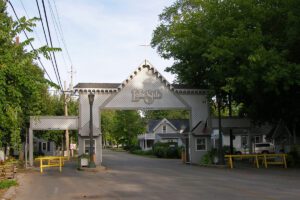
, OH
Established in 1873, Lakeside is a pioneer of the American Chautauqua Movement, one of the greatest revival movements in United States history which flourished in the late nineteenth and early twentieth centuries. Founded by the Methodist Church, Lakeside is one of the few existing Chautauqua communities that remain and thrive today. Each summer, the late-Victorian community provides spiritual, cultural, intellectual, and recreational programs designed to nurture the mind, body, and spirit. It draws visitors from across the country and around the world for its Chautauqua program. Lakeside is recognized on the National Register of Historic Places.
, OH
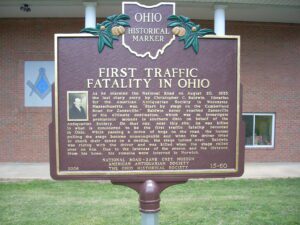
As he traveled the National Road on August 20, 1835, the last diary entry by Christopher C. Baldwin, librarian for the American Antiquarian Society in Worcester, Massachusetts, was, “Start by stage on the Cumberland Road for Zanesville.” Baldwin never reached Zanesville or his ultimate destination, which was to investigate prehistoric mounds in southern Ohio on behalf of the Antiquarian Society. On that day, near this site, he was killed in what is considered to be the first traffic fatality recorded in Ohio. While passing a drove of hogs on the road, the horses pulling the stage became unmanageable and when the driver tried to check their speed on a decline, the stage turned over. Baldwin was riding with the driver and was killed when the stage rolled over on him. Due to the lateness of the season and the distance from his home, his remains were interred in Norwich.
, OH
An influential American journalist of the late nineteenth century, Ambrose Bierce (1842 – c. 1914) was born in Meigs County and reared in Kosciusko County, Indiana. He fought in the Union Army during the Civil War, a formative experience related in his short stories “Chickamauga” and “An Occurrence at Owl Creek Bridge.” Moving to San Francisco in the years after the war, he began his career as a writer and newspaper columnist. His cynical wit and elaborate puns reached a wide audience during the last quarter of the nineteenth century through such papers as William Randolph Hearst’s San Francisco Examiner. Bierce’s best-known book, the Devil’s Dictionary (1911), is a lexicon of humorous definitions first published in his newspaper columns. In December 1913 or January 1914, Bierce vanished during travels in rebellion-torn Mexico.
, OH
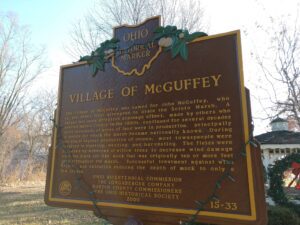
The Village of McGuffey was named for John McGuffey, who in the 1860s first attempted to drain the Scioto Marsh. A larger and more effective drainage effort, made by others who entered Hardin County in the 1880s, continued for several decades until thousands of acres of land were in production, principally of onions for which the marsh became nationally known. During the era of highest production of onions, most townspeople were involved in planting, weeding, and harvesting. The fields were bordered by windrows of willow trees to decrease wind damage over the black silt-like muck that was originally ten or more feet deep throughout the marsh. Successful treatment against wind erosion and oxidation reduced the depth of muck to only a few inches.
, OH
“I say white brother, because I believe that to be the proper phrase, inasmuch as I believe in the principle of the fatherhood of God and the brotherhood of all mankind no matter what the color of his skin may be.” Richard L. Davis championed the cause of racial equality throughout the eastern coalfields, calling for an end to the color line and for all miners to unite against wage slavery. He was born in Roanoke County, Virginia in 1862 and arrived in racially integrated Rendville in 1882, where he became an organizer for the Knights of Labor. In 1886, a year after the Great Hocking Valley Strike, Davis wrote his first letters to the editor of the National Labor Tribune, establishing himself as voice for miners in the labor movement. (Continued on other side)