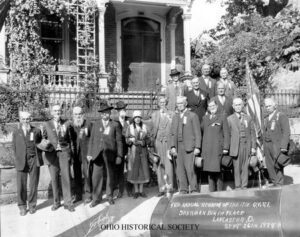
The 17th Infantry, created by Congress in 1812 and formed with personnel from western states, was the only Regular Army regiment in General James Winchester’s column of the Army of the Northwest’s campaign to regain Detroit. During the War of 1812, the 17th fought at Frenchtown, Fort Meigs, Fort Stephenson, and Thames River. In 1815, the 17th was consolidated with the 5th, 19th, and 28th Infantry to form the 3rd Infantry. In May 1861, the 17th Infantry was again organized as a Regular Army regiment and has since served continuously with distinction.
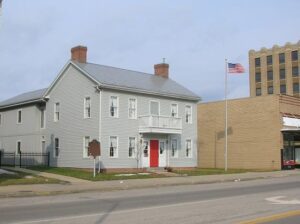
One of seven native Ohioans to serve as president of the United States, William McKinley (1843-1901) was born at this site. The original house was moved from this site and ultimately destroyed by fire. The McKinleys lived here until 1852 when they moved to Poland, Ohio, where William attended the Poland Seminary. He briefly attended Allegheny College in Pennsylvania, but poor health and family financial strain forced him to return to Ohio. As an enlistee in the 23rd Ohio Volunteer Infantry during the Civil War, McKinley rose to the rank of major. After the war, he settled in Canton and practiced law. Elected to Congress in 1876, McKinley favored high protective tariffs, a policy he continued to support as President.(Continued on other side)
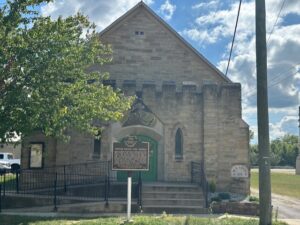
Wayman Chapel was dedicated in 1874 as part of Ohio’s Third District of the African Methodist Episcopal Church. The first Black church in Knox County, it began in 1870 under the guidance of Rev. James A. Ralls. The congregation met in local homes and church basements until completing their red brick church at 102 West Ohio Avenue in 1876. Additions made 1947-1948 included an upgraded facade. For more than a century, Wayman Chapel provided an educational, cultural, and spiritual hub for its members as well as the wider Black community of Mt. Vernon.
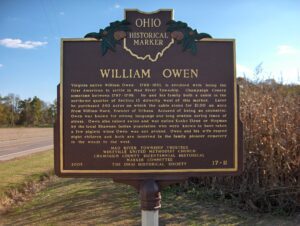
Virginia native William Owen, 1769-1821, is credited with being the first American to settle in Mad River Township, Champaign County sometime between 1797-1799. He and his family built a cabin in the northeast quarter of Section 15 directly west of this marker. Later he purchased 240 acres on which the cabin stood for $1.00 an acre from William Ward, founder of Urbana. Accused of being an eccentric, Owen was known for strong language and long oration during times of stress. Owen also raised swine and was called Kosko Elene or Hogman by the local Shawnee Indian population who were known to have taken a few piglets when Owen was not around. Owen and his wife reared eight children and both are interred in the family pioneer cemetery in the woods to the west.
Manchester was founded in 1791 by Nathaniel Massie as a base to survey the land warrants of American Revolutionary War soldiers in the Virginia Military District. This bank of the Ohio River provided a secure site for the last civilian stockade built in Ohio. The natural protection of this fortification included marshland to the west and north and the river on the south. The nearby three islands provided a safe place for retreat in dangerous circumstances and also supplied an area to raise food in its rich bottomlands. The invention of the steam powered paddle wheel boat allowed the river to become the city’s main source of shipping and commerce in the nineteenth century. Manchester was an important port of call for provisions; the export of agricultural products; and the manufacture of goods such as pottery, furniture, and leather goods.
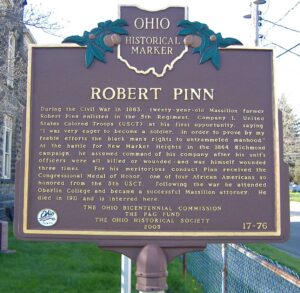
During the Civil War in 1863, twenty-year-old Massillon farmer Robert Pinn enlisted in the 5th Regiment, Company I, United States Colored Troops (USCT) at his first opportunity, saying, “I was very eager to become a soldier, in order to prove by my feeble efforts the black man’s rights to untrammeled manhood.” At the battle for New Market Heights in the 1864 Richmond campaign, he assumed command of his company after his unit’s officers were all killed or wounded – and was himself wounded three times. For his meritorious conduct Pinn received the Congressional Medal of Honor, one of four African Americans so honored from the 5th USCT. Following the war he attended Oberlin College and became a successful Massillon attorney. He died in 1911 and is interred here.
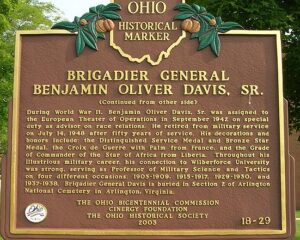
Benjamin Oliver Davis, Sr. (July 1, 1877 – November 26, 1970), the nation’s first African American general in the Regular Army, was born in Washington, D.C. Davis first served as a temporary first lieutenant of the 8th U.S. Volunteer Infantry during the Spanish-American War. Following that conflict, he enlisted as a private in the 9th U.S. Cavalry, serving in the Philippine Insurrection where he began to rise in rank. Davis was promoted to first lieutenant in 1905, captain in 1915, lieutenant colonel in 1920, colonel in 1930, and brigadier general in 1941. His military career took him around the world. In 1909, he was detailed as Military Attache to Monrovia, Liberia. During World War I, Davis was stationed in the Philippines. In 1938, he took command of the New York’s African American 396th National Guard Infantry, later known as the 369th Coast Artillery (Antiaircraft) Regiment. (Continued on other side)
The Snowden Family Band was an acclaimed African-American stringband who performed in and around Knox County for nearly seventy years, from the 1850s into the 1920s. Buried in Morris Chapel Cemetery are Thomas Snowden (1803-1856), his wife Ellen Cooper Snowden (1817-1894), and their nine children: Oliver, Sophia, Mary, Ben, Lew, Phebe, Martha, Elsie, and Annie. Born into slavery in Maryland, Thomas and Ellen separately relocated to Knox County and to freedom during the 1820s. They married in 1834. In the 1850s, the six surviving children formed a band under Ellen’s direction. Talented musicians, the Snowden Family performed banjo and fiddle music for public events and at their homestead near Mount Vernon. Many believe that the song “Dixie,” attributed to minstrel Daniel Decatur Emmett (1815-1904), originated with the Snowden Family Band.