

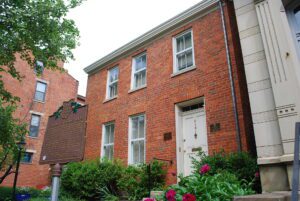
, OH
The oldest building in Cincinnati’s basin area, the Betts House exemplifies a national trend on the expanding frontier of impermanent log and frame structures giving way to more permanent brick architecture. It is the earliest surviving brick building in the city. During Cincinnati’s period of settlement in the early 1800s, the William and Phebe Betts family established a brickyard here that supplied building materials for the rapidly growing frontier city. The Betts House lends its name to the Betts-Longworth Historic District. Established in 1983, the district represents the last nineteenth century remnant of Cincinnati’s lower West End and surrounds the older Betts House with tall, narrow mid-and late-nineteenth century buildings. The Betts house is oriented to the cardinal directions, rather than to the city’s slightly skewed grid.
, OH
Fout Hall was one of three original buildings on the Bonebrake Theological Seminary campus. Constructed 1920-1923, it was named for Dr. J. E. Fout, who managed campus construction. Bonebrake Seminary was founded in 1871 by Dayton’s United Brethren in Christ Church and became co-educational in 1873. Generous cash and land gifts (1909-1911) enabled the construction of a new campus. Fout Hall, the administration building, and a powerhouse were designed by Dayton architect Frederick J. Hughes in the Jacobethan Revival style. The three-story buff-brick dormitory was the largest of the buildings and cost $250,000. As well as dining hall, laundry, and storage facilities, it featured 12 single rooms, 54 two-room suites, and 6 three-room suites. Fout Hall was an integral part of the National Register listing of the Dayton View Triangle Historic District in 2022.
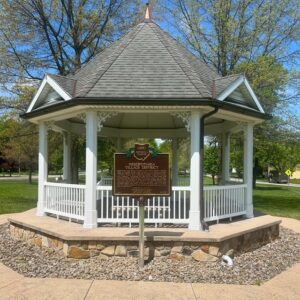
, OH
Mesopotamia Village District was listed in the National Register of Historic Places on December 24, 1974. Many consider it to be “the most unspoiled nineteenth century central green type of village in northeastern Ohio.” The district includes houses, commercial buildings, a town hall, churches, and a cemetery. Surrounding the 1600-foot-long public green these structures represent Greek Revival, Gothic Revival, Queen Anne, Italianate, and vernacular architectural styles constructed between 1820 and 1902. One of the oldest buildings in the district is the colonnaded Greek Revival commercial building at the southwest end of the green. Built in the 1820s for early resident Isaac Clark, it was operated as a store by F.C. Peck. Over the ensuing centuries it has served as a barber shop, post office, and an undertakers. (Continued on other side)
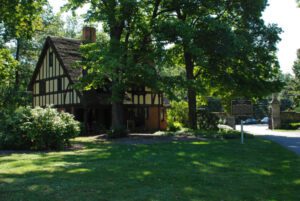
, OH
Completed in 1915, the Gate Lodge is one of several service buildings located at Stan Hywet Hall dedicated to the operations of the estate. Located at the front entrance gates, this two-story Tudor Revival structure was designed by the Seiberlings’ architect Charles S. Schneider. Originally, the Gate Lodge served as a residence for the estate’s superintendent. The first to fill this role was William Dennis who moved in with his family to the Gate Lodge after its completion and resided there until his death in 1923. Between 1923 and 1944, Fred, the eldest child of F.A. and Gertrude Seiberling, lived in the Gate Lodge with his wife Henrietta and their three children. In 1935, Henrietta brought here the two men who would formally found Alcoholics Anonymous, Bill Wilson of New York and Dr. Bob Smith of Akron.
, OH
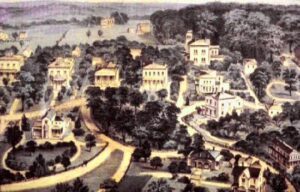
Established in 1851 after the addition of the Cincinnati, Hamilton, and Dayton Railway, Glendale incorporated in 1855 as Ohio’s first planned community and one of the nation’s first planned villages. The original planning included forested greenbelts and parks, curvilinear streets meandering around established trees, large lots, and superior building standards. Glendale is designated as a National Historic Landmark community from the Department of Interior and a Certified Local Government through the Ohio Historic Preservation Office, all owed to Glendale’s persistent adherence to the plan and faithful preservation of original infrastructure. Much of today’s preserved infrastructure includes the original 59 pivotal buildings, curvilinear streets, tree canopy, stone gutters, gas streetlights, and railroad depot.
, OH
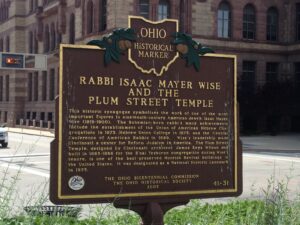
This historic synagogue symbolizes the work of one of the most important figures in nineteenth-century American Jewry, Isaac Mayer Wise (1819-1900). The Bohemian-born rabbi’s many achievements include the establishment of the Union of American Hebrew Congregations in 1873, Hebrew Union College in 1875, and the Central Conference of American Rabbis in 1889. Wise’s leadership made Cincinnati a center for Reform Judaism in America. The Plum Street Temple, designed by Cincinnati architect James Keys Wilson and built in 1865-1866 for the B’nai Yeshurun congregation during Wise’s tenure, is one of the best-preserved Moorish Revival buildings in the United States. It was designated as a National Historic Landmark in 1975.

, OH
The ARK in Berea is the first structure in Cuyahoga County to incorporate sustainable building concepts from the Earth Summit in Rio de Janeiro in 1992. Hand built in 1994 as a work of art by environmental artists David and Renate Jakupca, it is a study for future buildings for the Headquarters of the International Center for Environmental Arts (ICEA) and Eco Village. A hybrid structure utilizing cob, straw bales, aluminum cans, used tires, and recycled construction materials, the ARK (Architektur Recycled Kulturstall) helps to address the environmental problems of large urban areas and the trend of rebuilding rather than remodeling existing structures. The ARK is used as a museum, community center, and art studio of David Jakupca.
, OH
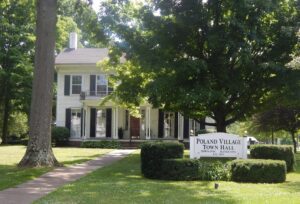
The Village of Poland officially incorporated in August 1866, a year after the end of the Civil War. In April 1867, the citizens elected John Leslie as mayor. As of 1880, Poland’s population exceeded 400. Through its history, the village has consisted of a four-acre village green, churches, schools, hotels, a sawmill, gristmill, post office, tannery, and foundry, as well as carriage, tin, and cabinet shops; drug, dry goods, and hardware stores, and doctors, blacksmiths, and shoemakers. Residents swam in and skated on Yellow Creek. The Poland Municipal Forest was established in 1938 and annexed later as the Village continued to grow. In 1966, the residents held a three day Centennial Celebration, featuring an address by Governor James Rhodes. The centennial year also saw the publication of a history of Poland and the restoration of Centennial Gardens.