

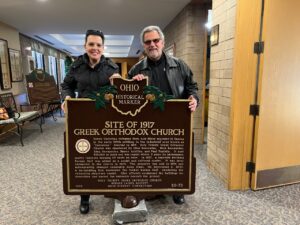
, OH
Greek Christian refugees from Asia Minor migrated to Canton in the early 1900s settling in the industrial area known as “Carnahan.” Erected in 1917, Holy Trinity Greek Orthodox Church was chartered by Elies Korosedes, Nick Kessenides, Alex Heropoulos, Harry Achilles, and Paul Paulidis. It cost $50,000 to build and was repaid within 3 years by parishioners, mostly laborers earning 30 cents an hour. In 1927, a separate building Koraes Hall was added as a social and cultural center. It was later connected to the church in 1934. The property was sold in 1976 and subsequently changed ownership many times. On September 2, 2020, a devastating fire destroyed the former Koraes Hall, rendering the remaining structure unsafe. City officials condemned the buildings for demolition and buried the remnants beneath the ground.
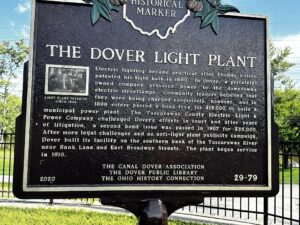
, OH
Electric lighting became practical after Thomas Edison patented his light bulb in 1880. In Dover, a privately-owned company provided power to the downtown’s electric streetlamps. Community leaders believed that they were being charged excessively, however, and in 1898 voters passed a bond levy for $15,000 to build a municipal power plant. The Tuscarawas County Electric Light & Power Company challenged Dover’s efforts in court and after years of litigation, a second bond issue was passed in 1907 for $35,000. After more legal challenges and an anti-light plant publicity campaign, Dover built its facility on the southern bank of the Tuscarawas River near Bank Lane and East Broadway Streets. The plant began service in 1910 and, with the Northern Ohio Traction & Light Company, supplied electricity to Dover.
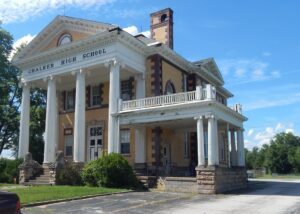
, OH
Southington native Newton Chalker built, furnished, and donated Chalker High School to his community in 1907. Chalker was born in 1842 in Southington Township and lived there until adulthood. He later built a prosperous law and real estate practice in Akron. Chalker’s dedication to improve educational opportunities in the township likely originated with his personal struggle to complete high school, which was repeatedly interrupted by financial concerns and family obligations. The Chalker High School building was designed in the Neo-Classical Revival architectural style which was favored for public buildings, churches and schools early in the twentieth century. The building exhibits Classical influences through the use of fluted columns that support a pedimented gable, resembling a Greek temple. Chalker High School and the Civil War Monument were listed in the National Register of Historic Places in 2010. (Continued on other side)
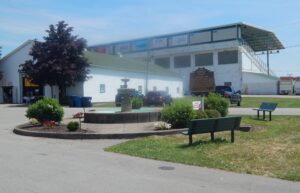
, OH
In 1846, the same year that Mahoning County was created, Ohio’s General Assembly passed an act “for the encouragement of agriculture.” An outgrowth of this legislation led to the founding of the Mahoning County Agricultural Society in April 1847. Boasting a membership of 170, the Society agreed to sponsor competitions for premiums to be distributed at an “annual fair and cattle show the next fall.” Canfield was the geographic center of the county and selected as the site for the first fair. In October, from the lawn of the First Congregational Church, Comptroller of the United State Treasury Elisha Whittlesey welcomed participants. Admission was one shilling (twelve and one half cents). The Village Green overflowed with exhibitions of prized livestock, harvests, plowing contests, and horse racing. Early fairs were one-day events attended primarily by gentlemen. However, the church provided a venue for ladies to display their handiwork. (continued on other side)
, OH
The German Reformed Church was organized on Kelleys Island in 1865. The congregation built this church from island stone in 1866 on 1/2 acre of land purchased from Alfred S. and Hannah Kelley. By 1871, the congregation, one of five on the island, heard services in German and had 25 families as members, including those of Baumler, Beatty, Becker, Boker, Burger, Cattenach, Dodge, Elfers, Fischer, Gerlach, Hess, Huber, Jordon, Keifer, Lange, Nowalk, Pringnitz, Renter, Schaedler, Scheele, Smith, Stoll, Suhr, and Trieschman. Rev. A. William Von Kaske was the congregation’s last resident minister, leaving in 1915. The church’s final service, a funeral for William Burger, was held in 1942. The church’s Ladies Aid Society was able to maintain the building until 1957, after which it was left vacant. The Kelleys Island Historical Association leased the church in 1981 and was granted the deed in 1986.
, OH
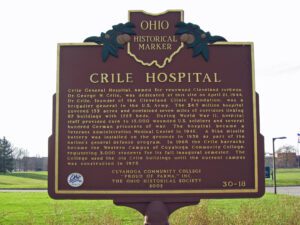
Crile General Hospital, named for renowned Cleveland surgeon, Dr. George W. Crile, was dedicated at this site on April 21, 1944. Dr. Crile, founder of the Cleveland Clinic Foundation, was a brigadier general in the U.S. Army. The $4.5 million hospital covered 153 acres and contained seven miles of corridors linking 87 buildings with 1725 beds. During World War II, hospital staff provided care to 15,000 wounded U.S. soldiers and several hundred German prisoners of war. The hospital became a Veterans Administration Medical Center in 1945. A Nike missile battery was installed on the grounds in 1956 as part of the nation’s general defense program. In 1966 the Crile barracks became the Western Campus of Cuyahoga Community College, registering 3,000 students for its fall inaugural semester. The College used the old Crile buildings until the current campus was constructed in 1975.
, OH
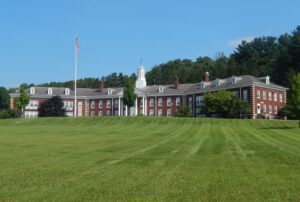
Tuberculosis, or TB, is a contagious disease that was responsible for the deaths of one out of every seven people in the U.S. in the early 20th century. The Licking County Tuberculosis Sanatorium, known as the TB San, was constructed in 1931-1932 at a cost of $250,000. The facility kept TB patients separate from the general population, controlling the spread of disease. The location provided patients with rest, fresh air, food, and exercise, the main treatments for TB in the 19th through mid-20th centuries. (Continued on other side)
, OH
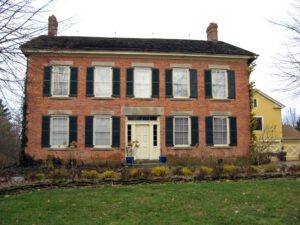
Born in Jefferson, Ohio, Theodore E. Burton graduated from Oberlin College and became a prominent Cleveland attorney. He was elected to Congress in 1888 and served from 1889-91, 1895-1909, and 1921-28. He was elected U.S. Senator in 1908 and 1928 and was a leading contender for the U.S. Presidency in 1916. Due to his work in saving Niagara Falls from development and his opposition to wasteful waterways projects, President Theodore Roosevelt appointed Burton chairman of the Inland Waterways Commission in 1907 and the National Waterways Commission in 1909. Burton is credited with pushing legislation through Congress that authorized the construction of the Panama Canal and negotiating agreements to ensure its neutrality. He lobbied to fight wasteful spending and influence of big business and sponsored the Sherman Anti-Trust Act of 1890. As president of the American Peace Society, Burton hosted the First World Conference on International Justice in Cleveland in 1928, attended by 13,000, including world leaders.