

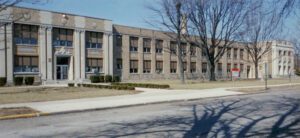
, OH
The North Baltimore Elementary and High School stood at 124 S. Second St. and was dedicated November 11, 1927. The tan and brown brick building replaced a school (built 1884) that a fire destroyed on January 26, 1926. The new school building, for children in grades 1-12, also included classrooms for home economics and business courses, as well as a 900-seat auditorium (including balcony), second floor cafeteria, gymnasium, administrative offices, and a public library. E.E. Leidy was the school’s superintendent and R. Vern Northup was the high school principal. The members of the board of education were Dr. E.A. Powell, President, D.B. Bushey, Vice President, C.G. Nigh, Clerk, and Nellie Roberts and R.E. Simon. Previously known as the “Independents,” the school’s sports teams became the “Tigers” in 1931. (Continued on other side)
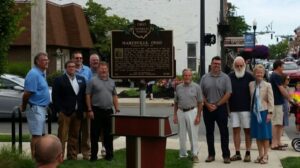
, OH
Marysville, Ohio. On August 10, 1819, Samuel W. Culbertson (1780-1840), a Zanesville lawyer, established Marysville at the convergence of Mill Creek and the road connecting Delaware to Urbana. Culbertson purchased 450 acres of land on July 10, 1817 and authorized Charles Roberts to survey the village, which originally contained 96 lots. Culbertson named the village in honor of his daughter, Mary Ellen (1810-1853), who later married US Congressman, Joshua Mathiot (1800-1849). The village was originally in Delaware County, located in part of the Virginia Military District. It was land given as bounties to soldiers from Virginia after the Revolutionary War. Union County, which included Marysville, was created in 1820, and Marysville became the county seat in 1822. (Continued on other side)
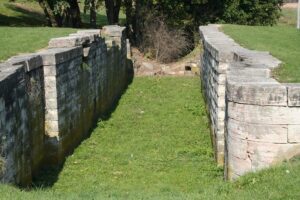
, OH
This section of the Miami and Erie Canal, constructed from 1833-1837, was vital to this region’s commerce and development. It allowed for farmers and businesses to get their goods to larger markets at a lower cost and faster speed than by hauling overland. Passengers could also travel across the area by canal boat. John Clark saw the location of the Lock 15, situated in Monroe Township at the junction of the Milton-Carlisle Pike (Main Street), as an opportunity and in 1840, platted the new town of Tippecanoe City (now Tipp City). Many types of commerce and trade grew up around the canal including boarding houses, saloons, a tannery, and a mill. Some of the original buildings still stand, such as a mill to the west of Lock 15, John Clark’s home at the southeast corner of Main and First streets, and the hotel at the northeast corner of Main and Second streets.
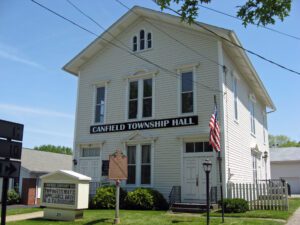
, OH
The Canfield Township Hall was erected in 1884. It served as the first public building in which the Canfield citizens could conduct town business, elections, and public meetings. An example of Renaissance Revival or “Italianate” architecture, the building is typical of late Victorian commercial buildings, but constructed of wood rather than of the customary brick. Drafted by Colonel S. Kinney, it was originally constructed for the sum of $2,389 by G.W. Strock at the corner of South Broad and East Main streets, on a lot purchased for $500. In 1936, R.J. Neff moved the hall several hundred feet south to its present location. In addition to official township meetings, the second floor has been used for a variety of activities, including social meetings, lectures, contests, dances, and roller-skating. The building served as an early home of the Canfield Historical Society and operated continuously for over one hundred and twenty-five years.
, OH
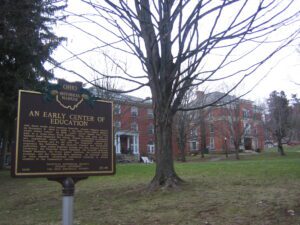
Just three weeks after reaching Granville, pioneer villagers decided on December 9, 1805 to build a log cabin where eighty children would attend school. By 1820, public school classes were being held in a three-story brick building. When rail lines and the National Road bypassed the village, dreams of becoming an industrial and commercial center were dashed. Educational institutions, however, thrived and by the Civil War Granville’s citizens had organized the following: the Granville Literary and Theological Institution, later called Granville College and then renamed Denison University; the Granville Female Seminary, the Granville Episcopal Female Seminary, the Young Ladies’ Institute, the Granville Female Academy, and the Granville Male Academy. As Granville enters its third century, educational excellence continues to attract students to the community’s schools.
, OH
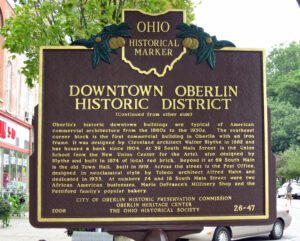
The intersection of Main and College streets has been the center of Oberlin since the town and college were founded in 1833. The first downtown buildings were made of wood and were destroyed by a series of spectacular fires. The first college building, Oberlin Hall, stood on the southwest corner of College and Main and included recitation rooms, a dining hall, chapel, offices, and lodging. In 1887, Akron architect Frank Weary designed the large brick building at numbers 5 to 13 West College. Number 23 West College (Gibson Block) once housed a silent movie theater on the second floor. East College Street’s historic buildings include the Apollo Theater, which showed Oberlin’s first talking movie on May 11, 1928. From 1897 to 1929, an interurban streetcar line connected Oberlin’s downtown to Cleveland. Oberlin’s downtown historic district was placed on the National Register of Historic Places in 2003.
, OH
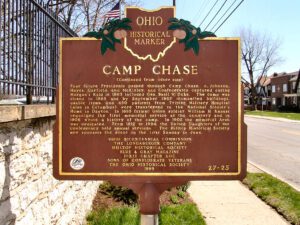
Camp Chase was a Civil War camp established in May 1861, on land leased by the U.S. Government. Four miles west of Columbus, the main entrance was on the National Road. Boundaries of the camp were present-day Broad Street (north), Hague Avenue (east), Sullivant Avenue (south), and near Westgate Avenue (west). Named for former Ohio Governor and Lincoln’s Secretary of the Treasury Salmon P. Chase, it was a training camp for Ohio soldiers, a parole camp, a muster-out post, and a prisoner-of-war camp. As many as 150,000 Union soldiers and 25,000 Confederate prisoners passed through its gates from 1861-1865. By February 1865, over 9,400 men were held at the prison. More than 2,000 Confederates are buried in the Camp Chase Cemetery.
, OH
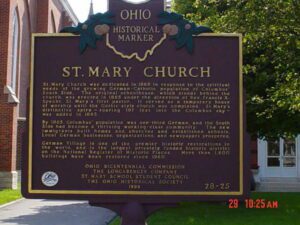
St. Mary Church was dedicated in 1868 in response to the spiritual needs of the growing German-Catholic population of Columbus’ South Side. The original schoolhouse, which stands behind the church, was erected in 1865 under the direction of Rev. Francis X. Specht, St. Mary’s first pastor. It served as a temporary house of worship until the Gothic-style church was completed. St. Mary’s distinctive spire – soaring 197 feet into the Columbus sky – was added in 1893. By 1865, Columbus’ population was one-third German, and the South Side had become a thriving working-class community. The new immigrants built homes and churches and established schools. Local German businesses, organizations, and newspapers prospered. German Village is one of the premier historic restorations in the world, and is the largest privately funded historic district on the National Register of Historic Places. More than 1,600 buildings have been restored since 1960.