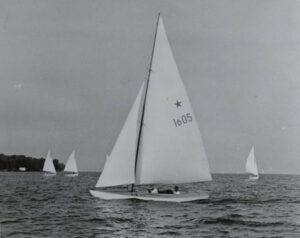
In total area, Lake Erie is the twelfth largest freshwater lake in the world and the most shallow of the five Great Lakes. It is about 210 miles long, 57 miles wide, with a shoreline of approximately 871 miles, and has a maximum depth of 210 feet. It served as a passage for early explorers navigating by canoe into the interior of North America and has since become a key link to commercial shipping on the Great Lakes. Lake Erie is an important water resource for recreation and tourism as well as for municipal and industrial use. Its warm, shallow waters harbor a diverse and abundant fishery, primarily known by anglers for fine catches of walleye, yellow perch, and smallmouth bass.
Now ranked among the country’s finest, the zoo began in 1900 with one large woodchuck in a box at Walbridge Park. After the organization of the Toledo Zoological Society, 1905-10, the zoo began its steady growth, particularly after 1923 under the leadership of Percy C. Jones. An ambitious federal construction program during the Great Depression of the 1930s provided several major structures.(See other side)
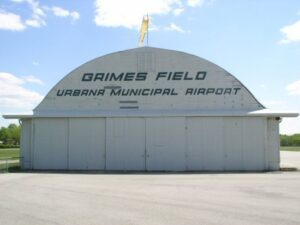
Raised in an Ohio orphanage, Warren G. Grimes (1898-1975) ran away after finishing the ninth grade and at age 16 went to work for the Ford Motor Company in Detroit. He later became a partner in an electrical business where he was instrumental in designing and developing the first lights for the Ford Tri-Motor airplane. In 1930 Grimes moved to Urbana and founded a small lighting fixture plant, Grimes Manufacturing. The inventor of the familiar red, green, and white navigation lights found on the wing tips and tails of aircraft, Grimes, known as the “Father of the Aircraft Lighting Industry,” also developed other aircraft fixtures, including landing, instrumental, and interior lights. Every American-made airplane flown during World War II was equipped with Grimes lights. Grimes served as mayor of Urbana and chairman of the State of Ohio Aviation Board.
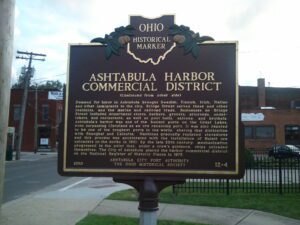
When the Pittsburgh, Youngstown and Ashtabula Railroad was finished in 1873, Ashtabula’s harbor became a direct route to ship iron ore to the booming steel mills of Youngstown and Pittsburgh. On the west side of the Ashtabula River, a brush-filled gulley became Bridge Street. New buildings and bridges attest to the harbor’s importance as a commercial and shipping hub from the late 19th through mid 20th centuries. Fires destroyed wood-frame buildings on the block closest to the river. A fire in 1886 nearly cleared the north side of Bridge Street. Another fire swept over the south side in 1900. Fire resistant brick buildings replaced frame structures and over the course of rebuilding, the level of the street rose approximately eight feet. In 1889, a swing-span bridge replaced the original pontoon bridge over the river. A bascule lift (draw) bridge replaced the swing bridge in 1925.
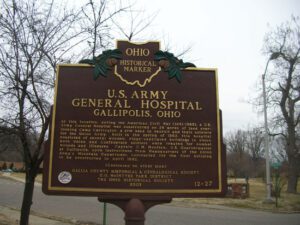
At this location, during the American Civil War (1861-1865), a U.S. Army General Hospital was constructed on 29 acres of land overlooking Camp Carrington, a site used to recruit and train soldiers for the Union Army. Built in the spring of 1862, this hospital consisted of several wooden, ridge-ventilated buildings in which both Union and Confederate soldiers were treated for combat wounds and illnesses. Captain C.M. Moulton, U.S. Quartermaster at Gallipolis, upon instructions from Headquarters of the Union Army’s Mountain Department, contracted for the first building to be constructed in April 1862. (continued on other side)
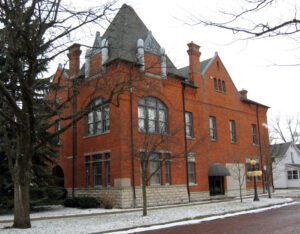
Completed in 1892 at the height of the region’s oil boom, the Pemberville Town Hall followed a late-1800s municipal trend to house many civic functions under one roof. The fire station, jail, and council chambers occupied the ground level, while the entire second floor hosted a public auditorium, or “opera house,” that seated 250. The 1897 debut of The Mikado featured new electric lighting. The ornate Opera House was the center of Pemberville’s social activities for decades, hosting dances, plays, socials, graduation ceremonies, political meetings, lectures, and husking bees. Traveling companies performed concerts, vaudeville, minstrel, and medicine shows. Following World War II the Opera House fell into disuse. It was restored in 1999 to both its former grandeur and its place in Pemberville’s cultural life.
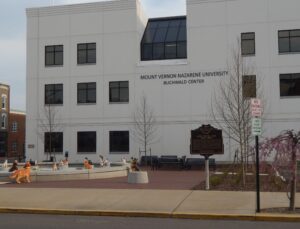
Side A: Jane Payne, M.D. (1825-1882). Dr. Jane Payne’s family migrated from Bristol, England in 1825. Her father Henry served as an Episcopal priest in Ohio, finally settling in Mount Vernon. Although her sight was impaired and she was challenged by infirmities left by childhood diseases and injuries, Payne resolved to be a physician. She began her studies with Dr. John W. Russell (1804-1887) in Mount Vernon. In 1861, she graduated first in what was the ninth class of the Woman’s Medical College of Pennsylvania in Philadelphia. Overcoming prejudices against female physicians, Dr. Payne practiced from 1861 to 1882. She showed special concern for municipal sanitation and care for the poor. Her office was located at northwest corner of South Main and West Gambier streets. Dr. Payne succumbed to cancer and is buried in Mound View Cemetery.
During the 9-month Hocking Valley Coal Strike beginning in June 1884, tensions between the Columbus & Hocking Coal and Iron Company and striking miners led to violence and destruction. Starting October 11, 1884, unknown men pushed burning mine cars into six mines located around New Straitsville to protest being replaced by “scab” workers. Mine operators attempted to plug all fissures to no avail. As years passed, ground collapsed under buildings and roadbeds, and mine gases seeped into schools and homes. Residents were evicted and homes demolished. Potatoes baked in the heated soil and roses bloomed in the winter. At times, the fire soared 100 feet in the air and could be seen for five miles. (Continued on other side).