

, OH
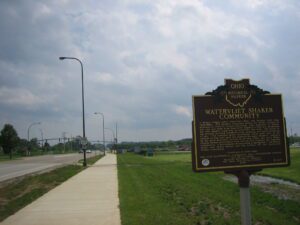
A Shaker village called Watervliet, Ohio, was located here from 1806-1900. The Shakers, originally called the United Society of Believers in Christ’s Second Appearing, were followers of Mother Ann Lee who came from Manchester, England in 1774 and established the first Shaker community in Watervliet, New York. The tenets of the religion included communal living, celibacy, and public confession of sins. The frenzied dance movements, which were part of the worship of their sect, gave the members the name “Shakers.” Attracted by the great Kentucky revivals in the late 1700s and early 1800s, Eastern Shaker missionaries came west to find converts and establish communities. A discontented Presbyterian congregation in the Beaver Creek area called Beulah was the nucleus for the Watervliet Shaker community. (continued on other side)
, OH
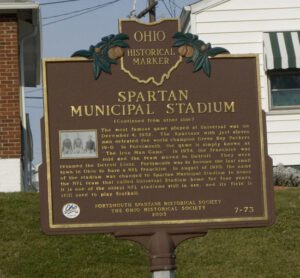
Opened in the fall of 1930, Universal Stadium became the home of the Portsmouth Spartans professional football team. Earlier that summer, the Spartans had just become a member of the National Football League (NFL). Led by a few local businessmen, the Portsmouth National Football League Corporation raised money to help build the permanent stadium for the Spartans. The stadium opened on September 14, 1930 as the Spartans defeated the Newark (New Jersey) Tornadoes for their first NFL victory. Ten days later the Spartans played one of the NFL’ s first night games against the Brooklyn Dodgers. The Portsmouth Times said, “Night football has come to stay, at least in Portsmouth.” From 1930 to 1933, the Spartans compiled a record of 19 wins 2 losses and 4 ties at Universal Stadium. (continued on other side)
, OH
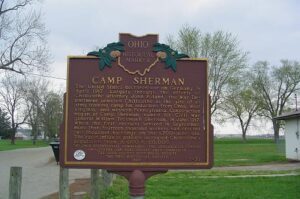
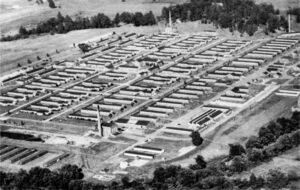
The United States declared war on Germany in April 1917. Largely through the efforts of Chillicothe attorney John Poland, the War Department selected Chillicothe as the site of an army training camp for inductees from Ohio, West Virginia, and western Pennsylvania. Construction began at Camp Sherman, named for Civil War general William Tecumseh Sherman, in June 1917. When the first recruits arrived in September, more than fourteen thousand workers had erected two thousand buildings on the 1,700-acre site. The rapid influx of soldiers increased Chillicothe’s population from 16,000 to 60,000.
, OH
During the Second World War, the U.S. Army constructed a 131-building hospital on level farmland a quarter mile northwest of this marker. The army built the facility as a 1,520-bed hospital in the winter and spring of 1942-’43. It was later expanded to 168 buildings with a 2,000-bed capacity, including a German POW camp for 234 prisoners engaged in hospital work. Between June 1943 and March 1946, when the facility closed, 17,608 veterans were treated here, most having returned with injuries received in the European or Pacific theaters of war. Convalescence and rehabilitation were the hospital’s primary missions. Most patients returned to active duty when they recovered. After the war, the facility became the Cambridge State Hospital, which treated mentally ill and developmentally disabled Ohioans until 2008. Thereafter, the facility became the privately-operated Cambridge Behavioral Hospital and the state-operated Cambridge Developmental Center.
, OH
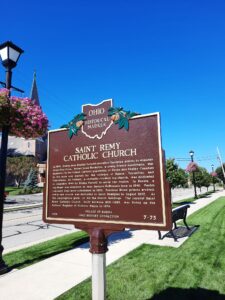
In 1839, Bishop John Baptist Purcell recruited European priests to minister to his Ohio flock. Father Louis Navarron, a young French missionary, was appointed to the French Catholic population of Darke and Shelby Counties in the area now marked by the villages of Russia, Versailles, and Frenchtown. St. Valbert, a centrally-located log church, was dedicated in December 1840 by Bishop Purcell to serve the region. In Russia, a log chapel was dedicated on Jean Jacques DeBrosse’s farm in 1846. Parish boundary lines were established in 1850, Precious Blood priests arrived, and a new church was dedicated to Saint Remigius in August 1852. As the congregation grew, so did the church buildings. The current Saint Remy Catholic Church, built between 1891-1892, was listed on the National Register of Historic Places in 1979.
, OH
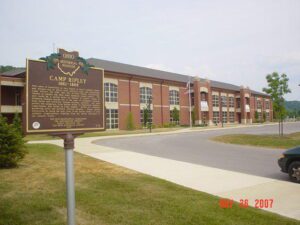
With news of hostilities at Fort Sumter in South Carolina, Ripley men formed one of Ohio’s first military units and established Camp Ripley on what was the 12-acre Ripley Fairgrounds. Chosen as Captain was West Point graduate Jacob Ammen. His unit would be a saving force for Ulysses S. Grant’s troops at Pittsburg Landing raising him to the rank of Brigadier General. Soon barns and buildings became military quarters, and tents dotted the landscape from William Street to Maplewood Cemetery. Camp Ripley, also known as Camp Ammen, served as a regional mustering point and military drilling location. Ripley gained distinction as being the only town in the United States to have soldier’s organizations fighting from the Rocky Mountains to the Atlantic Ocean.
, OH
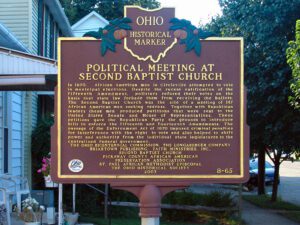
In 1870, African American men in Circleville attempted to vote in municipal elections. Despite the recent ratification of the Fifteenth Amendment, pollsters refused their votes on the basis that state law forbade them from receiving the ballots. The Second Baptist Church was the site of a meeting of 147 African American men seeking redress. Together with Republican leaders these men produced petitions that were sent to the United States Senate and House of Representatives. These petitions gave the Republican Party the grounds to introduce bills to enforce the Fifteenth and Fourteenth Amendments. The passage of the Enforcement Act of 1870 imposed criminal penalties for interference with the right to vote and also helped to shift power and authority from the individual state legislatures to the centralized Federal government.
, OH
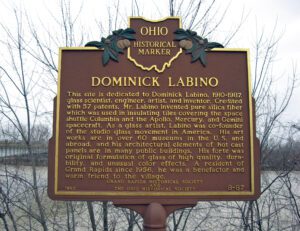
This site is dedicated to Dominick Labino, 1910-1987, glass scientist, engineer, artist, and inventor. Credited with 57 patents, Mr. Labino invented pure silica fiber which was used in insulating tiles covering the space shuttle Columbia and the Apollo, Mercury, and Gemini spacecraft. As a glass artist, Labino was co-founder of the studio glass movement in America. His art works are in over 60 museums in the U.S. and abroad, and his architectural elements of hot cast panels are in many public buildings. His forte was original formulation of glass of high quality, durability, and unusual color effects. A resident of Grand Rapids since 1956, he was a benefactor and warm friend to the village.