

, OH
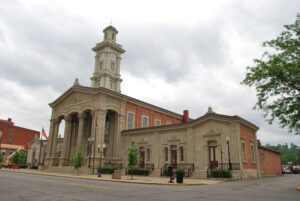
Ross County’s first courthouse was Ohio’s first statehouse. The courthouse was erected on the Public Square in 1801. Thomas Worthington, one of the building’s superintendents, laid out the foundation. Chillicothe was the last capital of the Northwest Territory, and the final session of the territorial legislature met in the courthouse in 1801. Ohio’s first constitution was written here in 1802. On March 1, 1803, Ohio’s first General Assembly convened in the building, making it the statehouse. During a time of strained relations between Native Americans and settlers in Ohio, the great Shawnee leader Tecumseh delivered a speech here in 1807 to reassure citizens that the Indians would remain peaceful. The courthouse served as the statehouse from 1803 to 1810 and from 1812 to 1816. The building was razed in 1852 to make way for the present courthouse.
, OH
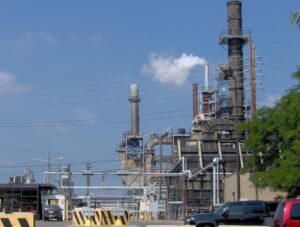
Oil became a valuable resource in Ohio when significant quantities were discovered in Lima in 1885. The discovery brought an economic boom to Lima and northwest Ohio. News of the Lima oil field spread, attracting the attention of John D. Rockefeller, co-founder of Standard Oil. Against the advice of his board, Rockefeller invested heavily in Lima crude, despite its high sulfur content and foul odor. Storage tanks and pipelines for the crude sprung up rapidly. Having great faith in the ingenuity of his engineers and scientists, Rockefeller stockpiled the crude and sent Standard’s chief refining specialist, J.W. Van Dyke, to Lima to construct and manage the new Solar Refinery. Together with Herman Frasch, a German chemist, the two men perfected the technique to desulphurize the crude and turn it into quality kerosene and fuel oil.
, OH
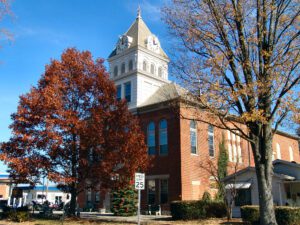
The Richwood Opera House and Town Hall was erected in 1890 as a community center designed to house the town council chambers, fire department, jail and opera house. The Richardsonian Romanesque styled building served Richwood in all these capacities for nearly 75 years. The Opera House was the site of minstrel shows, concerts, movies, lecture courses, revivals, farmers’ institutes, commencements, and community meetings. The second floor gymnasium was used for a men’s independent basketball league, dance classes, and as a teen center after World War II. Construction of an interurban railway running between Richwood and the resort town of Magnetic Springs in 1906 provided an expanded audience for the Opera House. (continued on other side)
, OH
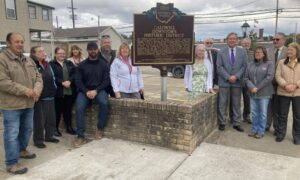
The Caldwell Downtown Historic District is the historic commercial and governmental core of the Village of Caldwell, which was founded in 1857 on farmland owned by Joseph and Samuel Caldwell. Caldwell serves as the county seat of Noble County, the last of Ohio’s 88 counties to be organized. The agricultural community prospered and by 1873 was the second-largest producer of tobacco in Ohio. The Pennsylvania Railroad arrived in 1872, and the development of salt, oil, coal, and natural gas extraction companies followed during the 1880s. Two separate fires in 1897 devastated portions of the north and south quadrants of the district. As a result, Caldwell formed a volunteer fire department and the Village Council introduced legislation prohibiting construction of wood buildings within a block of the public square. (Continued on other side)
, OH
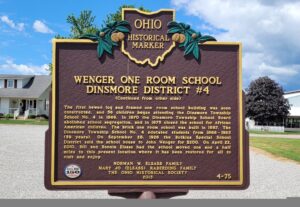
Dinsmore Township School District #4 was formed in 1865following a decision by the township’s board of education that a school would be built in the center of every four sections of land, or every four square miles. This placement of school buildings gave township children the opportunity to attend school close to home and the chance at receiving a public education up to the eighth grade, Nine districts were created for the children of white households, and an additional district was formed to educate the children of the African American families, for a total of ten districts in the township. On June 11, 1866, the Dinsmore Township School Board purchased land from George Wenger to build the District #4 school near the intersection of Ohio Route 274 and Wenger Road. (Continued on other side)
, OH
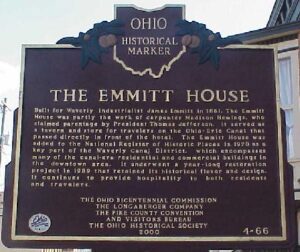
Built for Waverly industrialist James Emmitt in 1861, The Emmitt House was partly the work of carpenter Madison Hemings, who claimed parentage by President Thomas Jefferson. It served as a tavern and store for travelers on the Ohio-Erie Canal that passed directly in front of the hotel. The Emmitt House was added to the National Register of Historic Places in 1978 as a key part of the Waverly Canal District, which encompasses many of the canal-era residential and commercial buildings in the downtown area. It underwent a year-long restoration project in 1989 that retained its historical flavor and design. It continues to provide hospitality to both residents and travelers.
, OH
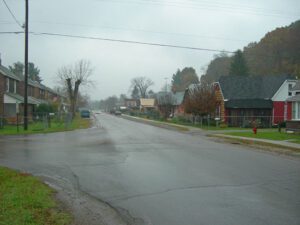
Originally known as Hocking Furnace, Haydenville was founded by and named for Columbus industrialist Peter Hayden (1806-1888), who energetically developed the coal, iron, sandstone, and fire clay deposits found in abundance in this area. Here he operated an iron furnace, coal mines and sandstone quarries, shipping products on the Hocking Canal and, later, the Hocking Valley Railroad he helped build. The incorporation of the Haydenville Mining and Manufacturing Company in 1882 initiated the manufacture of brick and ceramic tile from fire clay. Business boomed in the late 19th century as cities paved their streets with brick and fireproof construction became popular in the wake of widely publicized and tragic fires.
, OH
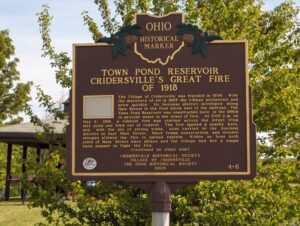
The Village of Cridersville was founded in 1856. With the discovery of oil in 1885 the village prospered and grew quickly. Its business district developed along Main Street in the first block east of the railroad. The Town Pond Reservoir was constructed here in the 1890s to provide water in the event of fire. At 3:00 p.m. on May 2, 1918, a rubbish fire was started across the street from this pond and blew out of control. The fire ignited a nearby barn, and, with the aid of strong winds, soon carried to the business district on East Main Street. Wood frame construction and wooden shingles allowed the fire to spread rapidly. Within an hour both sides of Main Street were ablaze and the village had but a single hand pumper to fight the fire. (continued on other side)