

, OH
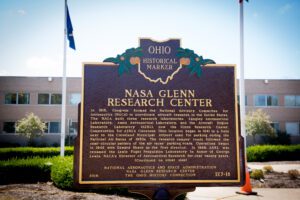
In 1915, Congress formed the National Advisory Committee for Aeronautics (NACA) to coordinate aircraft research in the United States. The NACA built three research laboratories: Langley Aeronautical Laboratory, Ames Aeronautical Laboratory, and the Aircraft Engine Research Laboratory (AERL), now the Glenn Research Center. Construction for AERL’s Cleveland, Ohio location began in 1941 in a field next to the Cleveland Municipal Airport used for parking during the National Air Races of the 1930s. The research campus’ roads followed the semi-circular pattern of the air races’ parking roads. Operations began in 1942 with Edward Sharp as the first director. In 1948, AERL was renamed the Lewis Flight Propulsion Laboratory in honor of George Lewis, NACA’s Director of Aeronautical Research for over twenty years.
, OH
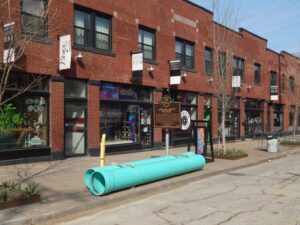
This block of W. 29th Street was home to Cleveland’s vibrant LGBT community and central to the development of the modern LGBT civil rights movement. In 1988, the Striebinger Building, at 1418 W. 29th, housed Cleveland’s Lesbian-Gay Community Services Center, which addressed the needs of the LGBT community. Cleveland’s first Pride Festival since the mid-1970s was held on the block in 1989, and in 1990 Cleveland’s first Pride Parade culminated here. During the HIV/AIDS crisis, The Living Room and ACT UP were located in the Striebinger Building and gave support to those with HIV/AIDs and provided a platform for political activism. It was on this block where many people could find their voices to “come-out” and advocate for their rights and their humanity. (Continued on other side)
, OH
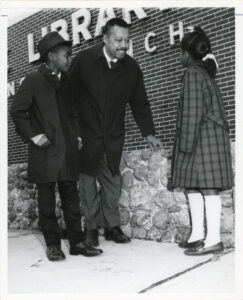
On November 19, 1968, the Columbus Metropolitan Library dedicated the first public library in the nation named after Dr. Martin Luther King Jr. After King’s assassination on April 4, 1968, the East Side Community Council requested that the new library being planned for the King-Lincoln Bronzeville community bear his name. The King family had both family and civic ties to Columbus and were honored by the tribute. More than 1,000 people gathered outside 1600 E. Long Street to hear Martin Luther King Sr. deliver the November dedication speech. Continuing the King family tradition, Martin Luther King III cut the ribbon to open a new branch building at 1487 E. Long Street on October 18, 2018. The Martin Luther King Branch was the first Columbus public library to bear an individual’s name.
, OH
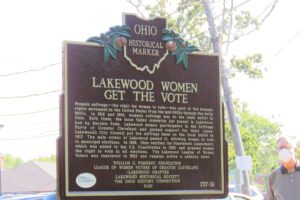
Women’s suffrage–the right for women to vote–was part of the women’s rights movement in the United States from the mid-1800s through the early 1900s. In 1912 and 1914, women’s suffrage was on the state ballot in Ohio. Both times, the issue failed statewide but passed in Lakewood. Led by Bernice Pyke, Lakewood women participated in the Suffrage Party of Greater Cleveland and gained support for their cause. Lakewood’s City Council put the suffrage issue on the local ballot in 1917. The male voters of Lakewood passed it, allowing women to vote in municipal elections. In 1919, Ohio ratified the Nineteenth Amendment, which was added to the U.S. Constitution in 1920 and granted women the right to vote in all elections. The Lakewood League of Women Voters was chartered in 1922 and remains active a century later.
, OH
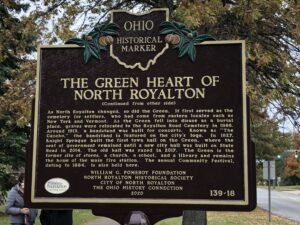
Bounded by Ridge, Royalton, and Bennett Roads, the Green has been the heart of North Royalton even before it was incorporated. Once part of Brecksville Township, Royalton became its own township in 1818. Local lore says that settlers David and Knight Sprague paid a gallon of whiskey to name the community after their hometown of Royalton, Vermont. In 1825, John Watkins sold five acres to create this Green, so that the township could have a cemetery, a public square, and a place for public buildings. In 1885, “North” was added to “Royalton” to distinguish it from another Royalton in Ohio. Formerly a small agricultural community known for milk and cheese production, as well as nurseries, North Royalton became a Cleveland suburb following World War II. North Royalton incorporated as a village in 1927 and became city in 1961. (Continued on other side)
, OH
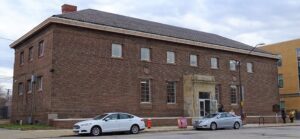
City architect Frederic H. Betz designed the St. Clair Avenue Public Bath House and it was constructed in 1919-1920 at a cost of $320,000. The facility included a large gymnasium, swimming pool, and laundry, in addition to showers. City Council dedicated the newly completed building to the late, beloved Cleveland Indians shortstop Raymond Chapman in 1920. The St. Clair Recreation Center, as it was later known, was in the impact zone and survived the East Ohio Gas Company disaster on October 20, 1944. The facility was remodeled in 1949 and subsequent renovations demonstrate the utility of the building. Edward J. Kovacic (1910-1974) was the superintendent of the bathhouse from 1933-1934 and served on the City Council from 1940-1953. In 1977, the facility was renamed to honor Kovacic’s contributions to the citizens of the St. Clair neighborhood and to the city. (Continued on other side)

, OH
Carl Stokes was born in Cleveland on June 21, 1927. Recognized for his trailblazing service as a public official, Stokes is one of the few American politicians whose career spanned all three branches of state government. Over 30 years, he served 3 terms as an Ohio legislator (1963-1967), 2 terms as Cleveland’s mayor (1967-1971), and 8 years as a municipal court judge (1983-1994). In 1972, he became the first Black anchorman for a television station in New York City. After a decade working in television, Stokes returned to Cleveland to work as an attorney for the United Auto Workers. In 1994, President Bill Clinton appointed him U.S. Ambassador to the Republic of Seychelles. While serving as Ambassador, he was diagnosed with cancer. Carl Stokes died, in Cleveland, on April 3, 1996.
, OH
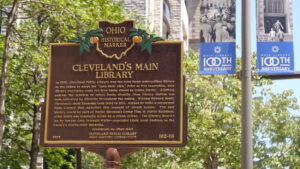
In 1890, Cleveland Public Library was the first large metropolitan library in the nation to adopt the “open shelf plan.” Prior to this innovation, only library employees could retrieve books stored in closed stacks. Allowing patrons the freedom to select books directly from library shelves was soon embraced by libraries throughout the nation. William Howard Brett, Cleveland’s chief librarian from 1884 to 1918, worked to build a permanent Main Library that embodied this concept of direct access. The new library would be part of Daniel Burnham’s Group Plan of Public Buildings. After Brett was tragically killed by a drunk driver, the Library Board — led by lawyer John Griswold White — appointed Linda Anne Eastman as the library’s fourth chief librarian. (Continued on other side)