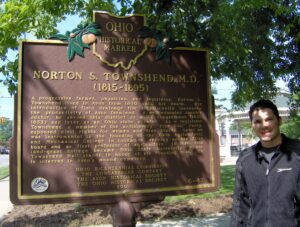
A progressive farmer, physician, and legislator, Norton S. Townshend lived in Avon from 1830 until his death. His introduction of field drainage tile significantly increased the productivity of Avon farmland. A well-educated country doctor, he served this district as a U.S. congressman (1851-1853) and later as an Ohio state senator. As a legislator Townshend, a member of the antislavery “Free Soil” Party, espoused civil rights for women and free blacks. Later he was instrumental in the founding of the Ohio Agricultural and Mechanical College in Columbus, serving on the first board and as its first professor of agriculture. In 1878, this land-grant college became Ohio State University, where Townshend Hall stands in honor of his founding role. He is interred in Avon’s mound cemetery.
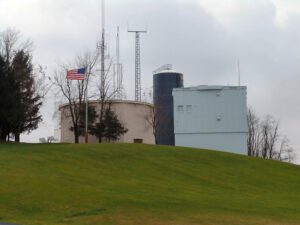
Campbell Hill is named for Charles D. Campbell of Bellefontaine, who owned this land from 1898 to 1937. A marble stone marker atop the hill, set in 1900 by the U.S. Coast and Geodetic Survey, marks it as the highest point in Ohio at an elevation of 1549.09 feet. In 1951, the federal government established the 664th Aircraft Control and Warning (AC&W) Squadron here as part of the North American Air Defense Command (NORAD). Its military and civilian operators used sophisticated radar and computer equipment to locate and identify aircraft as friendly or suspicious, and relayed information to a central site in Battle Creek, Michigan. This Cold War site operated until 1969. It was converted to civilian use as a vocational education center in 1974.
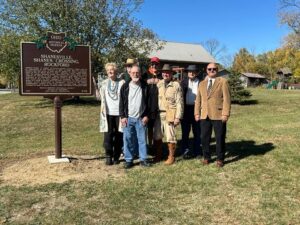
John Chapman (1774 – 1845) leased these three acres to the north and west from William Botts Hedges on April 29, 1828. He paid Hedges by cultivating 1,000 apple trees on the site over the next ten years. Apples provided an important food source. Cut and dried for sauces in the winter, they could be pressed into cider or “apple jack” at a time when water often carried disease. The Hedges Nursery profited the Shanesville area by shipping apples to the major trading posts at Piqua and Ft. Wayne. During his lifetime, Chapman proved an able businessman who established profitable orchards in Ohio, Pennsylvania, and Indiana. In 2009, American Forests, the Johnny Appleseed Foundation, the Museum at Urbana University, and the Village of Rockford planted two “Rambo” apple trees at the Hedges Nursery site.
In the early 1770s, Chief White Eyes (Koquechagachton) of the Delaware tribe founded White Eyes Town approximately two miles southeast of this marker on a plain near present day West Lafayette. A friend of the Moravian leader David Zeisberger, White Eyes was an ardent supporter of Moravian missionary efforts and kept the Delawares neutral during the American Revolutionary War. White Eyes’s dream was to bring his people under the influence of Christianity. He also hoped to establish a fourteenth state for the Indian nations, which would join the other thirteen. White Eyes died at the height of his career in November 1778 near Pittsburgh. The cause of his death remains open to question.
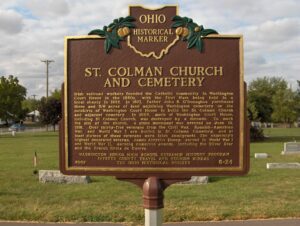
Irish railroad workers founded the Catholic community in Washington Court House in the 1850s, with the first Mass being held in a local shanty in 1852. In 1871, Father John B. O’Donoghue purchased three and 5/8 acres of land adjoining Washington cemetery on the outskirts of Washington Court House to build the St. Colman Church and adjacent cemetery. In 1885, much of Washington Court House, including St. Colman Church, was destroyed by a tornado. To mark the site of the church, a stone monument was erected on June 19, 1916. Over thirty-five veterans from the Civil War, Spanish-American War, and World War I are buried in St. Colman Cemetery, and at least sixteen of these veterans were Irish immigrants. The cemetery’s highest decorated veteran, James Aloysius Ducey, served in World War I and World War II, earning numerous awards, including the Silver Star and the French Croix de Guerre.
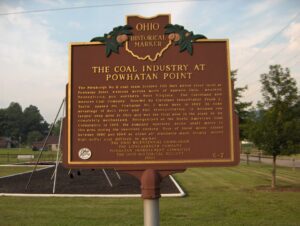
The Pittsburgh No. 8 coal seam, located 100 feet below river level at Powhatan Point, extends across much of eastern Ohio, western Pennsylvania, and northern West Virginia. The Cleveland and Western Coal Company, founded by Cleveland industrialist Frank E. Taplin, opened the Powhatan No. 1 mine here in 1922 to take advantage of both river and rail transportation. It became the largest deep mine in Ohio and was the first mine in the state to be completely mechanized. Reorganized as the North American Coal Corporation in 1925, the company operated seven shaft mines in this area during the twentieth century. Four of these mines closed between 1980 and 1984 as clean air standards made locally mined high-sulfur coal difficult to market.
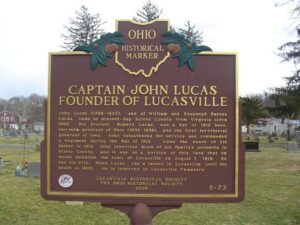
Lucasville Cemetery was originally established as the Lucas Family burying ground, with Susannah Lucas as the first recorded burial on May 4, 1809. Susannah’s husband, Captain William Lucas, a Revolutionary War veteran, is interred here along with the first wife of Governor Robert Lucas, Eliza “Betsy” Brown Lucas. By 1816, the cemetery was used as a public burying ground. Hand carved monuments inscribed with poetry can be found in the old section. Recognized as one of the oldest cemeteries in southern Ohio, Lucasville Cemetery has interred veterans of the Revolutionary War, War of 1812, Civil War, Spanish-American War, World Wars I and II, Korea, and Vietnam.
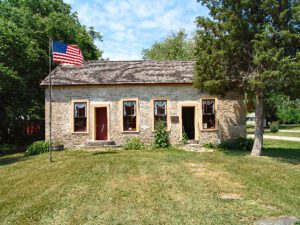
Built in 1822, this native limestone structure was the home of Benajah Wolcott, first keeper of the Marblehead Lighthouse (originally called the Sandusky Bay Light), and his second wife, Rachel Miller Wolcott. Benajah maintained the lighthouse from 1822 until his death ten years later. After Benajah’s passing the U.S. Government appointed Rachel as the keeper, making her the first female lighthouse keeper on the Great Lakes. The building is the oldest known residence still standing in Ottawa County and is a fine example of a “hall-and-parlor house,” an early American home design.