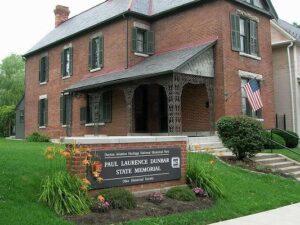
The first African-American to achieve prominence as a poet, Paul Laurence Dunbar was born and raised in Dayton, the son of former slaves. Working as an elevator operator while he established himself as a writer, Dunbar published his first book of poems, Oak and Ivy, in 1893. His third collection, Lyrics of a Lowly Life (1896) with an introduction by another Ohio-born author William Dean Howells, gained Dunbar widespread critical acclaim and popular recognition. Widely published in contemporary journals and literary magazines, Dunbar employed both turn-of-the-century African-American dialect and standard English verse to give a voice to the themes of everyday discrimination and struggles for racial equality. Tuberculosis cut his life short at age 33. Dunbar’s body of work includes twelve volumes of poetry, four books of short stories, a play, and five novels.
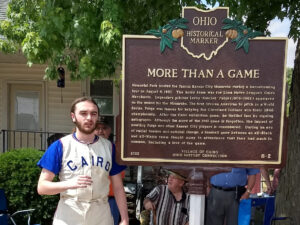
Memorial Park hosted the famous Kansas City Monarchs during a barnstorming tour on August 4, 1961. The home team was the Lima Metro League’s Cairo Merchants. Legendary pitcher Leroy “Satchel” Paige (1906-1982) appeared on the mound for the Monarchs. The first African American to pitch a World Series, Paige was famous for helping the Cleveland Indians win their 1948 championship. After the Cairo exhibition game, he thrilled fans by signing autographs. Although the score of the 1961 game is forgotten, the impact of meeting Paige and other Kansas City players is remembered. During an era of racial tension and national change, a baseball game between an all-Black and all-White team taught many in attendance that they had much in common, including a love of the game.
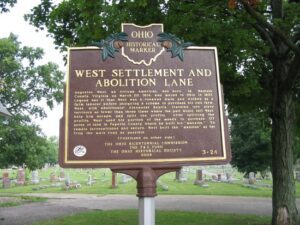
Augustus West, an African American, was born in Madison County, Virginia on March 20, 1814, and moved to Ohio in 1837. Legend has it that West was a runaway slave and worked as a farm laborer before designing a scheme to purchase his own farm. West, with abolitionist Alexander Beatty, traveled into slave territory no fewer than three times where the pair would sell West, help him escape, and split the profits. After splitting the profits, West used his portion of the money to purchase 177 acres of land in Fayette County where he built his “mansion.” To remain inconspicuous and secure, West built the “mansion” as far from the main road as possible. (continued on other side)
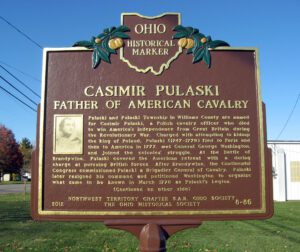
Pulaski and Pulaski Township in Williams County are named for Casimir Pulaski, a Polish cavalry officer who died to win America’s independence from Great Britain during the Revolutionary War. Charged with attempting to kidnap the king of Poland, Pulaski (1747-1779) fled to Paris and then to America in 1777, met General George Washington, and joined the colonies’ struggle. At the Battle of Brandywine, Pulaski covered the American retreat with a daring charge at pursuing British forces. After Brandywine, the Continental Congress commissioned Pulaski a Brigadier General of Cavalry. Pulaski later resigned his command and petitioned Washington to organize what came to be known in March 1778 as Pulaski’s Legion.
Augustus West, an African American, was born in Madison County, Virginia on March 20, 1814, and moved to Ohio in 1837. Legend has it that West was a runaway slave and worked as a farm laborer before designing a scheme to purchase his own farm. West, with abolitionist Alexander Beatty, traveled into slave territory no fewer than three times where the pair would sell West, help him escape, and split the profits. After splitting the profits, West used his portion of the money to purchase 177 acres of land in Fayette County where he built his “mansion.” To remain inconspicuous and secure, West built the “mansion” as far from the main road as possible. (continued on other side)
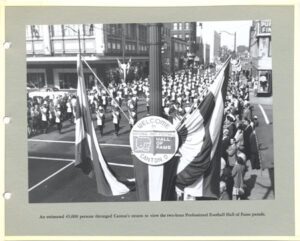
On September 17, 1920, representatives from ten professional football teams met in Canton and formed the American Professional Football Association, which in 1922 became the National Football League (NFL). Pro football evolved from club football in the 1890s, and by the early 1900s had begun to spread across the country, concentrating in the Midwest. Jim Thorpe, the first nationally prominent pro, started with the Canton Bulldogs-an early pro football power-in 1915. In 1959, Canton citizens launched a well-organized and ultimately successful effort to have their city, “the cradle of professional football,” designated as the site of a monument to the sport’s historic stars. The Professional Football Hall of Fame opened on September 7, 1963, inducting seventeen charter members. The Hall of Fame interprets and promotes the study of the role of professional football in American culture.
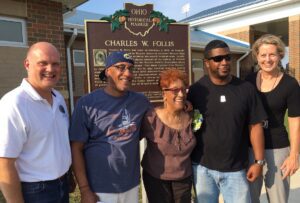
Charles W. Follis was born on February 3, 1879, in Virginia. His family moved to Wooster where he attended Wooster High School and helped establish the school’s football team. In 1901, Follis enrolled and played baseball at the College of Wooster and played football for the Wooster Athletic Association where he earned the nickname “The Black Cyclone from Wooster.” In 1904, Follis signed a contract to play football with Shelby Athletic Club, making him the first African-American professional football player. Follis faced discrimination on and off the field leading to many injuries. After a career-ending injury in 1906, Follis played baseball for the Cuban Giants of Long Island. He died of pneumonia in 1910 at the age of 31 and is buried in Wooster Cemetery.
In 1918, Charles Young made a desperate attempt to convince the U.S. Army that he was fit for duty. The Army’s highest-ranking Black officer, he had been medically retired and not given a command during World War I. To demonstrate his fitness, he rode 497 miles from his home in Wilberforce, Ohio, to Washington, D.C. Leaving on June 6 he made the journey in 17 days, 16 on horseback and 1 resting. Averaging 31 miles each day, he rode 45 minutes and walked 15 minutes every hour. Upon his arrival, Young met with Secretary of War Newton Baker. Pressured by the Black press and the White House, Baker hedged. He recalled Young to active duty a year later and assigned him to Camp Grant, Illinois, just five days before the end of the war.