Van Wert County Fairgrounds, 1055 South Washington Street
Van Wert
, OH
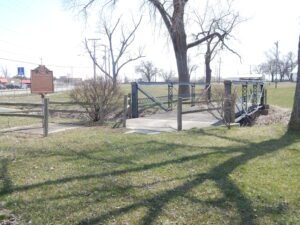
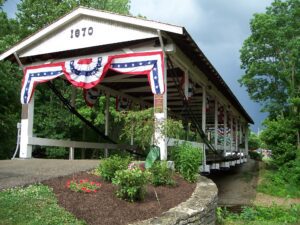
Built in 1894 at a cost of $575, this bridge spanned Town Creek at Hoghe Road (Township Road 82) for 100 years. The Van Wert County Commissioners approved the bridge’s construction in response to requests from the Cincinnati, Jackson & Mackinaw Railroad Company. The span is an example of the truss-leg bedstead design. It was intended to handle heavy loads traveling to and from area railroad tracks, which were less than a mile from the bridge’s original location. The bridge was removed from Hoghe Road in 1994. The Van Wert County Engineer’s Department rehabilitated the bridge and, with the permission of the Van Wert County Agricultural Society, relocated it to the county fairgrounds in 1997.
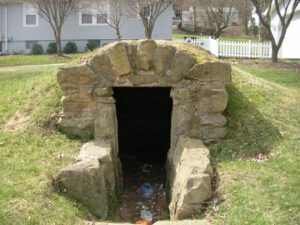
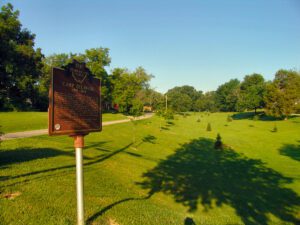
Prisoners convicted of rioting, larceny and adultery in Morgan County between 1833 and 1839 were confined to a dungeon near the Court House in McConnelsville. This stone vault, 11 feet high, 5 feet wide and 12 feet long, was discovered in 1964 and is believed to have been used as the county dungeon. The Morgan County Pomona Grange #81 in co-operation with the County Commissioners and the County Agricultural Society reconstructed the structure on this site in 1965 as a community service project.
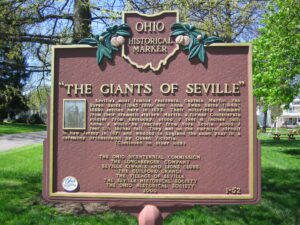
Seville’s most famous residents, Captain Martin Van Buren Bates (1845-1919) and Anna Swan Bates (1848-1889) settled here in 1873. Their notoriety stemmed from their dramatic stature: Martin, a former Confederate soldier from Kentucky, stood 7 feet 8 inches tall; Anna, a would-be teacher from Nova Scotia, stood 7 feet 11 inches tall. They met on the carnival circuit in New Jersey in 1871 and wedded in England the same year in a ceremony orchestrated by Queen Victoria. (Continued on other side)
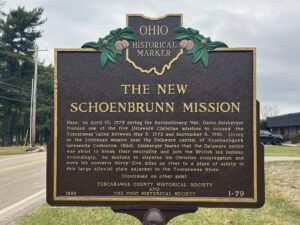
Here, on April 10, 1779 during the Revolutionary War, David Zeisberger founded one of the five Delaware Christian missions to occupy the Tuscarawas Valley between May 3, 1772 and September 8, 1781. Living at the Lichtenau mission near the Delaware capital of Goschachgunk (presently Coshocton, Ohio), Zeisberger feared that the Delaware nation was about to break their neutrality and join the British led Indians. Accordingly, he decided to disperse his Christian congregation and move his converts thirty-five miles up river to a place of safety in this large alluvial plain adjacent to the Tuscarawas River.
Restored in 1963, the Germantown Covered Bridge on East Center Street, spanning Little Twin Creek, was 93 years old and is reputed to be the only existing covered bridge of its kind in the world. For 41 years this unique inverted bow string truss covered bridge spanned Little Twin Creek on the Dayton Pike in Germantown, Ohio. In 1911 it was removed to its present location where it has been restored and beautified as a link with Ohio’s early history. It is a symbol of individual initiative in America’s early history.
Intersection of S. Sandusky Street & Olentangy Avenue
Delaware
, OH
Near this site, the Union army established two camps on either side of the Olentangy River during the Civil War. Both were known as Camp Delaware. The first camp, situated on the west side of the river in the summer of 1862, was where the white recruits of the 96th and 121st regiments of Ohio Volunteer Infantry were mustered into service. A second camp, on the east side of the Olentangy, was established in the summer of 1863 and became the rendezvous point for most African-American Ohioans joining the army. The 127th Regiment of Ohio Volunteer Infantry-later renamed the 5th Regiment United States Colored Troops, the 27th U.S. Colored Troops, and members of other African-American units were mustered into service at Camp Delaware.
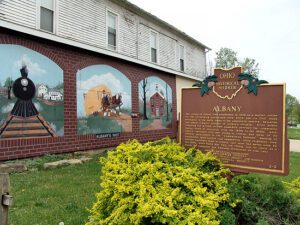
The village of Albany was established in 1838 as a market center for the surrounding agricultural area, which saw its first white settlement in the early years of the nineteenth century. Education was always a major concern of Albany’s citizens. Since public schooling was minimal, private academies provided the community various levels of education from the 1840s to the 1880s. Anti-slavery sentiment also was strong in Albany, and many of its citizens participated in the “Underground Railroad.” Because of educational opportunities and sympathetic white neighbors, free African-Americans came to Albany, but most had moved away by the 1930s. After World War Two, the village lost its status as a center for commerce and business.
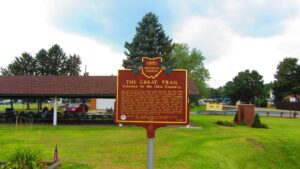
The ancient trail that passed near this spot was the major overland route entering the Ohio Country from the east through the 1700s. Also known as the Tuscarawas Path, the Great Trail was used by Native Americans, European explorers, fur traders, missionaries, military expeditions, land agents-and settlers after Ohio became a state. In January 1761, during the French and Indian War, Major Robert Rogers and thirty-eight rangers passed en route to Fort Pitt after taking Fort Detroit from the French. In 1764, during “Pontiac’s Conspiracy,” Colonel Henry Bouquet crossed here with an army of 1,500 men on his way to Goshachgunk (Coshocton), where he treated with the Delaware and freed captives. During the American Revolution, the Continental Army under General Lachlan McIntosh camped here for two days in November 1778.